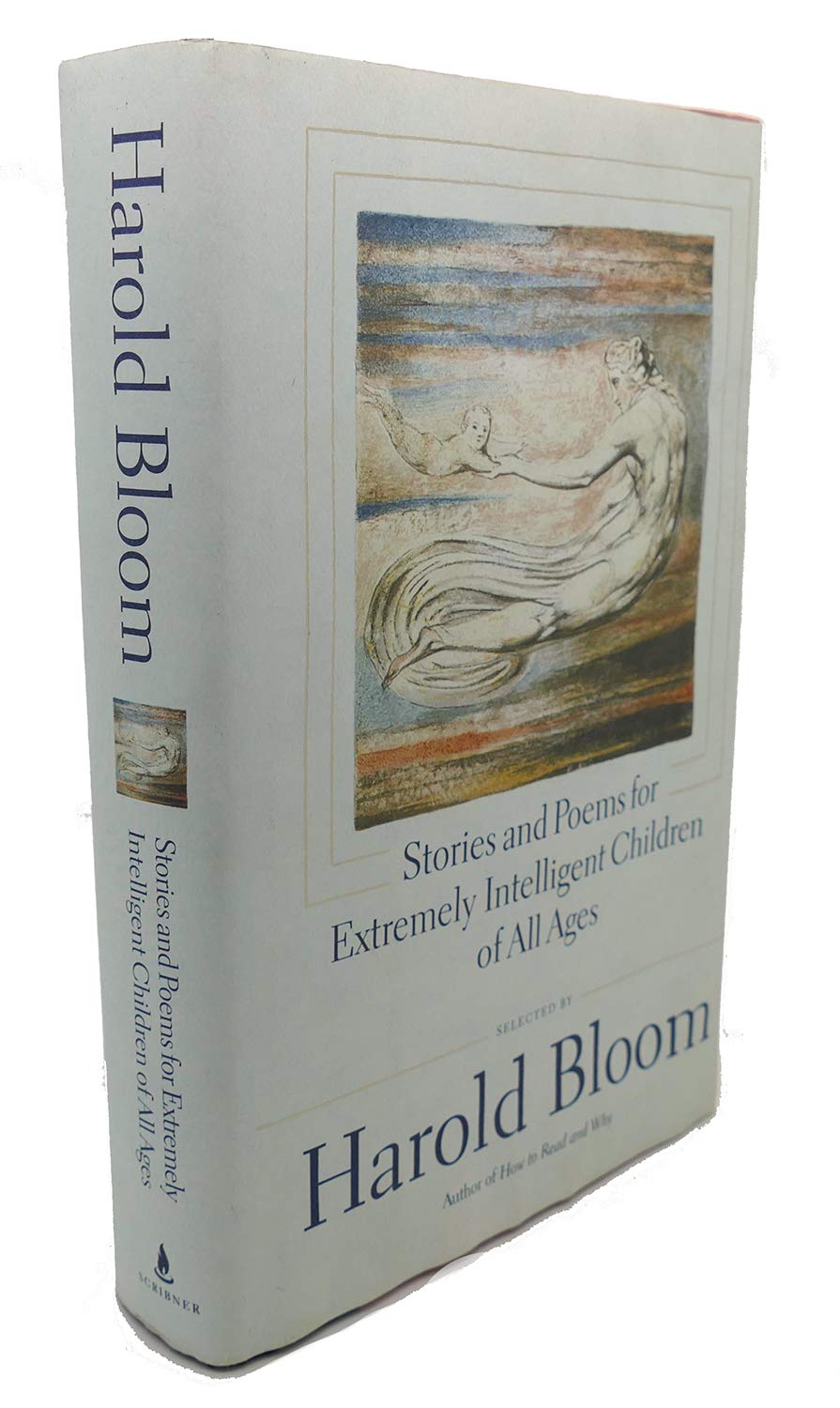



The nation's most celebrated literary critic introduces children to the exciting world of literature through this collection of great stories by Hans Christian Andersen, William Blake, O. Henry, Tolstoy, Mark Twain, Oscar Wilde, and others. 100,000 first printing. Apart from the Extremely Pompous title, and the heavy bent toward masculine authors, this collection of classics by the likes of Tolstoy, Edith Wharton, O. Henry, and Lewis Carroll is vastly impressive. And editor Harold Bloom does, of course, explain his title in the introduction. He believes that all the included authors "make themselves open to authentic readers of any age." Despising most "commercially offered" contemporary children's literature, Bloom offers up the greats: Edward Lear's "The Owl and the Pussy-Cat," Shakespeare's "The Lion in Winter," Hans Christian Andersen's "The Red Shoes," and dozens upon dozens more, organized on a seasonal scheme. Here, readers of all ages can learn, grow, be entertained, reflect. Bloom quotes poet Wallace Stevens in his test for verse or prose: "it must change, it must give pleasure, and it must be abstract." Every one of these masterpieces of varying lengths is worthy of reading, rereading, and reading aloud--Extremely Intelligent Children of All Ages would be wise to look beyond the title and devour this 573-page anthology, cover to cover. Bloom is the author of more than 20 other books, including another tome on the art of reading, How to Read and Why . (All ages, of course) --Emilie Coulter Grades 3-8--Bloom believes that his intended audience needs few, if any, selections written after World War I. Most stories and poems in this collection come from the 19th century and earlier. Authors represented include Aesop, Rudyard Kipling, Edward Lear, Christina Rossetti, Lewis Carroll, Robert Louis Stevenson, Christopher Smart, William Shakespeare, Alfred, Lord Tennyson, and many more. In his introduction, Bloom states: "-`Children's Literature'-is a mask for the dumbing-down that is destroying our literary culture. Most of what is now commercially offered as children's literature would be inadequate fare for any reader of any age at any time." Emotionally intelligent readers of all ages should be aware that Bloom's taste runs to black humor. Some of his selections, like Hans Christian Andersen's "The Red Shoes," O. Henry's "Witches' Loaves," or Mark Twain's "Journalism in Tennessee," are darkly cruel or savagely ironic. The selections are arranged thematically by the four seasons; there is no index. This collection of classic authors might be useful in a small library in need of poetry and prose from the Western canon. Libraries still owning Walter de la Mare's distinguished Come Hither (Knopf, 1923; o.p.) may pass, as may others who own works by the authors included or various Oxford collections of poetry. Bloom's collection is clearly not aimed at children's librarians, but at book-buying parents. Its consumer-flattering title recalls those conning tailors Hans Christian Andersen described in "The Emperor's New Clothes," a story conspicuously absent from this volume. Margaret A. Chang, Massachusetts College of Liberal Arts, North Adams Copyright 2002 Cahners Business Information, Inc. The New York Times Magazine Harold Bloom is "a colossus among critics....His enthusiasm for literature is a joyous intoxicant." -- Review Harold Bloom is Sterling Professor of Humanities at Yale University and Berg Professor of English at New York University. He has written more than twenty books, including The Western Canon, Shakespeare: The Invention of the Human, and How to Read and Why. He is a MacArthur Prize fellow, a member of the American Academy of Arts and Letters, and the recipient of many awards, including the Academy's Gold Medal for Criticism. He lives in New Haven, Connecticut, and New York City.