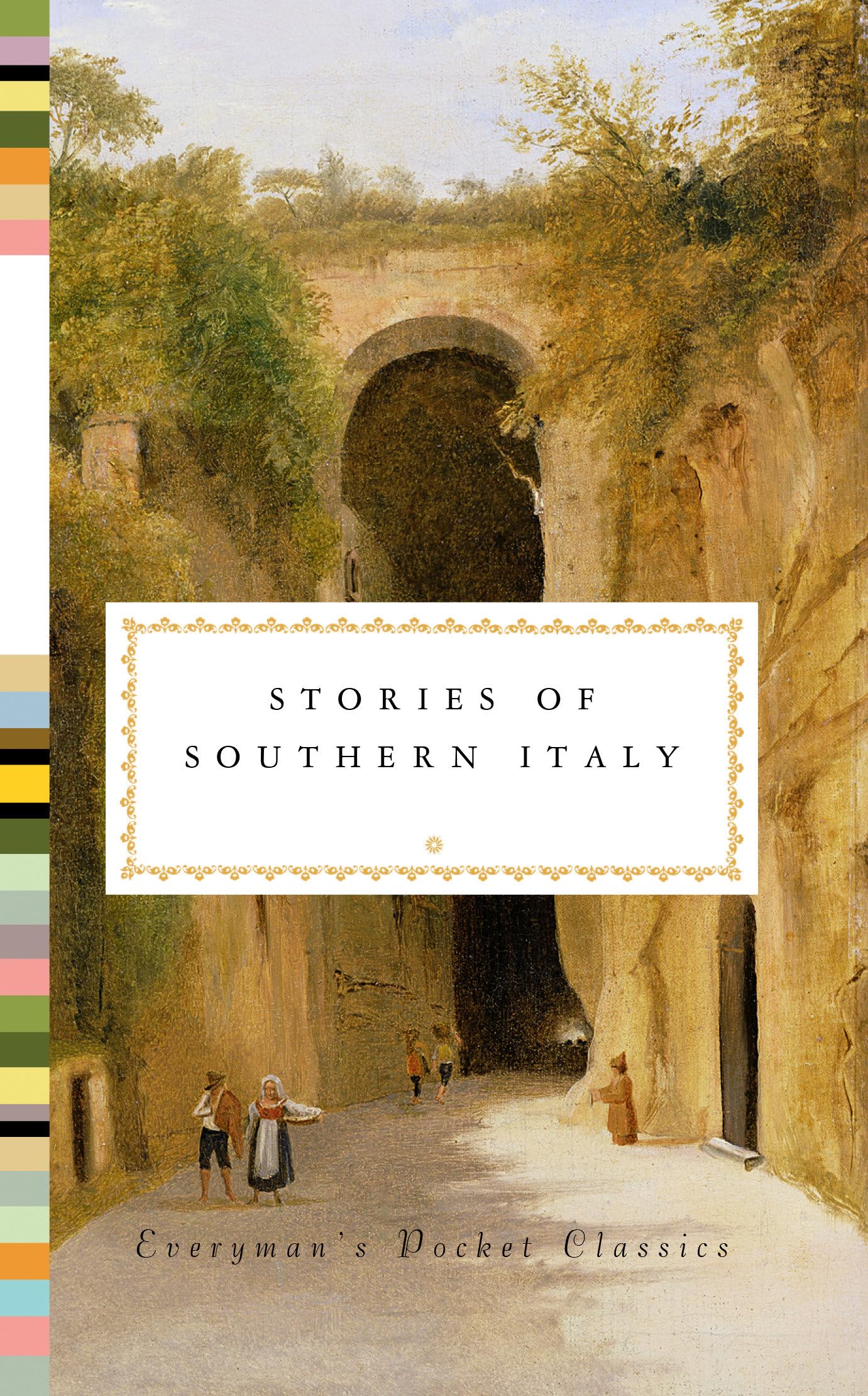



This dazzling hardcover collection brings to life the magnificent southern regions of Italy, from Naples to Sicily, as seen through the eyes of literary greats from Ovid and Virgil to Elsa Morante and Elena Ferrante. Southern Italy has long inspired one of the most vigorous literary traditions in Europe. Visitors since antiquity have sought to capture the extraordinary natural beauty and cultural riches of the region, and in this wide-ranging collection such notable foreign visitors as Goethe and Somerset Maugham sit alongside many of Italy’s finest writers, including Luigi Pirandello, Giuseppe Tomasi di Lampedusa, Elio Vittorini, and Anna Maria Ortese. The stories here range across the regions of Sicily, Calabria, Campania, Apulia, and Basilicata. Theocritus, Virgil, and Ovid describe a Sicily populated by Cyclopes and sea monsters. In an excerpt from The Smile of the Unknown Mariner, Vincenzo Consolo depicts an island on the frontier of Italian unification. The South’s legendary legacy of organised crime enlivens the stories of Leonardo Sciascia and Joseph Conrad. Curzio Malaparte and Norman Lewis immortalize the wreckage of Naples and the indomitable spirit of its people during World War II, and Elena Ferrante gives us a spectacular portrait of a poor but vibrant Neapolitan neighborhood in an excerpt from the best-selling My Brilliant Friend. Collectively, these entertaining tales provide a portal into a fascinating place in all its drama and beauty. Everyman's Library pursues the highest production standards, printing on acid-free cream-colored paper, with full-cloth cases with two-color foil stamping, decorative endpapers, silk ribbon markers, European-style half-round spines, and a full-color illustrated jacket. ELLA CARR is an editor at Everyman's Library in the UK, and author of the guide Florence Walks . She has contributed to a number of travel and hotel guides, and to publications including The Oldie and Exberliner . She is the editor of the Everyman's Library Pocket Classic collection Stories of Florence. Preface by Ella Carr The story of Southern Italy, and perhaps the rest of Europe, begins in Sicily. It is, as Goethe put it, ‘the clue to everything’. Famed for its extreme natural beauty and proverbial fertility, no part of Europe has been dominated by a greater number of races – the Phoenicians, Greeks, Romans, Goths, Byzantines, Arabs, Normans and Spanish among them – each of whom have left their traces in the island’s cultural DNA. As one of its greatest writers, Leonardo Sciascia, observed, the palimpsestic culture of Sicily can be seen as ‘a metaphor for the entire world’. In his novel The Skin , Curzio Malaparte attaches similar primordial significance to the ancient city of Naples: ‘that terrible, wonderful prototype of an unknown Europe, situated outside the realm of Cartesian logic – that other Europe of whose existence he [the American protagonist, Colonel Jack] had until that day had only a vague suspicion, and whose mysteries and secrets . . . filled him with a wondrous terror.’ This ‘wondrous terror’, I would argue, speaks to the baroque sensibility of the whole of Southern Italy. If Florence and Rome represent the light and reason of Italy’s Renaissance, the Mezzogiorno is its primeval underbelly, both more beautiful and more terrible. Southern Italy is characterized by extremes of light and dark, the unutterable beauty of its landscape sitting side by side with its legacy of violence and suffering. After Italian unification in 1871, the Southern economy suffered greatly; brigandage, poverty and organized crime, already longstanding issues, became entrenched, with economic difficulties persisting throughout the twentieth century. These poles of light and dark are reflected in the literature from this region. Like a Dutch vanitas portrait, Peter Robb’s almost indecently voluptuous description of Palermo’s food market captures Sicily in all its unbridled vitality, while simultaneously auguring death and decay – a metaphor for the ever-present threat of the mafia. This double-edged sword of beauty and horror haunts many of the stories in this anthology, of Sciascia, Somerset Maugham, Dacia Maraini and Elena Ferrante among others, as do the themes of corruption, hardship and injustice. Exile and return is another running theme. Vito Teti’s ‘Clouds and Back Streets’, based on his hometown in Calabria, explores the experience of being left behind following the mass emigration to la merica in the latter half of the twentieth century, which decimated much of the region and contributed to what Teti calls ‘the restless and precarious state of mind of the Calabrese, of being “here and elsewhere”’. Elio Vittorini’s Conversations in Sicily , which follows the narrator’s return home after eighteen years away, is equally suffused with Proustian longing for a vanished world, and with the sounds and smells of S