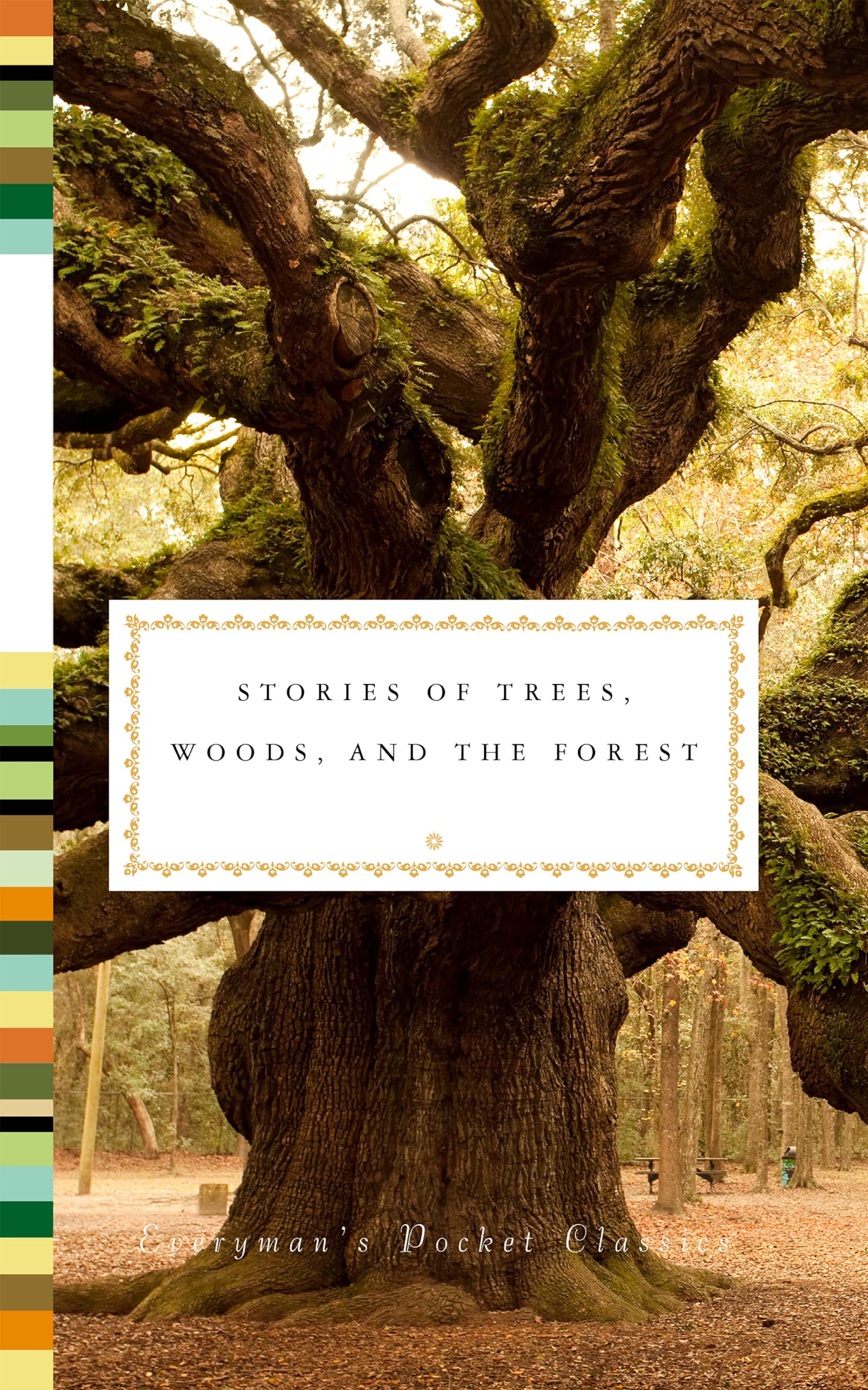
Stories of Trees, Woods, and the Forest (Everyman's Library Pocket Classics Series)
$19.99
by Fiona Stafford



A beautiful hardcover anthology of stories by a brilliant and surprising mix of classic and contemporary writers who have been inspired by trees and forests. Trees have starred in stories ever since Ovid described the nymph Daphne’s metamorphosis into a laurel, and the landscape of literature has long been enlivened by wild woodlands, sacred groves, and fertile orchards. This delightful collection ranges from Ovid to Austen and from Robin Hood’s Sherwood Forest (via Thomas Love Peacock’s Maid Marian ) to Washington Irving’s “The Legend of Sleepy Hollow,” and more stories from Eudora Welty, Tove Jansson, and D.H. Lawrence. Here are forest-haunted fairy tales both classic (the Brothers Grimm) and inventively retold (Angela Carter). There is room in these woods for comedy as well as terror, in Stella Gibbons’s Cold Comfort Farm , and Alexander McCall Smith’s “Head Tree.” Notable writers from around the world contribute arboreal fiction—from South Africa, Finland, France, Zimbabwe, Russia, Martinique, and India, as well as Britain, Ireland, Canada, and America. From Daphne du Maurier’s “The Apple Tree” to R. K. Narayan’s “Under the Banyan Tree.” The sheer range of stories in these pages will leave readers refreshed and dazzled. Everyman's Library pursues the highest production standards, printing on acid-free cream-colored paper, with full-cloth cases with two-color foil stamping, decorative endpapers, silk ribbon markers, European-style half-round spines, and a full-color illustrated jacket. FIONA STAFFORD is a professor of English literature at Oxford University. The author of many books, including a biograph of Jane Austen, she also wrote and presented the highly acclaimed "The Meaning of Trees" for BBC Radio 3's The Essay . Her book The Long, Long Life of Trees, published by Yale University Press in 2017, was a Sunday Times Nature Book of the Year. PREFACE If, on an early morning in October half-way across a dewy field, a line of trees becomes visible against the light blue sky, what would your impulse be? Perhaps it would depend on whether the wet trodden path through the grass winds away to a distant gate in a close-cut hedge, keeping well clear of the wood, or heads instead towards the scrubby elder, the brambles, field maple and blackthorn, before leading deep into the taller oaks and ashes beyond. If there were two paths, or none, the choice would be clear: on across the open fields or into the woods? Fields have trees of their own—thinning willows winding along a slow, sedge-edged river, rich brown sycamores towering above a drystone wall, a golden oak spreading over the corner of scarlet-spotted hedges. Sometimes they run beside an old orchard of mossed cottage trees or a Rectory garden dark with Scots pines and yews. A village pond might be ringed with hazel and alder, a scrap of grass where three lanes converge, covered with spiky shells and glossy nuts dropped from a huge horse chestnut. And if autumn walks lead through city streets, the peeling trunks of plane trees are rising from piles of broad, yellow, chamois-leather leaves. Park gates open between clumps of damp euonymus and privet, overlooked by tall hollies, whose upper leaves are glossy and smooth. Along a river banked with warehouses and converted mills, bare buddleia gleam with wet webs under copper sycamores catching the dawn light. The way into the woods is different. A few steps from open space to arboreal intimacy prompt a momentary pause to taste the difference in the air. Sodden leaves muffle the sound of footsteps, allowing the stillness to fill with the clear call of birds. A slight stir among high branches signals a squirrel moving swiftly in his own element. A tiny brown shape darting from dense ivy to a nearby tangle of brambles is probably a wren. Although it’s hard to tell quite what’s there, everything seems strangely clarified and pulsing with unseen life. When the woods are light and open, whether weeks or years ago or in months to come when bare twigs soften again and their light green leaves flap into spring, the damp, dank smells will be overcome by fresh flowers and wild garlic. Quiet or full of noises at any time of year, woods are natural trysting or picnic spots, places to work, play or bury treasure and truths. Solid trunks and branches are easiest to grasp, though filled with holes, nests, hidden lives and running away into ramifications. The overstorey may be flushed with light and colour, but there’s undergrowth thick with twisting stems and strands, too dense to follow or fully understand. These are places to hide, places where you might be caught unawares, havens and horrors, where you can’t quite see the wood for the trees and there’s no one to tell you what comes next. Even on your own, you know you’re not alone. There are voices in the woods. Birds and beetles, woodcutters, witches, wolves and wisemen, secret lovers, spectral horsemen, amateur actors, ardent adventurers, pred