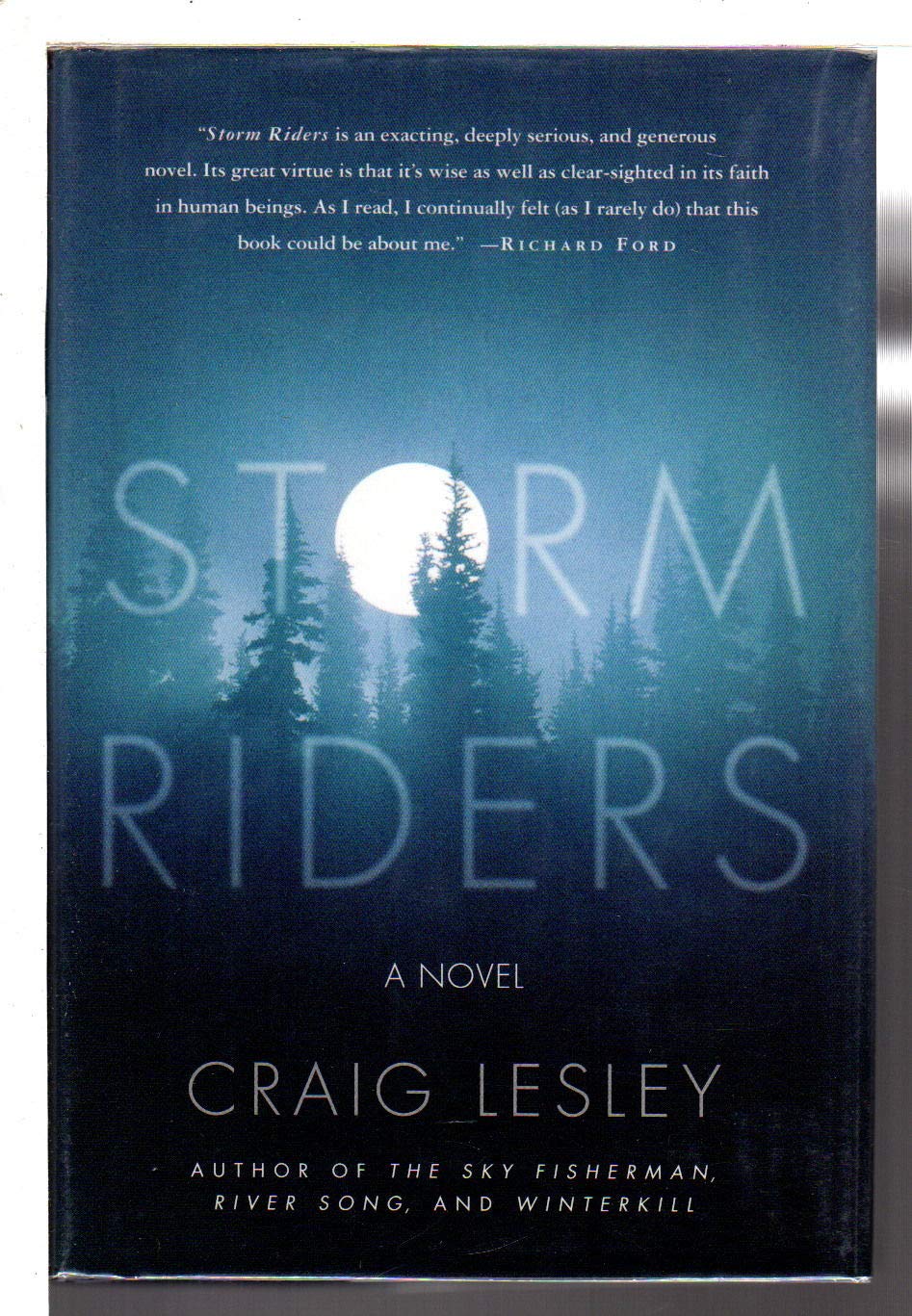



Winner of the Oregon Book Awards H.L. Davis Prize for Fiction Storm Riders examines the conflicted love of a single father struggling to raise his adopted Native American son, who was born with fetal alcohol syndrome. When a small girl mysteriously drowns near a student-housing complex, the boy is implicated and the father wrestles with his own doubt, guilt, and responsibility. Bringing to life the austere beauty of the Tlingit Alaskan village of the boy's family, as well as the highly educated pockets of the East Coast, Lesley vividly portrays a father and a son struggling to come to terms with each other and above all, with the truth. This novel, as The Chicago Tribune noted, is "a powerful tale with a strong emotional core." Young Wade drops into Clark's life like a disobedient Skylab. Wade, a Tlingit boy, is Clark's ex-wife's cousin--hardly a close relation. But the mild-mannered Clark, an Oregonian professor trying to make his way in the East, becomes foster father to Wade by attrition; there is simply no one else to care for the boy. In Craig Lesley's humane and beautifully competent fourth novel, Storm Riders , no romance is attached to the notion of saving a Native American child. Lesley makes both his heroes ornery and unlovable--and desperately real. Mysteries accrue around Wade. At the opening of the book, a neighbor girl drowns and he is blamed for the accident. In fact, throughout Wade's time with Clark, violent events crop up, and Lesley has the guts to leave these events unexplained. This deepens our sense of the core mystery of the story: Wade's damaged childhood remains unknowable. A string of therapists toss about theories--abuse, a learning disability, Fetal Alcohol Syndrome--and Lesley (who was foster parent to such a boy for a decade) shows how meaningless such theories are in the face of the day-to-day reality of Wade's difficulties. As Wade makes his way back to his tribe, Lesley spins his novel outward into a meditation on the way families are made and the way children are lost. A Tlingit elder describes to Clark the mythical "land otters" who make off with Tlingit children. Clark thinks he knows what the old man is talking about, and remarks that the land otters are a good metaphor for drugs and alcohol. "The old man shook his head. 'Sometimes there are real land otters.'" And that's the grace of Lesley's writing: Wade is a metaphor for all endangered children, and at the same time he's his own distinctive story, no more and no less. --Claire Dederer Having drawn a following in the Pacific Northwest for his previous novels (e.g., The Sky Fisherman), Lesley aims for national readership with this new book. For eight years, Clark Woods struggles to raise his foster son, Wade, a Tlingit orphan who suffers from fetal alcohol syndrome and other abuses. This saga seems to argue for keeping Indian children within the tribal unit, as Clark's love and care are not enough to "fix" whatever is damaged within Wade. With the death of a little girl at the novel's start and Wade's possible involvement, the reader dreads another awful event. This is an emotional look at the relationship between fathers and sons and the complexities of trying to raise a responsible child. Lesley creates chapters that often read like well-crafted short stories, complete in themselves. For any quality fiction collection. -Rebecca Sturm Kelm, Northern Kentucky University Lib, Highland Heights Copyright 1999 Reed Business Information, Inc. An extraordinarily moving tale from Lesley (The Sky Fisherman, 1995, etc.) of an idealistic Caucasian fathers agonizing relationship with his adopted son, a Tlingit Indian boy cursed with fetal alcohol syndrome and an abusive childhood. By adopting Wade, a charming, energetic six-year-old orphan whose hands are scarred from physical abuse, Oregon community-college professor Clark Woods hopes he will somehow atone for Emmett Woods, the man who walked out on Clark and his mother, Grace, shortly after Clark was born. Clarks Tlingit wife, Payette, who doesnt want children of her own, agrees to the situation at first, then becomes estranged from Clark as Wade becomes an increasing burden. Hyperactive and prone to sudden acts of violence, the boy also has severe learning disabilities and suffers hallucinations in which he sees whales, otters, and other Alaskan wildlife with totemic significance, in places where no such creatures exist. Special classes and therapy sessions fail to help him. When Payette walks out, Clarks mother moves in to help. Grace cant watch Wade all the time, and, when a neighbors two-year-old drowns in a drainage culvert, police suspect that Wade, who blamed the accident on a whale, may have harmed the girl. Charges arent filed, yet Clark is tormented with doubt as Wade grows older, stronger, and more dangerous. Natalie, Clarks second wife, loves the boy but fears he may harm their baby daughter, Helen, until Clark puts Wade in a group home. Wade runs off