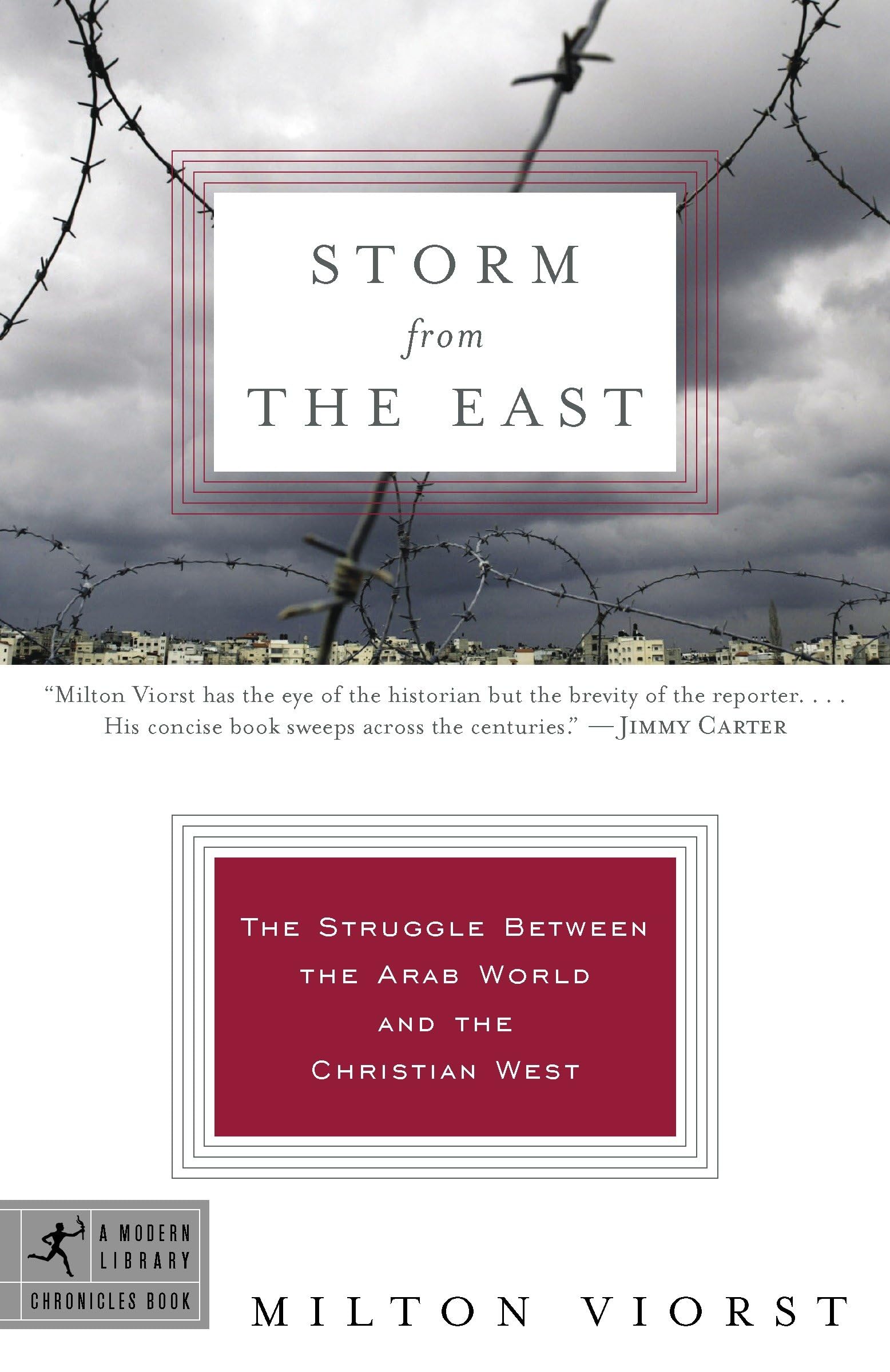
Storm from the East: The Struggle Between the Arab World and the Christian West (Modern Library Chronicles)
$13.70
by Milton Viorst



America’s engagement with the Arab world stretches back far beyond the Iraq wars. According to Milton Viorst, the current conflict is simply the latest round in a 1,400-year struggle between Christianity and Islam, in which the United States became a participant only in the last century. Today, the Bush Doctrine aims to free the Arab peoples from political oppression and create a democratic Iraq. So why are Arabs, and Iraqis in particular, so suspicious of our efforts? The explanation, Viorst says, is simple: “What the American leadership has miscalculated, or simply dismissed, is Arab nationalism.” In Storm from the East, Viorst offers a balanced, lucid, and vital history of America’s uneasy relationship with the Arab world and argues that brutal conflict in the region will continue until the West, with the United States taking the lead, honors the Arabs’ insistence on deciding their own destiny. Viorst examines the long struggle of the Arab world to overthrow Western hegemony. He explores the Arab experiences with democracy and military despotism; Nasserite socialism in Egypt and Ba’athism in Syria and Iraq; tribal monarchy in Saudi Arabia and Jordan; guerrilla warfare waged by the Palestinians; and, finally, Islamic rebellion culminating in Osama bin Laden’s extremist al-Qaeda. All have the same goal: the liberation of the Arabs from foreign domination. Storm from the East is a powerful work that, like no other, limns the political, religious, and social roots of Arab nationalism and the present-day unrest in the Middle East. Milton Viorst has covered the Middle East as a journalist and scholar since the 1960s. He was The New Yorker’s Middle East correspondent, and his work has appeared in The New York Times, The Washington Post, the Los Angeles Times, and The Wall Street Journal. He has written six books on the Middle East and lives in Washington, D.C., with his wife, the poet Judith Viorst. I Memory 622—1900 America’s war in Iraq, from its start, did not go as President Bush’s administration had predicted. Though the U.S. army captured Baghdad and Iraq’s other major cities easily enough, and encountered little resistance in abolishing the detested regime of Saddam Hussein, Iraqis did not greet America’s forces with the gratitude that they had been told to expect. Far from treating America’s soldiers as liberators, which is how they looked upon themselves, Iraqis regarded them as conquerors. It was a characterization for which most Americans were shockingly unprepared. Frustrated, the American invaders believed they were being misunderstood. The leadership in Washington had proclaimed repeatedly that its quarrel was not with the Iraqi people but with Saddam’s regime. It had assured its soldiers of the nobility of their mission, not just to end a dangerous military threat but to wipe out tyranny and create the conditions for democracy. Wasn’t that why the armies of their fathers and grandfathers had disembarked in 1944 in France, to a delirious welcome by the local population? In 1945, moreover, the defeated Germans and Japanese, taking for granted the victors’ benevolence, willingly established free and democratic regimes. So why were the Iraqis so hostile? Notwithstanding the political and cultural diversity among them, most Iraqis took the position that the American army was their enemy and placed serious obstacles in the way of its efforts to stabilize the country. This was the response of Sunnis and Shi’ites, Baghdadis and provincials, extremists and moderates, students, tribesmen, professionals, peasants, Saddam’s followers and his foes. By the third year of the war, many Shi’ites, perceiving an opportunity to shift political domination to themselves, had adopted with some wariness a strategy of cooperating with the occupiers. Iraq’s Kurdish community, to whom the occupation presented an opening to long-sought independence, did the same. But the once-powerful Sunnis, with nothing to gain, waged a fierce insurgency against the occupiers. United in mistrust of the Americans, however, Sunnis, Shi’ites, and Kurds were all impatient for them to go home. Why were Iraqis so much more hostile than America’s defeated enemies had been after World War II? Why, unlike the Germans and the Japanese, did they impugn America’s ideals and objectives? Why, after President Bush declared “mission accomplished,” did Americans keep dying on the battlefield? Clearly, the leadership in Washington had initiated the war on the basis of a grievous miscalculation of Iraq and of the Arabs. What the American leadership had failed to calculate, or simply dismissed, was Arab nationalism. Much as Iraqis were driven by sectarianism—Sunnis versus Shi’ites, Arabs versus Kurds—a long history of hostility to foreign occupation served as a bond among them. Yet American leaders, in deciding to invade Iraq, chose not to take this bond, and the deep emotions of Arab nationalism, into account. Back in mid-2003, a few months