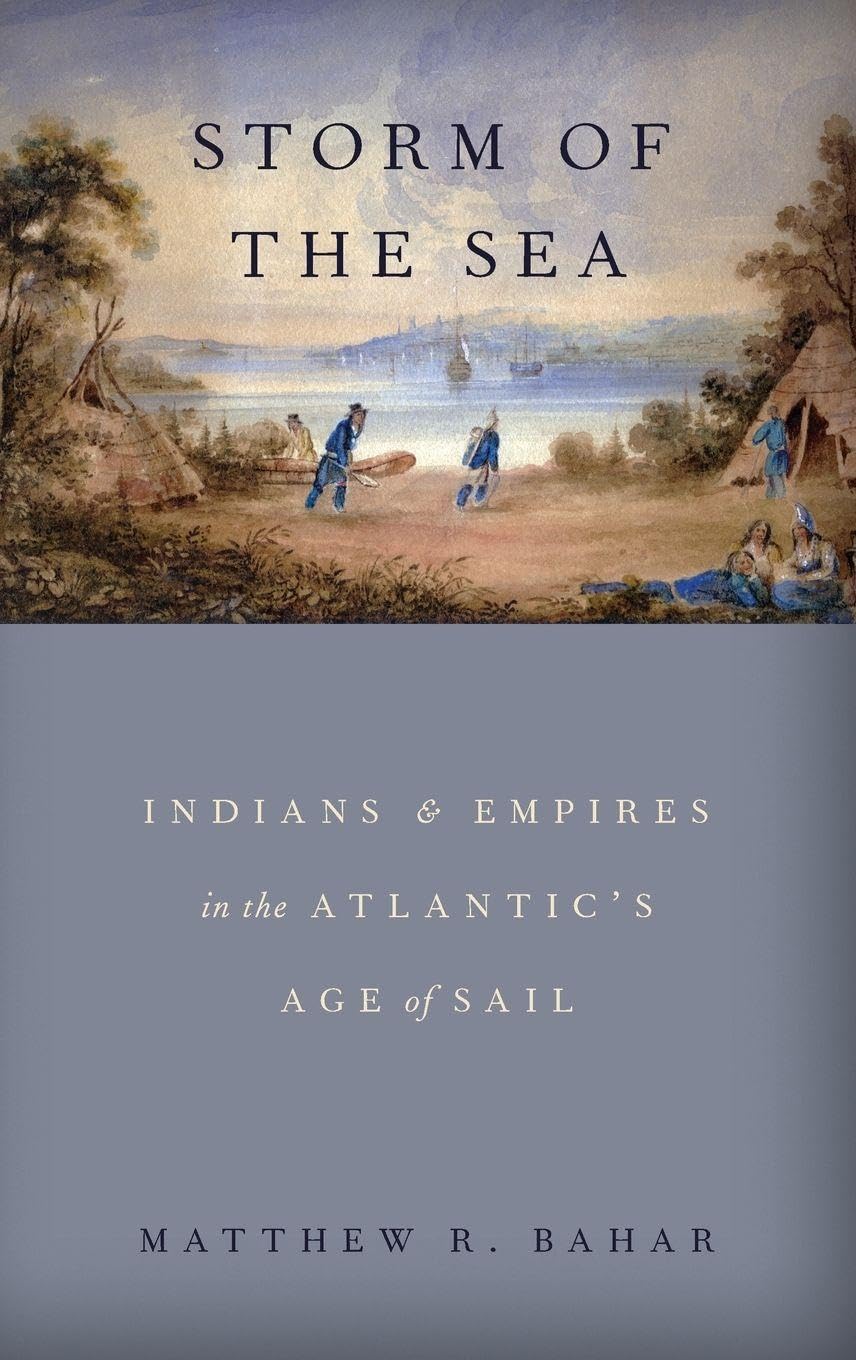
Storm of the Sea: Indians and Empires in the Atlantic's Age of Sail
$38.04
by Matthew R. Bahar



Narratives of cultural encounter in colonial North America often contrast traditional Indian coastal-dwellers and intrepid European seafarers. In Storm of the Sea, Matthew R. Bahar instead tells the forgotten history of Indian pirates hijacking European sailing ships on the rough waters of the north Atlantic and of an Indian navy pressing British seamen into its ranks. From their earliest encounters with Europeans in the sixteenth century to the end of the Seven Years' War in 1763, the Wabanaki Indians of northern New England and the Canadian Maritimes fought to enhance their relationship with the ocean and the colonists it brought to their shores. This native maritime world clashed with the relentless efforts of Europeans to supplant it with one more amenable to their imperial designs. The Wabanaki fortified their longstanding dominion over the region's land- and seascape by co-opting European sailing technology and regularly plundering the waves of European ships, sailors, and cargo. Their campaign of sea and shore brought wealth, honor, and power to their confederacy while alienating colonial neighbors and thwarting English and French imperialism through devastating attacks. Their seaborne raids developed both a punitive and extractive character; they served at once as violent and honorable retribution for the destructive pressures of colonialism in Indian country and as a strategic enterprise to secure valuable plunder. Ashore, Indian diplomats engaged in shrewd transatlantic negotiations with imperial officials of French Acadia and New England. Positioning Indians into the Age of Sail, Storm of the Sea offers an original perspective on Native American, imperial, and Atlantic history. "Bahar argues persuasively that understanding Indigenous peoples ability to maintain their homelands in this part of North America requires a deeper consideration of their maritime strength.... Storm of the Sea should be read widely by anyone interested in Indigenous power, Atlantic history, and resistance to settler colonialism." -- Jeffers Lenox, American Historical Review "Bahar's book is a path-breaking achievement. In uncovering an often ignored story of Native American maritime involvement in the Atlantic Northeast, it provides an important and commendable contribution to the history of the region's indigenous peoples as well as Early American maritime history. Storm of the Sea is well researched, argued, and pursues an original argument." -- Christoph Strobel, University of Massachusetts, Lowell, Journal of Early American History "A strikingly original history... Storm of the Sea constitutes an important historiographical intervention...Indeed, Bahar has performed a service by highlighting issues that future scholars of the Northeast and of maritime history will need to confront in moving their fields forward....Bahar's writing is consistently felicitous, rendering often complicated material in jargon-free prose that will prove accessible to nonspecialists at all academic levels." -- Neal Salisbury, William and Mary Quarterly "Many historians recognize that colonial America was, in many ways, places, and periods, shaped by Indigenous power. But by sea power? Recovering a time when Indian sailors, ships, and nautical prowess dominated coastal waters from Nova Scotia to Massachusetts, Matthew Bahar adds another dimension to understanding the Wabanaki confederacy and expands the narrative of encounter in early America."--Colin G. Calloway, author of The Indian World of George Washington "In this groundbreaking study, Matthew Bahar places Native American sailors at the helm. During the seventeenth and eighteenth centuries, he shows, Wabanaki seamen controlled the coast between Maine and Newfoundland by building, commandeering, and deftly navigating European vessels. Native sailors often overpowered European traders and fishermen, instilling fear across the Dawnland and demanding European deference to Native American authority. Deeply researched and altogether illuminating, Storm of the Sea makes significant contributions to both Native American and maritime history." --Christopher L. Pastore, author of Between Land and Sea: The Atlantic Coast and the Transformation of New England " Storm of the Sea is a revisionist blockbuster. No one before has traced, or even barely hinted at, the story of how the Mi'kmaqs and Wabanakis appropriated European sailing technology to empower their people and control the coasts of Maine and the Canadian Maritimes during the colonial age. Matthew Bahar powerfully demonstrates that a series of Mi'kmaq and Wabanaki sachems led a 150-year 'blue water strategy' enabling indigenous people to exercise hegemony over this region. For generations, scholars have assumed that the English remained scarce in colonial Maine because they set their sights elsewhere. Bahar shows instead that indigenous mariners defeated them there, over and over again. Beautifully written, deeply re