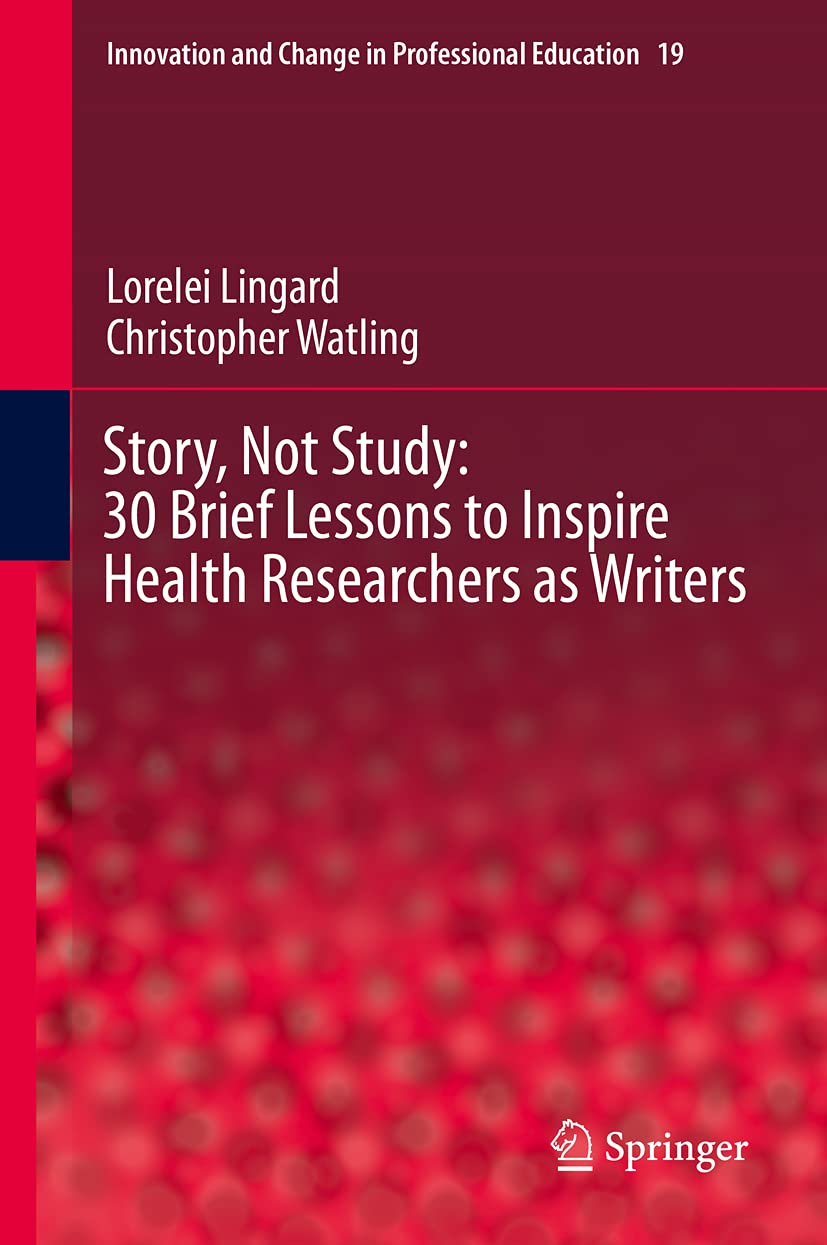
Story, Not Study: 30 Brief Lessons to Inspire Health Researchers as Writers (Innovation and Change in Professional Education, 19)
$47.78
by Lorelei Lingard



Many researchers dread writing. They find it laborious - even painful - to put their scholarly work into words. They get bogged down in the study, and lose track of the story. And they produce uninspiring papers that fail to resonate with readers or reviewers. This book offers an antidote to this problem: brief, accessible lessons that guide researchers to write clear and compelling scientific manuscripts. The book is divided into three sections – Story, Craft, and Community. The Story section offers advice on getting the balance of study and story just right, introducing strategies for tackling each section of a scientific manuscript. The Craft section considers the grammatical and rhetorical tools of the trade, showing how they can be wielded for maximum impact. And the Community section offers suggestions for writing collaboratively, supporting other writers, and navigating peer review. Each section features multiple short and pragmatic lessons, peppered with illustrative examples. Readers can use the chapters collectively to build holistic writing skills, or dip in and out to refine specific elements of the craft. Rooted in a coaching philosophy, we aim to unlock our readers’ potential as writers through instruction, reflection, and example. And we hope to inspire researchers to face writing with joy. This work is clearly written and easily understandable. Its many practical examples, tools, and exercises make an effective toolbox of support for scholarly writers. This will be invaluable to new scholars and help established scholars as well. The inclusion of examples specific to the health arena and the clear, elegantly simple explanations add strength and relevance to this work . Toni Ungaretti, Johns Hopkins School of Education, Baltimore, MD, USA This book is the most original perspective I have ever read about the craft of writing. As its title suggests, it is inspiring. Brownie Anderson, NBME, Philadelphia, PA, USA “This book works to shift readers’ views from writing as a series of mechanical procedures to writing as a thoughtful and considered process. In other words, rather than merely offering writing tools (which it does as well), it makes an argument for the importance of writing as thinking. The grouping of the bite-sized chapters into story, craft, and community makes this not only useful as a book one might read cover-to-cover, but also as one classes or writing groups could use piecemeal, drawing on the resources they need.” (Abigail Konopasky, Center for Health Professions Education (CHPE), Uniformed Services University of the Health Sciences and The Henry M Jackson Foundation for the Advancement of Military Medicine, Bethesda, MD, USA) This work is clearly written and easily understandable. Its many practical examples, tools, and exercises make an effective toolbox of support for scholarly writers. This will be invaluable to new scholars and help established scholars as well. The inclusion of examples specific to the health arena and the clear, elegantly simple explanations add strength and relevance to this work.” (Toni Ungaretti, Johns Hopkins School of Education, Baltimore, MD, USA) “This book is the most original perspective I have ever read about the craft of writing. As its title suggests, it is inspiring.” (Brownie Anderson, NBME, Philadelphia, PA, USA) Many researchers dread writing. They find it laborious - even painful - to put their scholarly work into words. They get bogged down in the study, and lose track of the story. And they produce uninspiring papers that fail to resonate with readers or reviewers. This book offers an antidote to this problem: brief, accessible lessons that guide researchers to write clear and compelling scientific manuscripts. The book is divided into three sections – Story, Craft, and Community. The Story section offers advice on getting the balance of study and story just right, introducing strategies for tackling each section of a scientific manuscript. The Craft section considers the grammatical and rhetorical tools of the trade, showing how they can be wielded for maximum impact. And the Community section offers suggestions for writing collaboratively, supporting other writers, and navigating peer review. Each section features multiple short and pragmatic lessons, peppered with illustrative examples. Readers can use the chapters collectively to build holistic writing skills, or dip in and out to refine specific elements of the craft. Rooted in a coaching philosophy, we aim to unlock our readers’ potential as writers through instruction, reflection, and example. And we hope to inspire researchers to face writing with joy. This work is clearly written and easily understandable. Its many practical examples, tools, and exercises make an effective toolbox of support for scholarly writers. This will be invaluable to new scholars and help established scholars as well. The inclusion of examples specific to the health arena and the clear