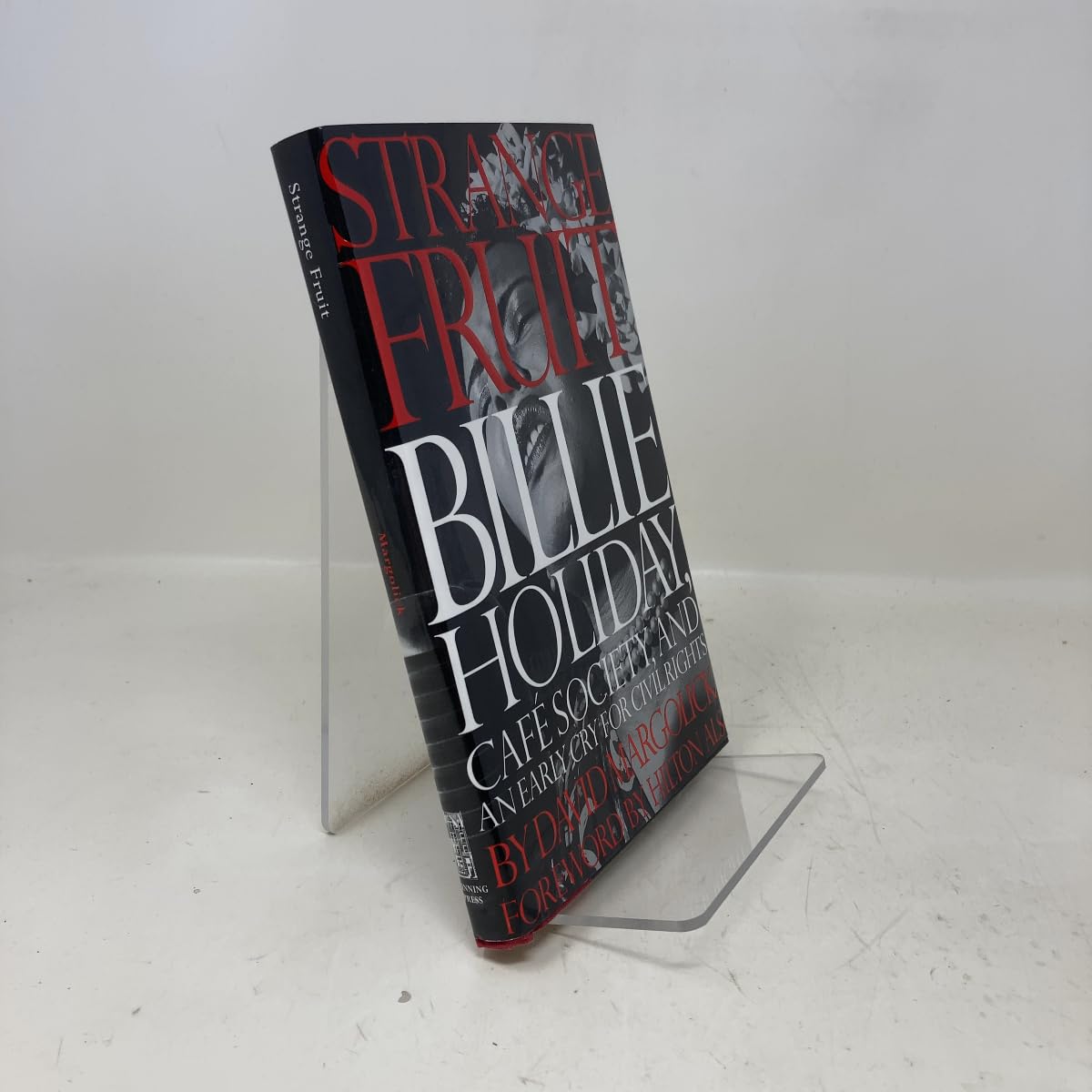
Strange Fruit: Billie Holiday, Cafe Society, And An Early Cry For Civil Rights
$44.86
by David Margolick



From four-time Pulitzer Prize nominee David Margolick, STRANGE FRUIT explores the story of the memorable civil rights ballad made famous by Billie Holiday in the late 1930s. The song's powerful, evocative lyrics-written by a Jewish communist schoolteacher who, late in life, adopted the children of Julius and Ethel Rosenberg-portray the lynching of a black man in the South. Holiday's performances sparked conflict and controversy wherever she went, and the song has since been covered by Lena Horne, Tori Amos, Sting, and countless others. Margolick's careful reconstruction of the story behind the song, portions of which have appeared in Vanity Fair, includes a discography of "Strange Fruit" recordings as well as newly uncovered photographs that capture Holiday in performance at Greenwich Village's Café Society. A must for jazz aficionados. Our image of Billie Holiday is that of the elegant and melancholy jazz singer known for her haunting voice and immortal classics like "Lady Sings the Blues" and "My Man." But there was another song she performed that stood out in her repertoire: "Strange Fruit," a disturbing and impressionistic elegy to lynched black men in the South. Now, for the first time, New York Times and Vanity Fair contributor David Margolick uncovers the extraordinary history of this important American composition that few singers dare to perform to this day. For Margolick, "'Strange Fruit' defies easy musical categorization and has slipped between the cracks of academic study. It's too artsy to be folk music, too explicitly political and polemical to be jazz. Surely no song in American history has ever been guaranteed to silence an audience or to generate such discomfort." Margolick reconstructs that discomfort when he details that fateful night in 1939 when Holiday first performed "Strange Fruit" at New York's Cafe Society. He also writes about the song's composer, Abel Meeropol (who later adopted the sons of spies Julius and Ethel Rosenberg). For the author, "Strange Fruit" was a protest act on par with Rosa Parks's refusal to give up her seat on a segregated bus years later, and he notes the influence the song has had on poets, singers, and writers as diverse as Maya Angelou, Cassandra Wilson, and Natalie Merchant. What David Margolick proves in this small but important book is that art can indeed move people in ways nothing else can. --Eugene Holley Jr. How did a lurid ("Black body hanging in the Southern breeze,/ Strange fruit hanging from the poplar trees") and almost rhythmless protest song about Southern lynching become a Depression-era sensation at the Greenwich Village nightclub Cafe Society and later around the world? The great Billie Holiday sang it, for one thing. This story of the life of the 1939composition written by a Bronx leftist school teacher, Abel Meeropol, and claimed for years by its most famous singer (who made it one of her standards) takes an interesting approach. Margolick (Undue Influence) presents a quick, fluent survey of the times and characters that formed "strange Fruit" - a song that inspired and enraged many listeners in those days before the Civil Rights movement and changed Holiday as a performer. The book is also (at 144 wide-margined pages) barely padded-out from its beginnings as a Vanity Fair article. When Margolick exhausts the story of the ballad's provocative early performance and the evolving folklore surrounding its authorship, he adds on lightweight testimonials by later performers who've wrestled with "Strange Fruit" - Tori Amos, Natalie Merchant, Cassandra Wilson, Sting-but you sense that the real story is over even before it so quickly ends. Recommended for large public libraries, this does not replace Holiday biographies. [This book is being published on April 7, Lady Day's 85th birthday; Time magazine named "Strange Fruit" the Best Song of the Century.-Ed.]-Nathan Ward, "Library Journal. --Nathan Ward, "Library Journal" Copyright 2000 Reed Business Information, Inc. Anyone who has heard Billie Holiday sing "Strange Fruit" knows of, if not understands, the awful shame blacks have had to bear living in America. The first two lines explain it: "Southern trees bear a strange fruit, / Blood on the leaves and blood at the root." Holiday first sang this dirge in early 1939 in the integrated CafeSociety nightclub in New York, and soon after that fateful event, it became Holiday's signature song. Margolick tells that story and many more concerning "Strange Fruit" in this biography of the song itself, which is being published on the eighty-fifth anniversary of Holiday's birth. Bobby Short, the diminutive supper-club singer, aptly characterizes the early protest song as "a way of moving the tragedy of lynching out of the black press and into the white consciousness." Studs Turkel further defines it: "When you think of the South and Jim Crow, you naturally think of the song, not of `We Shall Overcome.'" But time is fleeting, so it isn't utterly surp