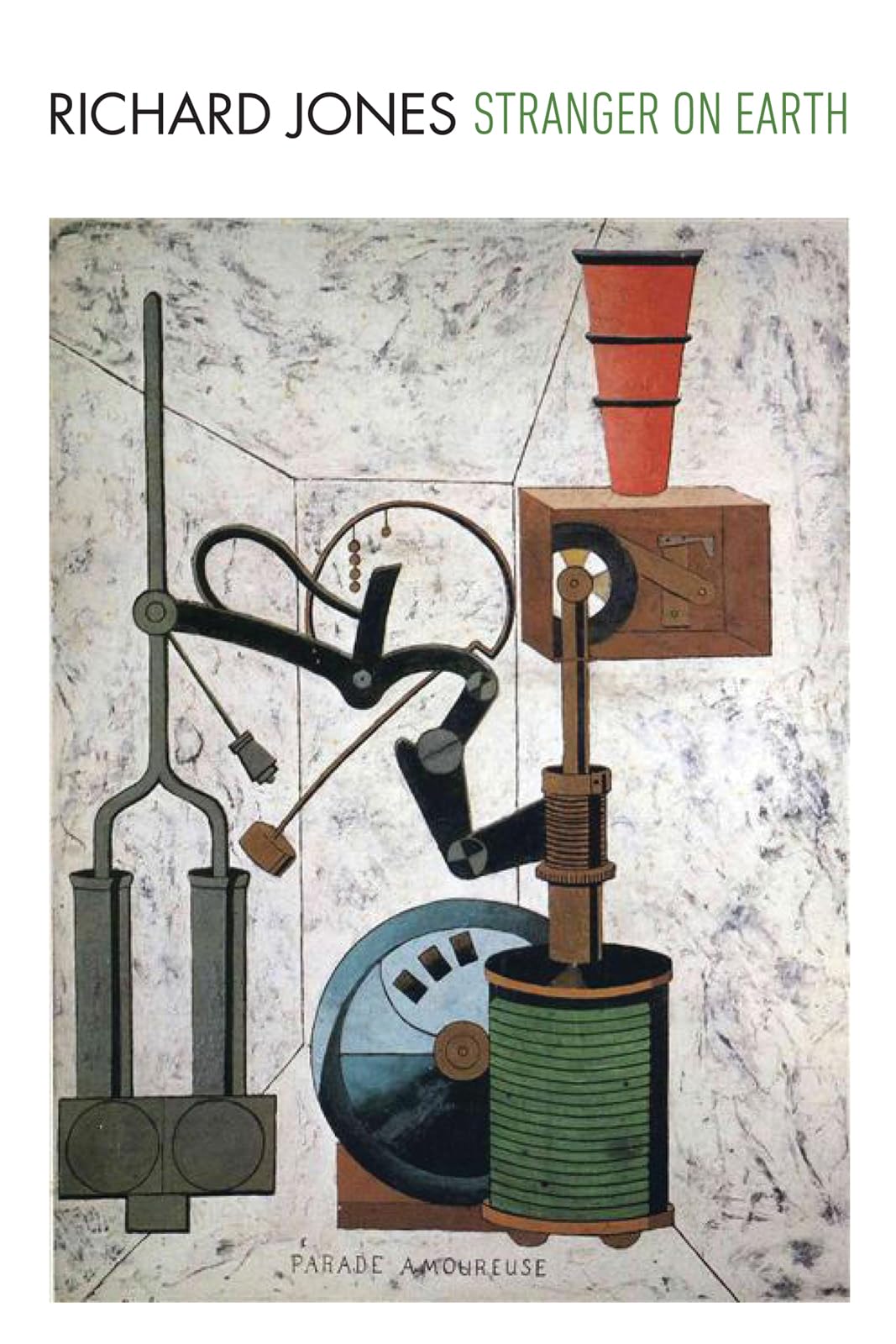



"Jones writes brief, simple poems about isolated incidents while gracefully alluding to the complex relationships underlying them." ― Publishers Weekly "Skillful, direct, and surprisingly delicate." ― The Village Voice "A poet of uncommon perceptual gifts." ― Library Journal Richard Jones’s prodigious volume travels the wide arc of a lifetime in Proustian detail. He remembers a peripatetic upbringing, travels to London and Paris, separation from and reunion with his wife in the Italian countryside, morning tea with his daughter and trail runs with his sons, flights with a pioneering aviator father and conversations with a deaf mother. "Impossible task, staying alive," Jones writes, and yet a perspicacious examination of the life we have lived yields clarity and enrichment. Finding poetry in what went before, Stranger on Earth opens the door to what Proust calls "those dwelling-places deep within us that we would not have known how to enter." Richard Jones has published eleven books of poetry and his poems have been featured on NPR’s “All Things Considered.” He is the founder and editor of Poetry East, and he teaches at DePaul University in Chicago, where he lives with his family. "Jones is nothing if not sincere, and his fluent free verse and glowing prose poems pursue some very traditional goals... [and] beauty and mystery are what he finds, commemorating parents and friends, contemplating the art of poetry, and celebrating his young children..."—Publishers Weekly “Skillful, direct, and surprisingly delicate.”—The Village Voice “A poet of uncommon perceptual gifts.”—Library Journal Poet, critic, and editor Richard Jones has published eleven books of poetry and his poems have been featured on National Public Radio’s “All Things Considered,” and “The Writer’s Almanac,” as well as programs on the BBC. He has edited the anthologies Poetry and Politics and Of Solitude and Silence: Writings on Robert Bly, and his poetry was selected by Billy Collins to appear in the anthology Poetry 180. Jones has received the Coordinating Council of Literary Magazines’ Editors Award for his work editing the literary journal Poetry East, which he founded in 1980. He has also worked for two decades with high school teachers, librarians, and community groups to develop reading skills and a wider audience for the art. Since 1987, Jones has been teaching at DePaul University, where he currently directs the creative writing program. He lives in Chicago with his wife and three children. Scarlet Fever The family sailed from England when I was little. We departed from Southampton and crossed the Atlantic in a season of storms. After seven sleepless days of nausea we landed in New York harbor. My father carried me in his arms down the ship's gangplank. For the next few months we lived a peripatetic existence out of suitcases, driving the DeSoto and staying with relatives. Then—still with no home—my father, the war pilot, left us in Portsmouth, Virginia, at his sister's house and returned to duty in England. I fell ill with scarlet fever. The day I got sick, my mother suffered a vertigo attack. For days she could not lift her head from the downstairs sofa, while I lay feverish in a second-floor room under the eaves. Fires inside me burned and raged. The doctor snapped his black bag shut; the health inspector posted on the front door a quarantine sign: no one was allowed in or out of the house. My sister and cousins whispered I'd be lost. A telegram was sent to London. An Episcopalian priest, I'm told, knelt by my bed and prayed. I cannot remember whose hand held the cold compress when my temperature spiked and the end loomed near. I still don't know what hand gave me water, my aunt's, my sister's, or someone unknown to me, or what angel to thank for accompanying the child I was through the valley of death. And yet, after all these many years and a long and lucky life, whenever fever dreams wake me in the dark, I sometimes feel on my brow that cool, damp cloth— calming me, healing me— one of a thousand mysteries I give thanks for when I close my eyes at night. The Way We didn't go to London after all. She was German and we drove her old Citroen from her father's home in Hanover south to the Alsace where we stayed for a week in her uncle's cottage. Then we followed the winding Costa Brava to Barcelona and crossed the plain to Madrid. If we'd parked the car and walked the Camino north, we might have done the pilgrimage properly, but instead we drove to Toledo, then on through forests to Lisbon and the sea where we camped on Portugal's lonely beaches. In Galicia we stopped at Santiago de Compostela— as if “the field of stars” had been our destination all along. We walked the town's cobblestone streets and through colonnades crowded with university students. In the great cathedral we wet our fingertips in the seashell filled with holy water while the blue smoke of incense lif