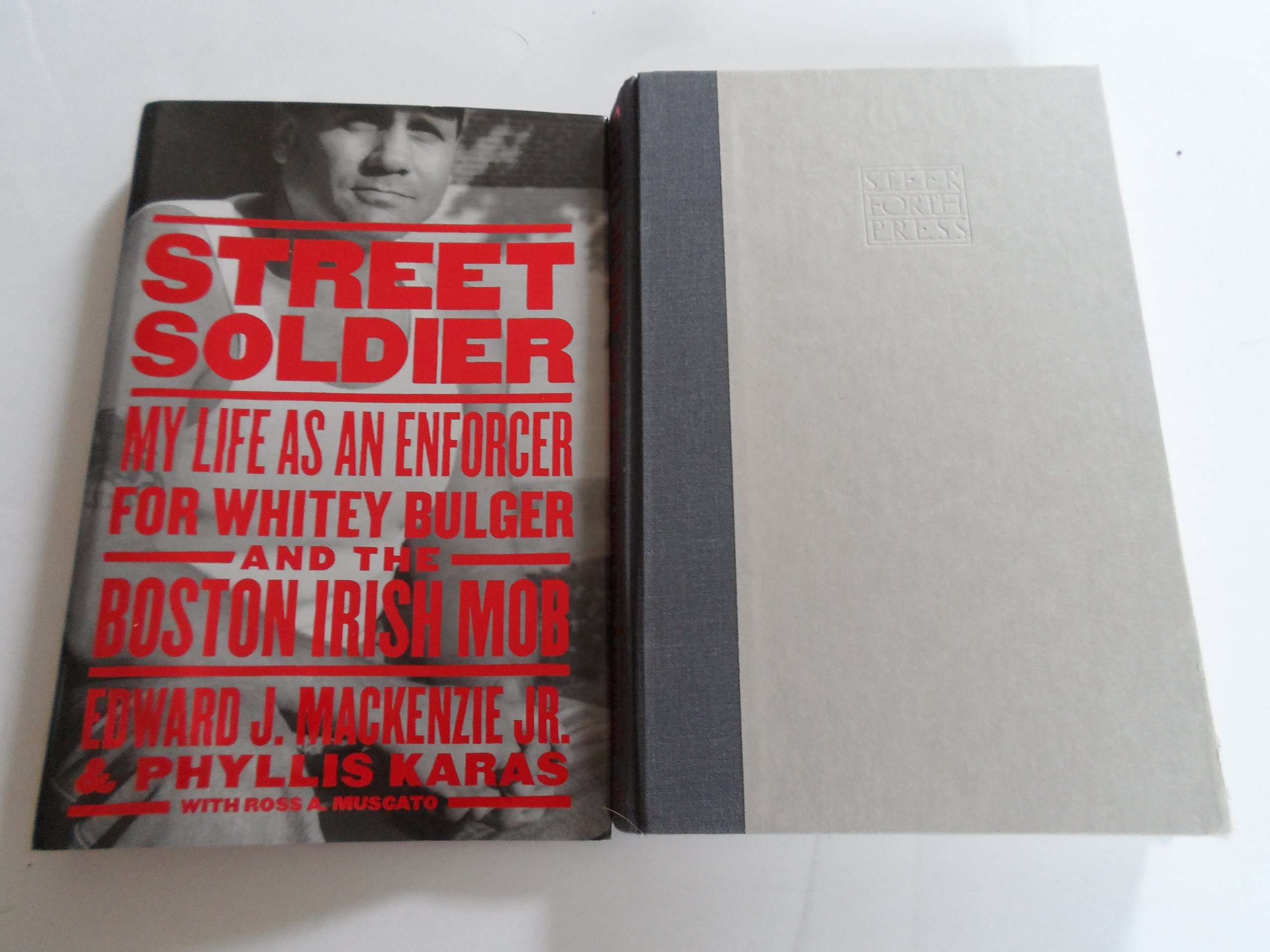
Street Soldier: My Life as an Enforcer for Whitey Bulger and the Irish Mob
$28.12
by Edward MacKenzie Jr



For decades the FBI let James “Whitey” Bulger get away with murder, allowing him continued control of his criminal enterprise in exchange for information. He went on the lam in 1995 and today follows top-ranked Osama bin Laden on the FBI’s Ten Most Wanted List. Edward J. MacKenzie, Jr. was a drug dealer and enforcer who would do just about anything for Bulger. In this compelling eyewitness account, Eddie Mac delivers the goods on his one-time boss and on such former associates as Stephen “The Rifleman” Flemmi and turncoat FBI agent John Connolly. Street Soldier is also a story of the search for family, for acceptance, for respect, loyalty, and love. Abandoned by his parents at the age of four, Mackenzie became a ward of the state, suffered physical and sexual abuse, and eventually drifted into Bulger’s orbit. The Eddie Mac who emerges in these pages is complex: An enforcer who was also a national kick-boxing champion; a womanizer who fought for custody of his daughters; a kid never given much of a chance who went on, as an adult, to earn a college degree in three years; a man who lived by a strict code of loyalty but also helped set up a sting operation that would net one of the largest hauls of cocaine ever seized. Street Soldier is as disturbing and fascinating as a crime scene, as heart-stopping as a bar fight, and at times as darkly comic as Quentin Tarantino’s Pulp Fiction or Martin Scorsese’s Good Fellas. All due respect to the Gambinos and the Genoveses, but the Italian mob families arent the only gangsters to make for compelling memoirs. In terms of relentless ruthlessness and its obsession with the almighty dollar, the Irish mob of Bostons James "Whitey" Bulger could match its New York counterparts hit for bloody hit. For decades, Edward J. MacKenzie, Jr. (a.k.a. Eddie Mac) was a drug dealer, enforcer, and key associate of Bulger (on the lam as this book was published). Mac's first-person account of those years is rife with more gory details per page than the entire last season of The Sopranos . By the brutal code of honor and loyalty in the streets, the candid dishing of such dirt marks MacKenzie as a world-class rat, second only to Salvatore "Sammy the Bull" Gravano, the man who put John Gotti away. But Eddie Mac has some justification in spilling the beans; in exchange for his tips, the Feds turned a blind eye toward his crimes. (It's also worth nothing that Bulger himself was an informant for the FBI.) The author certainly doesnt portray himself as any sort of hero or "gangster with a heart of gold." Witness his charming account of one of many attempts to "enlighten" a wayward associate: "Probation notwithstanding, I had to open Steves eyes a little. I headed over to Dunkin Donuts and bought a cup of coffee for $1.24. Medium, black, scalding hot. . . .Steve was still in his car, sleeping like a baby. The window was down and he had his head against the door, hands under his cheeks. I poured the hot coffee down the side of his face, making sure to get some on his eyeballs. . . I swear if Id had enough money to buy the gasoline that day thats what I would have done. . . but Id only had $1.30, so the coffee had to do." Although MacKenzie has not one but two ghost writers (Karas is a contributor to People magazine and the author of The Onassis Women , while Muscato is a self-described "strategic communications consultant"), the prose never rises above the level of the sleaziest pulp fiction. But that of course is exactly its appeal, and fans of the true-crime genre will find Street Soldier a supreme pleasure, guilty or not. --Jim DeRogatis “Eddie MacKenzie’s graphic account of his life as a violent street criminal in South Boston is almost unspeakably brutal, coldblooded, ruthless, merciless, callous, cruel — and fascinating. Reading it is like happening upon a street crime and entering the perpetrator’s mind.” — John W. Dean in the New York Times Book Review “An almost unbeatable insider’s account of the mob.”— Library Journal “MacKenzie is the first ‘predator’ (his description) from the murderous Irish mob in Boston to come forward without an indictment hanging over his head and attempt to tell the ugly truth about an organized crime group that plagued Boston for much of the past 30 years.”— Jonathan Wells in the Boston Herald “Americans love their bad guys and . . . books about criminal gangs proliferate and prosper. One of the best is Street Soldier .”— Les Roberts in the Washington Post “In my 25 years of studying crime and criminals, I have never come across a book quite like Street Soldier . One-third of the way through, I had to put it down, because I was so shaken by the depraved life and gruesome events that it openly describes.” — Richard Moran in the Chicago Tribune “This memoir is more than just true crime sensationalism or conscience-cleansing confessional. . . . It contains the edginess of a great thriller.”— Publishers Weekly “A tour of