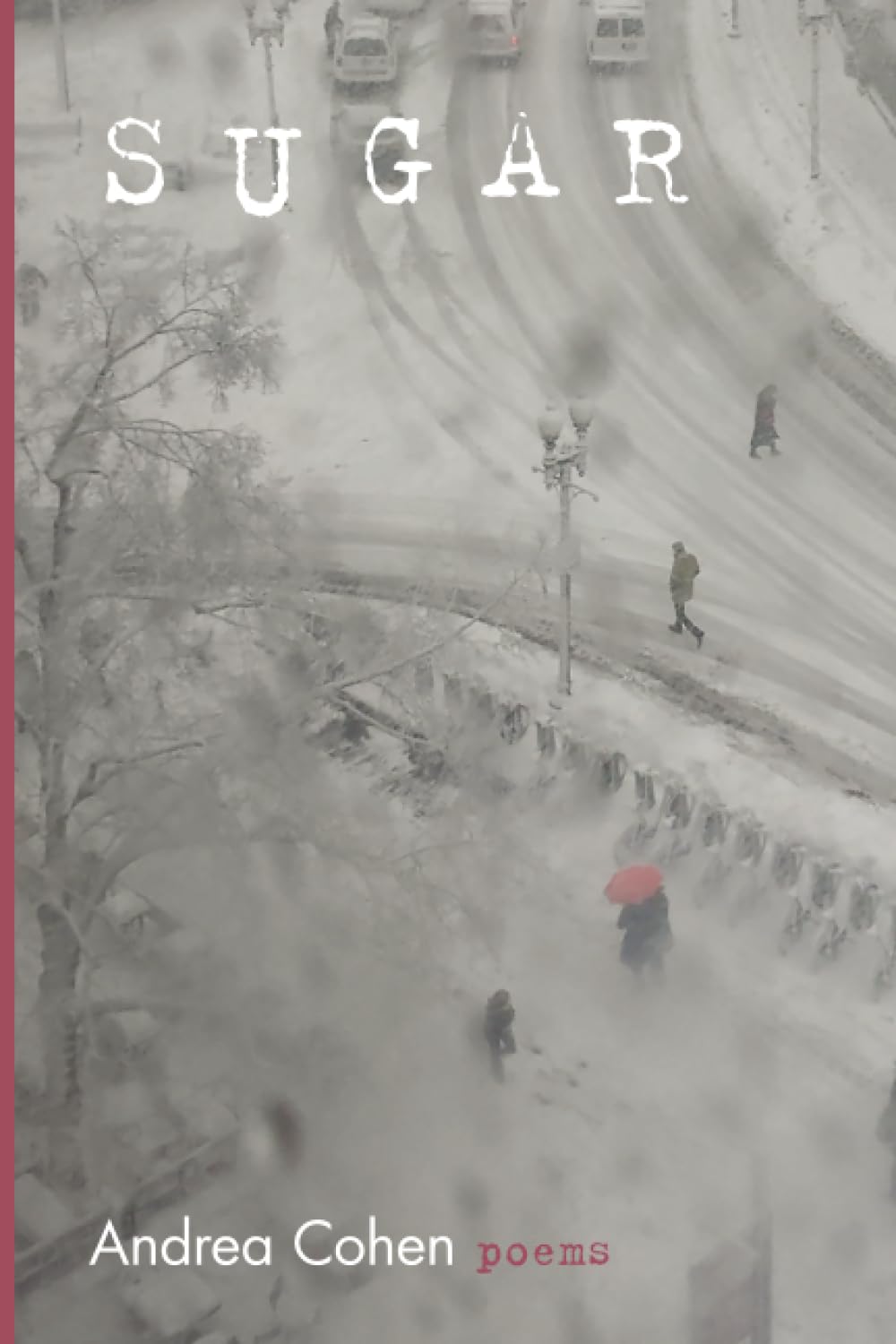



In her ninth collection of poetry, Andrea Cohen returns with her patent precision, wry wisdom, and all-encompassing lyrics, where each image seems both small and mammoth, able to identify magic in the mundane and to see beyond it to the broader picture. Take, for example, the titular poem, in which the speaker insists that she was present for an anecdote her friend has relayed to her as if it happened to someone else. She insists, making her case by presenting details, like how "from some hidden speaker / Lady Day [was] singing Sugar / I never maybe my sugar— / maybe as an action item— / imagine—"... Cohen's closing line is brutally beautiful, encapsulating a life philosophy as much as it represents the last word in this argument: "and if I never was / here please please don’t tell me." Perhaps the great irony of Andrea Cohen’s work is that the economy of her poems, their spare construction, is what makes them capacious enough to hold the magnitude of this fundamental paradox: life is too severe to sugarcoat, and yet, in the end, we crave the complex flavor of this particular mess, the singular experience of its bite and sweetness. Our bodies are brief windows through which we can experience the world, and, in Sugar , Cohen reminds us that we find wonder in what we cannot fathom precisely because we cannot control it: “You can’t climb / on top and call // yourself conqueror, / or straddling, whip // love into submission. / Love wanders from sky // to sky — [...] // a kind of glowing / twilight makes / before it tires / of one place.” These poems enjoin us to make of our lives a spectacular place for love to retire, for evening to come, for the aftertaste of dark honey to linger. Past Praise "If Andrea Cohen’s poems sometimes feel like they are whispering in your ear long after you have read them, it’s because these aren’t just poems. Cohen has found a way to make spells out of glimpses of the world. But these are poems that don’t take themselves too seriously, but rather, in a playful manner, reveal the world via half-breaths, with rhymes that spark or ring in the ear-becoming a tune to follow, a tune to live by." ―Ilya Kaminsky "These poems are not fancy; they are true, and if there’s higher praise one can give, I’m not sure. There’s a joyful sort of darkness at play, an awareness of the abyss on all sides, and a here-we-are-in-this-absurdity sense of luck and wildness…These poems, with warmth and force, show how we get purchase on our days." ―Nina MacLaughlin in the Boston Globe "Cohen offers high-flying pleasures that transform the sorrows of memory, family, and failed love into the winged perceptions of a particularly charming and vigilant poet." ―David Woo in LitHub Andrea Cohen's poems have appeared in The New Yorker , The New York Review of Books , The Threepenny Review , The New Republic , The Atlantic Monthly , and elsewhere. She is the author of nine poetry collections, including Sugar , The Sorrow Apartments , Everything , Nightshade , Unfathoming , Furs Not Mine , Kentucky Derby , Long Division , and The Cartographer's Vacation . Awards include a Guggenheim Fellowship and several residencies at MacDowell. She directs the Blacksmith House Poetry Series in Cambridge, MA. Bell It was a small dinner bell. It was silver and she rang it whenever she was hungry for the memory of someone coming.