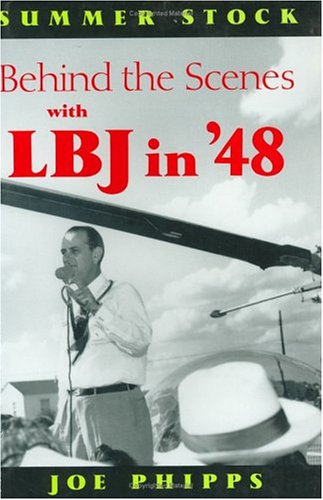
Summer Stock: Behind the Scenes with LBJ in '48 (A. M. Pate, Jr. Series on the American Presidency) (Volume 3)
$21.26
by Joe Phipps



In the summer of 1941, Congressman Lyndon Baines Johnson ran for the U.S. Senate in a special election. He lost. It was the only political race LBJ ever lost, and he always claimed that W. Lee "Pappy" O'Daniel had stolen the office from him. In the summer of 1948, Johnson ran again for the Senate. This time his chief opponent in the Democratic primaries was former Texas Governor Coke Stevenson. After much counting and recounting of ballots, Johnson was declared the winner of the runoff, or second primary, by just eighty-seven votes out of millions cast, votes that Stevenson claimed Johnson bought in deep South Texas - the stomping grounds of George Parr, "the Duke of Duval County." Joe Phipps signed on as a volunteer player in this summer stock production, taking a role as general aide and "go-fer" for the Congressman. Then a young World War II veteran with experience in radio broadcasting, Phipps did not imagine that he would assume a major part in an election that would change not only the face of Texas politics but the way campaigners were promoted then and the way campaigns would be prosecuted in the future. Not only were the short radio broadcasts Phipps produced innovative, but Johnson's method of campaigning was new to voters. Rather than concentrate on urban areas, Johnson acquired a helicopter - an exotic new flying object at the time - and took his message to people all across Texas. It may well have been the votes garnered by LBJ in the rural counties that kept him in the race and eventually sent him to the United States Senate. Much of the drama of the summer of '48 is well known and has been told many times by political historians and Johnson biographers. Unlike previous writers, however, Joe Phipps was there for most of the hectic campaign, working closely with Lyndon Johnson, the consummate politician - complex and contradictory, yet a simple man - on a daily basis as aide and confidant. Phipps sat in radio studios with the candidate, flew in the helicopter on the stump, met with the Congressman in Johnson's home at Austin, and confided with him in hotel rooms on the road. Joe Phipps' narrative graphically exposes the human side of the pivotal events of the summer of '48. Lyndon Johnson's controversial campaign for the U.S. Senate in 1948 has been meticulously dissected by Robert Caro in The Years of Lyndon Johnson: Means of Ascent ( LJ 4/15/90), reexamined by Robert Dallek in Lone Star Rising: Lyndon Johnson and His Times, 1908-1960 (a "Best Book of 1991," LJ 1/92), and is now the focal point of this lively, intimate political memoir. Phipps, a broadcaster and journalist, was first recruited by Johnson in 1945 to run his Texas radio station. He relucantly served in the Senate campaign as an advance man, publicist, and confidante. His memoir is both a defense of LBJ as a shrewd and caring politician and an inside look at the unique world of Texas politics. The flavor and excitement of the campaign is laced with LBJ's earthy language and dominated by his larger-than-life presence. Phipps's own political coming of age is an appealing subplot to the main political drama. In spite of Phipps's rather blatant biases, this will be a useful complement to the major biographies of Johnson. Appropriate for both academic and public libraries. - Thomas A. Karel, Franklin & Marshall Coll. Lib., Lancaster, Pa. Copyright 1992 Reed Business Information, Inc. In the summer of 1941, Congressman Lyndon Baines Johnson ran for the U.S. Senate in a special election. He lost. It was the only political race LBJ ever lost, and he always claimed that W. Lee "Pappy" O'Daniel had stolen the office from him. In the summer of 1948, Johnson ran again for the Senate. This time his chief opponent in the Democratic primaries was former Texas Governor Coke Stevenson. After much counting and recounting of ballots, Johnson was declared the winner of the runoff, or second primary, by just eighty-seven votes out of millions cast, votes that Stevenson claimed Johnson bought in deep South Texas - the stomping grounds of George Parr, "the Duke of Duval County". Joe Phipps signed on as a volunteer player in this summer stock production, taking a role as general aide and "go-fer" for the Congressman. Then a young World War II veteran with experience in radio broadcasting, Phipps did not imagine that he would assume a major part in an election that would change not only the face of Texas politics but the way campaigners were promoted then and the way campaigns would be prosecuted in the future. Not only were the short radio broadcasts Phipps produced innovative, but Johnson's method of campaigning was new to voters. Rather than concentrate on urban areas, Johnson acquired a helicopter - an exotic new flying object at the time - and took his message to people all across Texas. It may well have been the votes garnered by LBJ in the rural counties that kept him in the race and eventually sent him to the United States Senate. Much of the d