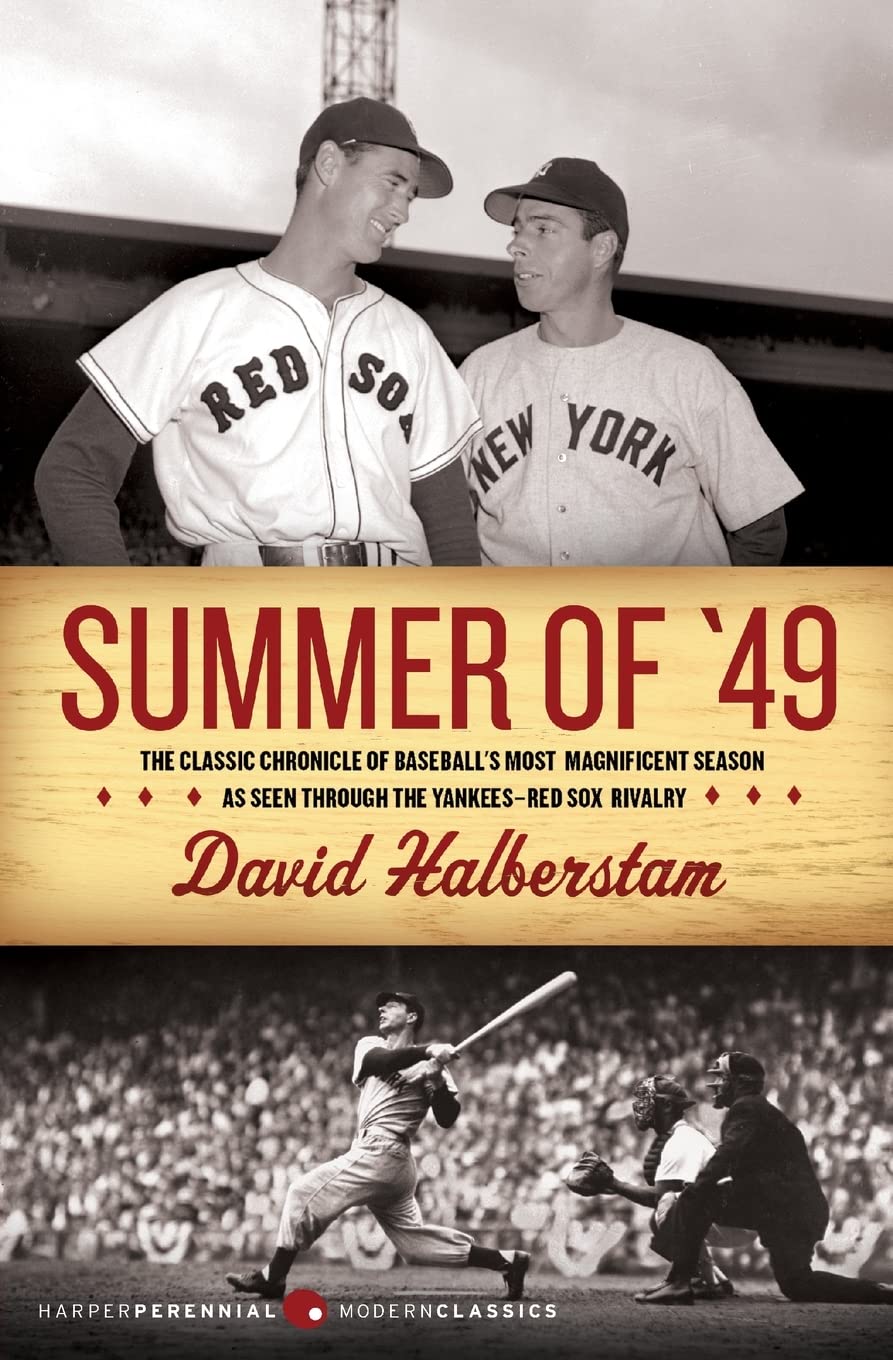
Summer of '49: The Classic Chronicle of the Mythic 1949 Yankees-Red Sox Rivalry Between DiMaggio and Williams (Harper Perennial Modern Classics)
$10.69
by David Halberstam



“Dazzling…A celebration of a vanished heroic age and a ‘simpler America’ ” — New York Times Book Review David Halberstam’s classic chronicle of baseball’s most magnificent season, as seen through the battle royal between Joe DiMaggio’s Yankees and Ted Williams’s Red Sox for the hearts of a nation. The year was 1949, and a war-wearied nation turned from the battlefields to the ball fields in search of new heroes. It was a summer that marked the beginning of a sports rivalry unequaled in the annals of athletic competition. The awesome New York Yankees and the indomitable Boston Red Sox were fighting for supremacy of baseball’s American League and an aging Joe DiMaggio and a brash, headstrong hitting phenomenon named Ted Williams led their respective teams in a classic pennant duel of almost mythic proportions—one that would be decided in an explosive head-to-head confrontation on the last day of the season. With incredible skill, passion and insight, Pulitzer Prize-winning author David Halberstam returns us to that miraculous summer—and to a glorious time when the dreams of a now almost forgotten America rested on the crack of a bat. “Hits one out of the park...The pages should go on forever!” - Boston Herald With incredible skill, passion, and insight, Pulitzer Prize–winningauthor David Halberstam returns us to a glorious time when the dreams of a now almost forgotten America rested on the crack of a bat. The year was 1949, and a war-weary nation turned from the battlefields to the ball fields in search of new heroes. It was a summer that marked the beginning of a sports rivalry unequaled in the annals of athletic competition. The awesome New York Yankees and the indomitable Boston Red Sox were fighting for supremacy of baseball's American League, and an aging Joe DiMaggio and a brash, headstrong hitting phenomenon named Ted Williams led their respective teams in a classic pennant duel of almost mythic proportions—one that would be decided in an explosive head-to-head confrontation on the last day of the season. David Halberstam was one of America's most distinguished journalists and historians. He covered the beginnings of the Civil Rights movement and reported for the New York Times on the war in Vietnam. The author of fifteen bestsellers, he won the Pulitzer Prize for his Vietnam reporting. He was killed in a car accident on April 23, 2007, while on his way to an interview for what was to be his next book. Summer of '49 By David Halberstam HarperCollins Publishers, Inc. Copyright © 2006 David Halberstam All right reserved. ISBN: 0060884266 Chapter One In the years immediately following World War II, professional baseball mesmerized the American people as it never had before and never would again. Baseball, more than almost anything else, seemed to symbolize normalcy and a return to life in America as it had been before Pearl Harbor. The nation clearly hungered for that. When Bob Feller returned from the navy to pitch in late August 1945, a Cleveland paper headlined the event: THIS IS WHAT WE'VE BEEN WAITING FOR. All the prewar stars were returning to action -- DiMaggio, Williams, Feller, and Stan Musial -- and their very names seemed to indicate that America could pick up right where it had left off. They were replacing wartime players of lesser quality. Indeed, a player named George (Cat) Metkovich spoke for many of the wartime players when he told his Boston teammates at the end of the 1945 season, "Well, boys, better take a good took around you, because most of us won't be here next year." The crowds were extraordinary-large, enthusiastic, and, compared with those that were soon to follow, well behaved. In the prewar years the Yankees, whose teams had included Ruth, Gehrig, and DiMaggio, claimed that they drew 1 million fans at home each season. In fact, they had not drawn that well. The real home attendance was more likely to have been around 800,000. After the war the crowds literally doubled. In 1941, the last year of prewar baseball, the National League drew 4.7 million fans; by 1947 the figure had grown to 10.4 million. In the postwar years the Yankees alone drew more than 2 million fans per season at home. Nor was it just numbers. There was a special intensity to the crowds in those days. When the Red Sox played the Yankees in the Stadium, they traveled to New York by train, passing through Massachusetts, Rhode Island, and Connecticut. Everyone seemed to know the schedule of their train, and as it passed through endless small towns along the route, there would be large crowds gathered at the stations to cheer the players, many of the people holding up signs exhorting their heroes to destroy the hated Yankees. The conductor would deliberately slow the train down and many of the players, on their way to do battle with the sworn enemy, would come out on the observation decks to wave to the crowds. Near the end of the 1946 season, a young Red Sox pitcher named Dave Fer