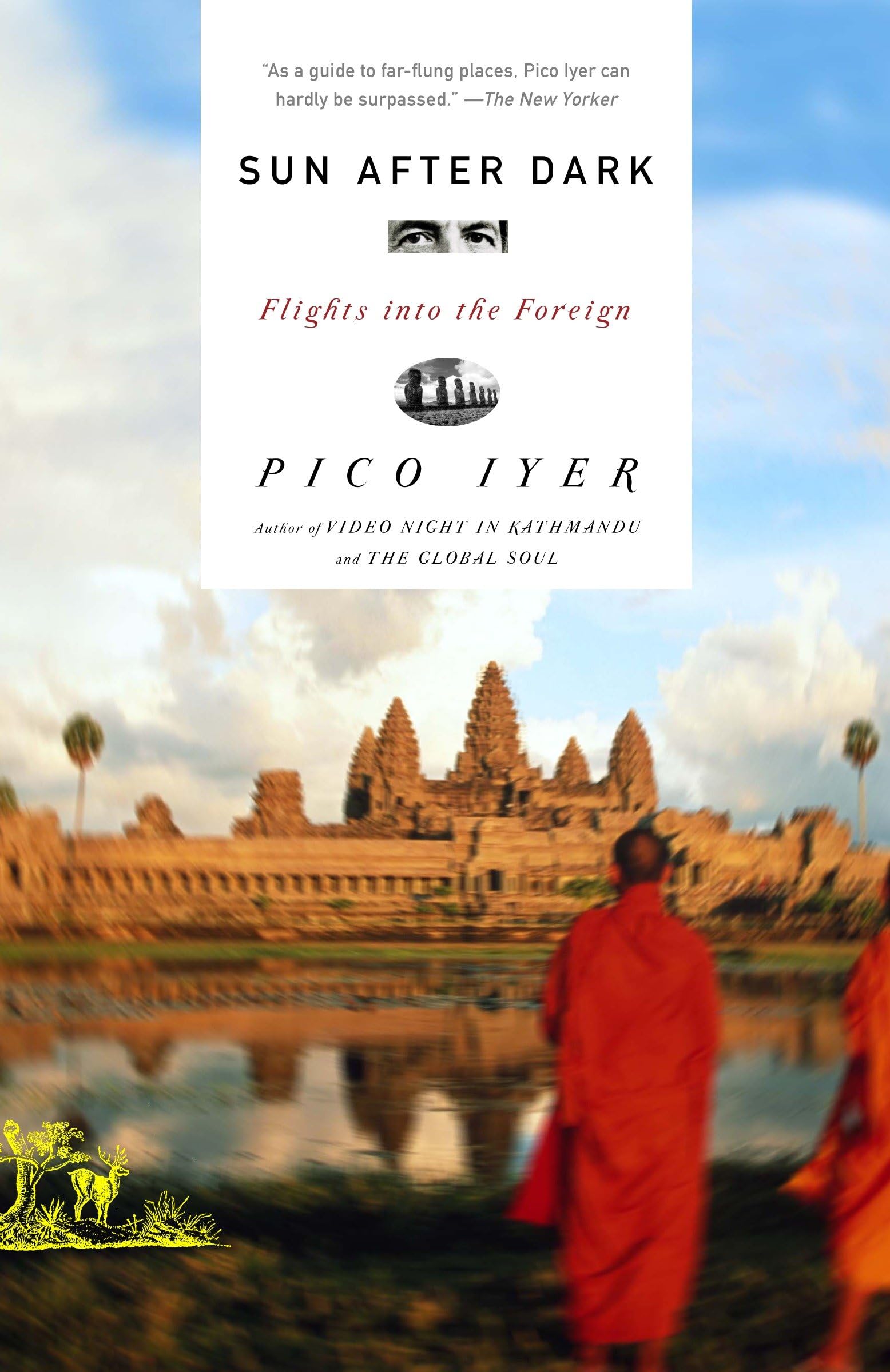



One of the best travel writers now at work in the English language brings back the sights and sounds from a dozen different frontiers. A cryptic encounter in the perfumed darkness of Bali; a tour of a Bolivian prison, conducted by an enterprising inmate; a nightmarish taxi ride across southern Yemen, where the men with guns may be customs inspectors or revolutionaries–these are just three of the stops on Pico Iyer’s latest itinerary. But the true subject of Sun After Dark is the dislocations of the mind in transit. And so Iyer takes us along to meditate with Leonard Cohen and talk geopolitics with the Dalai Lama. He navigates the Magritte-like landscape of jet lag, “a place that no human had ever been until forty or so years ago.” And on every page of this poetic and provocative book, he compels us to redraw our map of the world. “As a guide to far-flung places, Pico Iyer can hardly be surpassed.” – The New Yorker “If Iyer is only a travel writer, then so was Henry James.” –Los Angeles Times “Iyer brings . . . startling freshness to his accounts of travel. . . . Ranks as one of Iyer's best books.” –The Seattle Times “Pico Iyer’s remarkable talent is enough justification for going anywhere in the world he fancies.” – Washington Post Book World “Brilliant . . . [Iyer] reflects back at us images from a post-colonial world that is gorgeously complex and stubbornly elusive, yet firmly within his grasp.” – New York Times "Pico Iyer is among the finest travel writers of his generation." – Time “Iyer travels to places that many of us have never been to, and may never go to. . . . Iyer writes beautifully, and I was happy to follow wherever his wanderings (physical and spiritual) led.” – San Francisco Chronicle “Pico Iyer is a writer like no other, sui generis, and in this book his particular gifts of thoughtfulness, perception and descriptive power, allied by now with profound experience, reach new levels of grace.” –Jan Morris “Jan Morris has retired; Graham Greene is dead. Pico Iyer is on his way to replacing them... Leave your guidebook behind. Go follow Iyer.” – National Geographic Adventure “Iyer is an exceptional travel writer, who not only limns Peruvian street maps with clarity and wit, but also offers a compelling rationale for immersing yourself in a foreign environment.” – Gotham “Iyer is a master of the ironic detail, and in these pieces he is able to notice the very objects whose juxtaposition will nail shut the lid of his beautifully constructed metaphorical box. . . . Goes where most of us will not go and returns with the dire details.” – Kirkus Reviews “Hallucinatory and observant, this little book confirms Iyer as one of the most gifted wanderers writing today.” – Seattle Weekly “Mr. Iyer writes with remarkable grace. . . . He is not only wonderful company but will take you on journeys–of place, heart and spirit–you perhaps had not dared imagine.” – Santa Barbara News-Press “The world’s best travel writer.” – The Oregonian One of the best travel writers now at work in the English language brings back the sights and sounds from a dozen different frontiers. A cryptic encounter in the perfumed darkness of Bali; a tour of a Bolivian prison, conducted by an enterprising inmate; a nightmarish taxi ride across southern Yemen, where the men with guns may be customs inspectors or revolutionaries-these are just three of the stops on Pico Iyer's latest itinerary. But the true subject of Sun After Dark is the dislocations of the mind in transit. And so Iyer takes us along to meditate with Leonard Cohen and talk geopolitics with the Dalai Lama. He navigates the Magritte-like landscape of jet lag, "a place that no human had ever been until forty or so years ago." And on every page of this poetic and provocative book, he compels us to redraw our map of the world. Pico Iyer is the author of several books about cultures converging, including Video Night in Kathmandu , The Lady and the Monk , The Global Soul , and, most recently, Abandon . His articles appear often in such magazines as Harper’s, Time, and the New York Review of Books . He lives in suburban Japan. THE PLACE ACROSS THE MOUNTAINS One midsummer evening in La Paz, just before New Year's Eve, I went out into the dark to find a taxi to take me to the modern suburbs. I hadn't slept--or not slept--for many days, it seemed, and so, not quite myself, I hailed a cab and told the driver to take me to a Mexican restaurant I had read about, down in the warm valley to the south. We followed the curves of a mountain road, and came very soon to a darkened grid of long, straight streets, stretching in every direction. I repeated the address of the place to the driver, but Indian names are hard to make out for a foreigner, and soon, very soon, we were lost. Security guards watched us from their posts, outside the villas of the rich; every last detail seemed picked out in the lunar quiet. Up above, in the commotion of the Indian