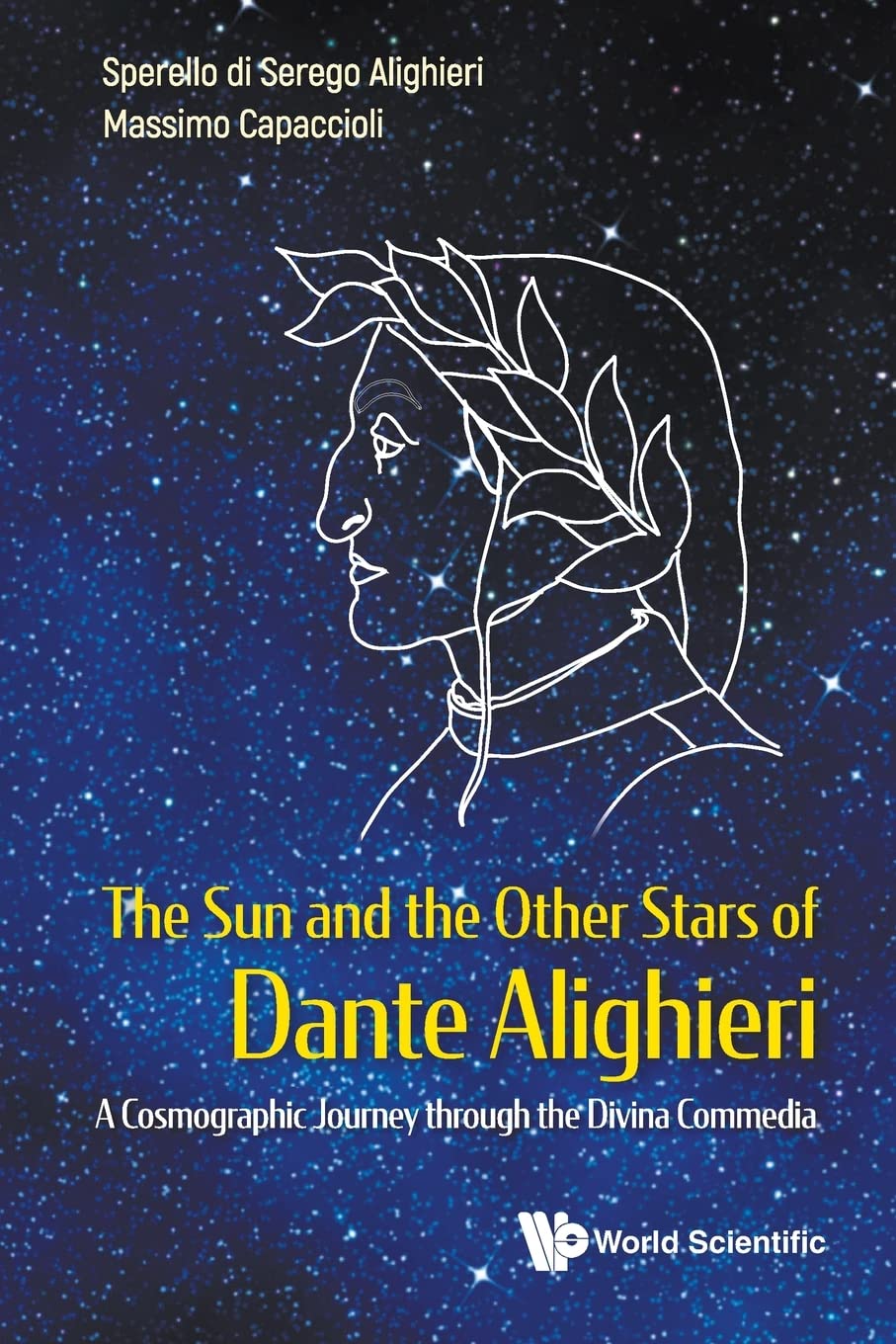
Sun And The Other Stars Of Dante Alighieri, The: A Cosmographic Journey Through The Divina Commedia
$27.60
by Sperello Di Serego Alighieri



The Divine Comedy by Dante Alighieri is the story of a journey across the Universe as it was known in the Middle Ages, a work of science fiction ante litteram. Dante had an encyclopedic mind, no doubt, and his poem is the most widely read book after the Bible. He was a master of the astronomical knowledge of his time, and used astronomy in his work to indicate places, to measure time, and to exemplify beauty. Indeed, in the Convivio, he wrote that science is "the ultimate perfection of our soul" and "astronomy — more than any other science — is noble and high for a noble and high subject." We propose a reading of the Divine Comedy through astronomy with a journey starting from the Earth, proceeding to the Moon, the planets, and to the outermost edges of the Universe. The way in which Dante connects ancient astronomy with modern conceptions of the cosmos will astonish readers more than 700 years later. Sperello di Serego Alighieri is an astrophysicists and a descendant of Dante Alighieri (19th generation after the poet). He worked at the Observatories of Padova and Arcetri (Firenze) on extragalactic astronomical research (normal and active galaxies, galaxy evolution, and cosmology) and on the development of astronomical instrumentation. He also worked for ESA at ESTEC in the Netherlands. He built the prototype of the instrument (Faint Object Camera) which allowed ESA to be a partner of NASA for the Hubble Space Telescope (HST). Also for ESA he worked as HST Instrument Scientist at the Space Telescope European Coordinating Facility in Garching bei Muenchen, Germany. He is the founder and first Director of the Centro Galileo Galilei for the Italian telescope TNG on the Canary Island of La Palma. In recent years he has worked on astronomy in Dante's Divina Commedia and on science communication, with conferences on the connection between astronomy and other sciences and arts. He has authored more than 300 scientific papers published in international journals. Massimo Capaccioli has served as professor of astronomy at the Universities of Padua and then of Naples Federico II, where he is currently emeritus. He has investigated the dynamics and evolution of stellar systems and the observational cosmology and published over 550 scientific articles in international journals (citations 13,055, H-index 57: source ADS Jan 2021). As a long-time director of the Capodimonte Astronomical Observatory in Naples, he has conceived and managed, in synergy with the European Southern Observatory (ESO), the construction of the VLT Survey Telescope (VST), one of the largest reflectors fully dedicated to astronomical surveys. He has chaired the Italian Astronomical Society (SAIt) for a decade and for a three-year turn the National Society of Sciences, Letters, and Arts in Naples. Journalist and passionate publicist, he has collaborated with various Italian newspapers and with the national public broadcasting company of Italy (RAI). He has authored both university textbooks and popular books (mostly in Italian), including: Arminio Nobile and the Measurement of the Sky (Springer 2012, with S Galano), Mille1Notte. Stories from the other world (Mediterranean 2018), Red Moon. The Soviet conquest of space (Carocci 2019), and The Enchantment of Urania: 25 centuries of explorations of the sky (Carocci 2020). The list of his honors includes the title of Commander of the Italian Republic for scientific merits (2005), the honorary professorship granted by the University of Moscow Lomonosov in 2010, the honorary doctorate by the Universities of Dubna (Russia, 2015), Kharkiv (Ukraine, 2017), and Pyatigorsk (Russia, 2019), and the medals Struve (2010; Russian Academy of Sciences), Tacchini (2013; SAIt), Karazin (2019; Karazin University, Kharkiv, Ukraine), and Gamov (2019: University of Odessa, Ukraine). He is a member of some academies in Italy and of the Academia Europaea.