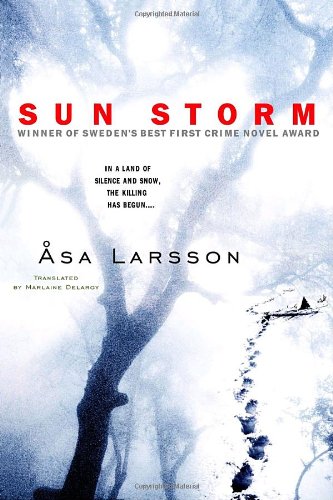



On the floor of a church in northern Sweden, the body of a man lies mutilated and defiled–and in the night sky, the aurora borealis dances as the snow begins to fall....So begins Åsa Larsson’s spellbinding thriller, winner of Sweden’s Best First Crime Novel Award and an international literary sensation. Rebecka Martinsson is heading home to Kiruna, the town she’d left in disgrace years before. A Stockholm attorney, Rebecka has a good reason to return: her friend Sanna, whose brother has been horrifically murdered in the revivalist church his charisma helped create. Beautiful and fragile, Sanna needs someone like Rebecka to remove the shadow of guilt that is engulfing her, to forestall an ambitious prosecutor and a dogged policewoman. But to help her friend, and to find the real killer of a man she once adored and is now not sure she ever knew, Rebecka must relive the darkness she left behind in Kiruna, delve into a sordid conspiracy of deceit, and confront a killer whose motives are dark, wrenching, and impossible to guess.... The Swedish invasion continues with this sure-handed thriller from a talented first novelist. Rebecca Martinsson, an overworked junior member in a Stockholm law firm, comes from remote Kiruna in Sweden's far north, where she was involved with a fundamentalist church called The Strength of All Our Strength. Now a charismatic church leader has been brutally murdered. After receiving a call from the victim's sister, Sanna, Rebecca immediately returns to Kiruna and the craziness she thought she had escaped. It's a lot crazier now, she soon discovers, as Sanna is arrested for the murder, and Rebecca finds herself saddled with trying to prove her innocence and take care of her two young girls. Larsson builds suspense gradually but inexorably, and she is equally good at creating mood, using the frozen landscape and isolated location to evoke the icy inner lives of the church members and the building need for release. More like Ruth Rendell's psychological thrillers than the procedurals of Larsson's fellow Swedes (Mankell and Thursten, for example), this impressive debut nevertheless heralds yet another striking voice from Scandinavia. Bill Ott Copyright © American Library Association. All rights reserved "For those who eschew exotic travel in favor of the familiar hammock, there's nothing better than a well-written and well-translated story from some place you'll probably never visit. Sun Storm is that story and more."—grade, Rocky Mountain News "Impressive ... [A] sure-handed thriller from a talented first novelist."— Booklist Asa Larsson was born in Kiruna, Sweden, in 1966. She studied in Uppsala and lived for some years in Stockholm, but now prefers the rural life with her husband, two children and several chickens. A former tax lawyer, she now writes full time. Dell will publish her next novel, the award-winning The Blood Spilt , in Spring 2007. And evening came and morning came, the first day When Viktor Strandgård dies it is not, in fact, for the first time. He lies on his back in the church called The Source of All Our Strength and looks up through the enormous windows in its roof. It’s as if there is nothing between him and the dark winter sky up above. You can’t get any closer than this, he thinks. When you come to the church on the mountain at the end of the world, the sky will be so close that you can reach out and touch it. The Aurora Borealis twists and turns like a dragon in the night sky. Stars and planets are compelled to give way to her, this great miracle of shimmering light, as she makes her unhurried way across the vault of heaven. Viktor Strandgård follows her progress with his eyes. I wonder if she sings? he thinks. Like a lonely whale beneath the sea? And as if his thoughts have touched her, she stops for a second. Breaks her endless journey. Contemplates Viktor Strandgård with her cold winter eyes. Because he is as beautiful as an icon lying there, to tell the truth, with the dark blood like a halo round his long, fair, St. Lucia hair. He can’t feel his legs anymore. He is getting drowsy. There is no pain. Curiously enough it is his previous death he is thinking of as he lies there looking into the eye of the dragon. That time in the late winter when he came cycling down the long bank toward the crossroads at Adolf Hedinsvägen and Hjalmar Lundbohmsvägen. Happy and redeemed, his guitar on his back. He remembers how the wheels of his bicycle skidded helplessly on the ice as he tried desperately to brake. How he saw the woman in the red Fiat Uno coming from the right. How they stared at each other, the realization in the other’s eyes; now it’s happening, the icy slide toward death. With that picture in his mind’s eye Viktor Strandgård dies for the second time in his life. Footsteps approach, but he doesn’t hear them. His eyes do not have to see the gleam of the knife once again. His body lies like an empty shell on the floor of the church; it is