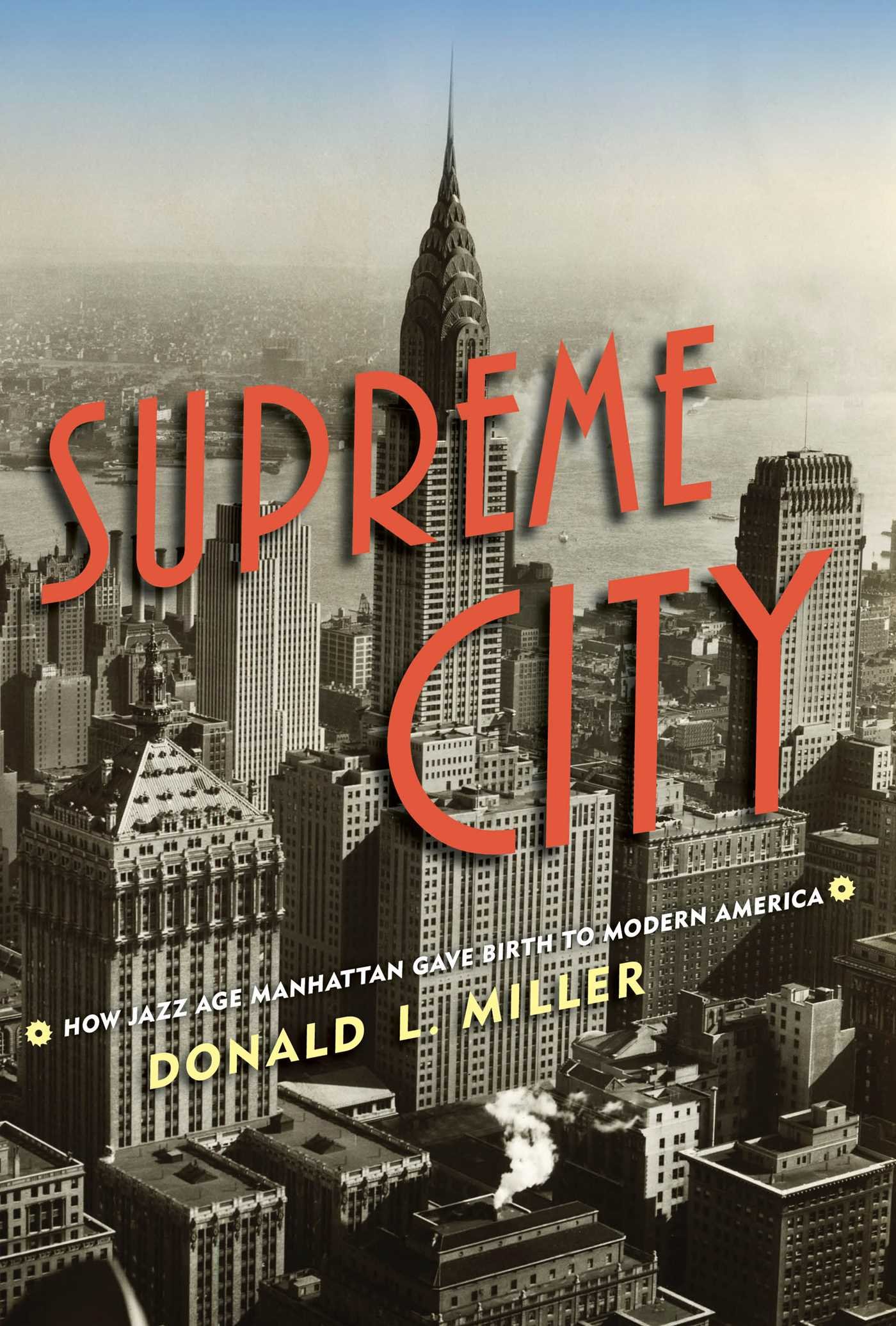
Supreme City: How Jazz Age Manhattan Gave Birth to Modern America
$28.23
by Donald L. Miller



While F. Scott Fitzgerald wrote, Manhattan was transformed by jazz, night clubs, radio, skyscrapers, movies, and the ferocious energy of the 1920s, as this illuminating cultural history brilliantly demonstrates. In four words—“the capital of everything”—Duke Ellington captured Manhattan during one of the most exciting and celebrated eras in our history: the Jazz Age. Radio, tabloid newspapers, and movies with sound appeared. The silver screen took over Times Square as Broadway became America's movie mecca. Tremendous new skyscrapers were built in Midtown in one of the greatest building booms in history. Supreme City is the story of Manhattan’s growth and transformation in the 1920s and the brilliant people behind it. Nearly all of the makers of modern Manhattan came from elsewhere: Walter Chrysler from the Kansas prairie; entertainment entrepreneur Florenz Ziegfeld from Chicago. William Paley, founder of the CBS radio network, was from Philadelphia, while his rival David Sarnoff, founder of NBC, was a Russian immigrant. Cosmetics queen Elizabeth Arden was Canadian and her rival, Helena Rubenstein, Polish. All of them had in common vaulting ambition and a desire to fulfill their dreams in New York. As mass communication emerged, the city moved from downtown to midtown through a series of engineering triumphs—Grand Central Terminal and the new and newly chic Park Avenue it created, the Holland Tunnel, and the modern skyscraper. In less than ten years Manhattan became the social, cultural, and commercial hub of the country. The 1920s was the Age of Jazz and the Age of Ambition. Original in concept, deeply researched, and utterly fascinating, Supreme City transports readers to that time and to the city which outsiders embraced, in E.B. White’s words, “with the intense excitement of first love.” *Starred Review* Miller dates the pivotal transformation of midtown Manhattan from the completion of Grand Central Terminal in 1913 and its direct impact on the area nearby, but he focuses on the next decade, during the colorful Prohibition Era mayoralty of Jimmy Walker. From 1921 to 1929, we learn, a building went up in New York, on average, every 51 minutes. Along with the construction came monumental cultural changes, described here in commensurate detail. In what amounts to a social history of an extraordinary place and time (though there is no attempt to explicitly demonstrate the premise of the subtitle), Miller offers portraits of outsized individuals who altered New York, most of them not native New Yorkers: architects, such as the Rumanian Jew, Emery Roth; media pioneers (David Sarnoff and William Paley); newspaper and book publishers (Horace Liveright, Richard Simon and Max Schuster, Bennett Cerf) , Broadway producers (Flo Ziegfeld), musicians (Duke Ellington); sports figures (Jack Dempsey, Babe Ruth), and successful merchants (Bergdorf and Goodman, Gimbel, et al.). He includes exceptional immigrant women: rival cosmetics giants Helena Rubenstein and Elizabeth Arden and designer Hattie Carnegie. Miller’s prose is workmanlike but his scope prodigious, even if the book’s focus blurs amidst the deluge of minutiae. Predominantly relying on previous publications, Miller usefully attaches a 50-page bibliography that, perhaps as much as the text itself, will become an essential resource for future historians. --Mark Levine "[An] entertaining new history of Manhattan in its modern heyday. . . . Accessible, romantic, sweeping and celebratory." -- Beverly Gage ― The New York Times Book Review “A great skyscraper of a book. Supreme City is the improbable story not just of America's greatest metropolis during the Jazz Age, but the biography of an epoch.” -- Rick Atkinson, author of The Guns at Last Light: The War in Europe, 1944-1945 “Sparkling. . . . The history of dozens of astonishing newcomers who — largely in one tumultuous decade, the 1920s — made New York into what Duke Ellington called the capital of everything. . . . Miller skillfully weaves these different and colorful strands into a narrative both coherent and vivacious. . . . The full story richly deserves his original synthesis and, for me, makes New York even more fascinating.” -- Robert MacNeil ― The Washington Post “Lower Manhattan dominated New York for three hundred years. In the 1920’s, however, as Donald L. Miller makes clear in a page-turning book with an astonishing cast of characters, Midtown became the beating heart of the metropolis. Supreme City is about how these few square miles at the center of a small island gave birth to modern America. If you love Gotham, you will love this book.” -- Kenneth T. Jackson, Barzun Professor of History, Columbia University; Editor-in-Chief, The Encyclopedia of New York City “Sweeping. . . . Enjoyable. . . . [In the 1920s] New York was the United States intensified, an electric vessel into which the hopes and desires of a nation were distilled. As Mr. Miller's vivid and exhaustive chronicle dem