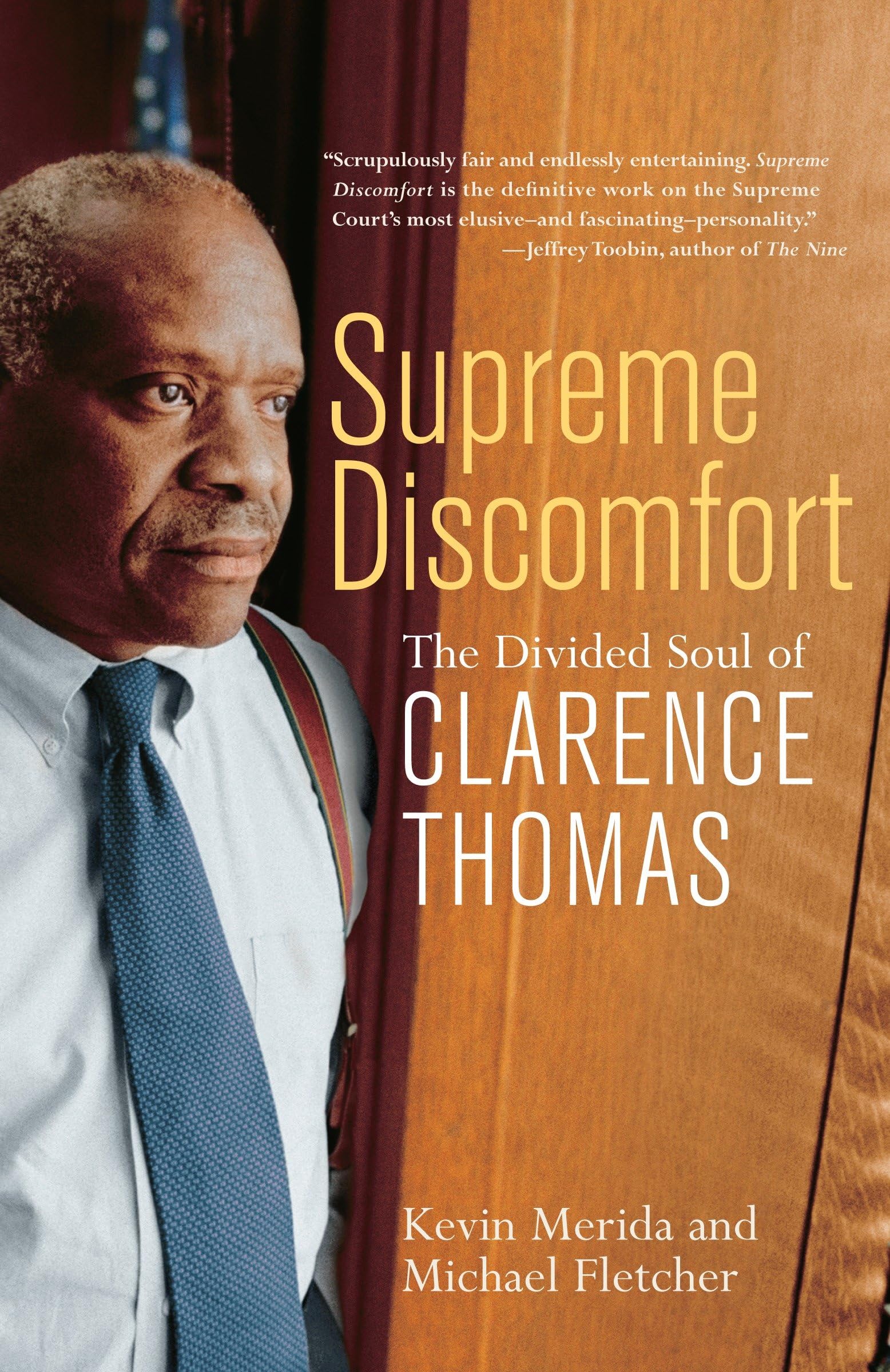



“[An] impeccably researched and probing biography . . . invaluable for any understanding of the court’s most controversial figure.”— The New York Times Book Review A sweeping, compelling portrait of Supreme Court justice Clarence Thomas and “an unflinching look at success and race in America” ( Kirkus Reviews , starred review), from two Washington Post journalists There is no more powerful, detested, misunderstood African American in our public life than Clarence Thomas. Supreme Discomfort is a haunting account of an isolated and complex man, savagely reviled by much of the Black community, not yet entirely comfortable in white society, internally wounded by his passage from a broken family and rural poverty in Georgia to elite educational institutions and finally to the pinnacle of judicial power. His staunchly conservative positions on crime, abortion, and, especially, affirmative action have exposed him to charges of heartlessness and hypocrisy. Supreme Discomfort is a superbly researched and reported work that features testimony from friends and foes alike who have never spoken in public about Thomas before—including a candid conversation with his fellow justice and ideological ally, Antonin Scalia. It offers a long-overdue window into a man who straddles two different worlds and is uneasy in both—and whose divided personality and conservative political philosophy will deeply influence American life for years to come. “The authors superbly deconstruct Thomas’s multiple narratives of critical life-events—the accounts vary depending on his audience—and it says much for their intellectual integrity that though they are clearly critical of their subject, their presentation allows readers to make their own judgments.” — New York Times Book Review “Clarence Thomas, even as the quiet justice, is a clanging symbol of politics and race in our time. I can’t think of two writers I’d rather have cut through the cacophony of the Thomas mythology than Kevin Merida and Michael A. Fletcher. In Supreme Discomfort , they have found the divided soul that divides a nation.” —David Maraniss, Pulitzer Prize–winning author of A Good American Family: The Red Scare and My Father “An engrossing biography of a conflicted man . . . [Merida and Fletcher] have done a superb job with this both harsh and sympathetic life of Clarence Thomas . . . an unflinching look at success and race in America.” — Kirkus Reviews (starred review) Kevin Merida is an associate editor at the Washington Post . He has been a national political reporter for the paper, a feature writer for its “Style” section, and a columnist for the Post ’s Sunday magazine. In 2000 he was named Journalist of the Year by the National Association of Black Journalists. Michael Fletcher covers the White House for the Washington Post , where he has been a reporter since 1995. He has previously covered education and race relations, chronicling issues including the racial achievement gap, racial profiling, criminal justice disparities, and the battle over the future of affirmative action. 1 COURTING VENOM Being Clarence Thomas Dallas attorney Eric Moye received his copy in the mail from a fellow Harvard Law School alum. He started reading it but stopped to make a copy of the copy for a friend. He continued reading, absorbed, enchanted, depressed, exhilarated. Couldn’t put it down—except to make more copies. It wasn’t a John Grisham thriller, but it might as well have been. “An Open Letter to Justice Clarence Thomas from a Federal Judicial Colleague” created an enormous buzz when the University of Pennsylvania Law Review published it in January 1992. Written by A. Leon Higginbotham Jr., chief judge emeritus of the U.S. Court of Appeals for the Third Circuit, it was part history lesson and part admonition. Crafted with scholarly precision, it contained eighty–five footnotes and numerous citations of important court cases. But the essence of it read like a stern grandfather lecturing his bullheaded grandson: Don’t forget the roots of your success, boy, and the responsibilities you have to those who paved your way . "You…must try to remember that the fundamental problems of the disadvantaged, women, minorities, and the powerless have not all been solved simply because you have ‘moved on up’ from Pin Point, Georgia, to the Supreme Court,” Higginbotham wrote in the conclusion of his twenty–four–page set of instructions to Thomas. Reciting a roster of notable names from the past, Higginbotham urged Thomas to see his life as connected to “the visions and struggles of Frederick Douglass, Sojourner Truth, Harriet Tubman, Charles Hamilton Houston, A. Philip Randolph, Mary McLeod Bethune, W. E. B. Du Bois, Roy Wilkins, Whitney Young, Martin Luther King, Judge William Henry Hastie, Justices Thurgood Marshall, Earl Warren, and William Brennan, as well as the thousands of others who dedicated much of their lives to create the America that made your o