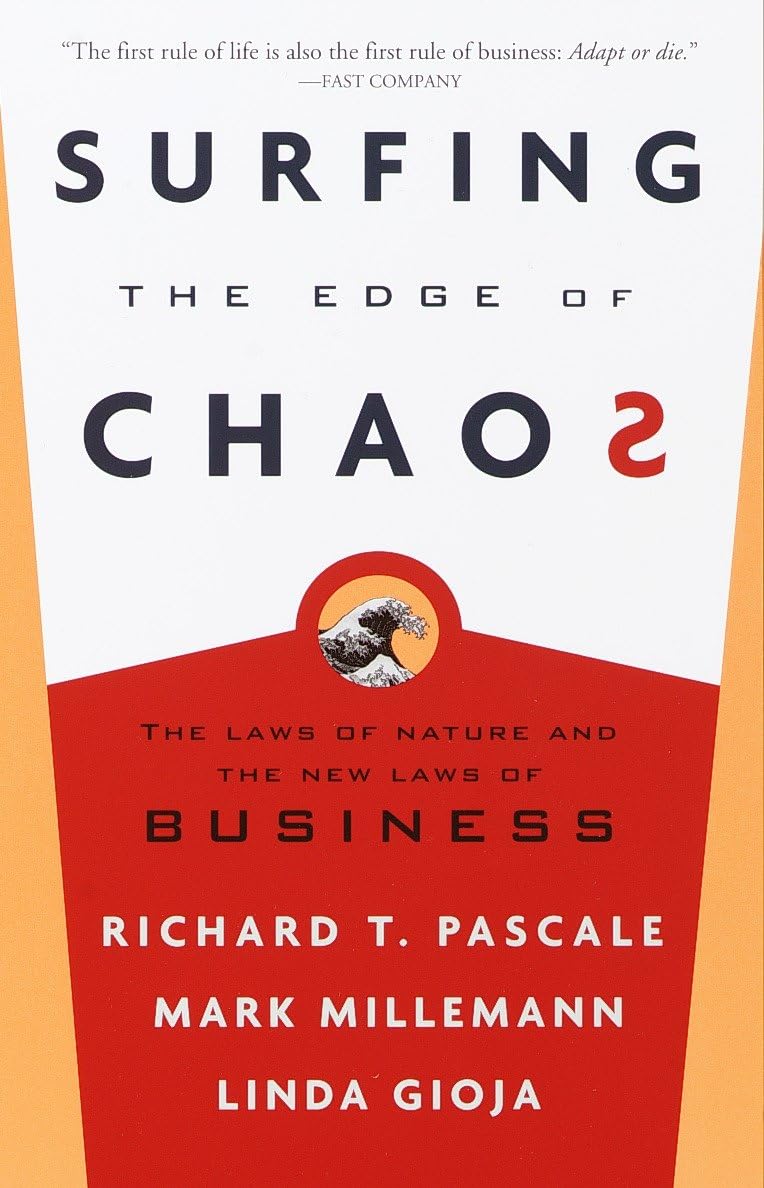
Surfing the Edge of Chaos: The Laws of Nature and the New Laws of Business
$13.14
by Richard Pascale



Surfing the Edge of Chaos is a brilliant, powerful, and practical book about the parallels between business and nature—two fields that feature nonstop battles between the forces of tradition and the forces of transformation. It offers a bold new way of thinking about and responding to the personal and strategic challenges everyone in business faces these days. “Great storytelling, experience-based insight, and effortless prose.” —Christopher Meyer, Director, The Cap Gemini Ernst & Young Center for Business Innovation, and coauthor of BLUR: The Speed of Change in the Connected Economy and Future Wealth “ Surfing the Edge of Chaos is a breakthrough book . . . rendering subtle and complex ideas into readable prose by refracting the ideas through the prism of real-life organizations. This book will be must reading for any serious executive or student of organizational change.” —Warren Bennis, University Professor and Founding Chairman of the Leadership Institute, University of Southern California, and author of Managing the Dream “ Surfing the Edge of Chaos is an action plan for bringing organizations to life and life to organizations.” —Prof. Gary Hamel, author of Leading the Revolution and coauthor of Competing for the Future; Visiting Professor, London Business School; and Chairman of Strategos “Grounded in both theory and practice, Surfing the Edge of Chaos helps any manager facing change to replace equilibrium and the status quo with innovation and self-renewal. The links drawn between the world of nature and the world of business form a particularly rich source of ideas for turning complexity and chaos into resolve and results.” —Dave Ulrich, Professor of Business, University of Michigan, and author of Results-Based Leadership “Great storytelling, experience-based insight, and effortless prose.” —Christopher Meyer, Director, The Cap Gemini Ernst & Young Center for Business Innovation, and coauthor of BLUR: The Speed of Change in the Connected Economy and Future Wealth “ Surfing the Edge of Chaos is a breakthrough book . . . rendering subtle and complex ideas into readable prose by refracting the ideas through the prism of real-life organizations. This book will be must reading for any serious executive or student of organizational change.” —Warren Bennis, University Professor and Founding Chairman of the Leadership Institute, University of Southern California, and author of Managing the Dream “ Surfing the Edge of Chaos is an action plan for bringing organizations to life and life to organizations.” —Prof. Gary Hamel, author of Leading the Revolution and coauthor of Competing for the Future; Visiting Professor, London Business School; and Chairman of Strategos “Grounded in both theory and practice, Surfing the Edge of Chaos helps any manager facing change to replace equilibrium and the status quo with innovation and self-renewal. The links drawn between the world of nature and the world of business form a particularly rich source of ideas for turning complexity and chaos into resolve and results.” —Dave Ulrich, Professor of Business, University of Michigan, and author of Results-Based Leadership Richard T. Pascale is the coauthor of The Art of Japanese Management and author of Managing on the Edge . He has also written for the Harvard Business Review . Mark Millemann has extensive experience working with CEOs and executive teams of companies around the world, including Sears, Hughes Space and Communications, BP Oil, Borg Warner Automotive, and the Illinois Power Company. Linda Gioja has consulted with CEOs and executives at such companies as Allstate, Sears, and Hughes Space and Communications. Of Colonies and Companies Rapid rates of change, an explosion of new insights from the life sciences, and the insufficiency of the machine model have created a critical mass for a revolution in management thinking. The fallout of the scientific renaissance has fostered uncertainty and soul-searching. Executives ask: How do we make practical sense of all this? How do we get the change and performance we need? Clues, it turns out, are to be found in the world of the termite. Come with us to a remarkable structure: the twelve-foot-high mound of the African termite, home to millions of inhabitants. The mound is an architectural marvel. Naturalist Richard Conniff has described its perfect arches, spiral staircases, nurseries, storage facilities, and living quarters that vary with the status of individual termites. Tunnels radiate out from the mound more than 160 feet in any direction. These structures enable the termites to forage for grass, wood, and water within an 80,000-square-foot area without being exposed to predators. Within the mound, a ventilation system--operated by opening and closing vents--creates a motion similar to respiration. Oxygen is "inhaled" into the twelve-foot tower of mud, and carbon dioxide is "exhaled." The system also holds the internal temper