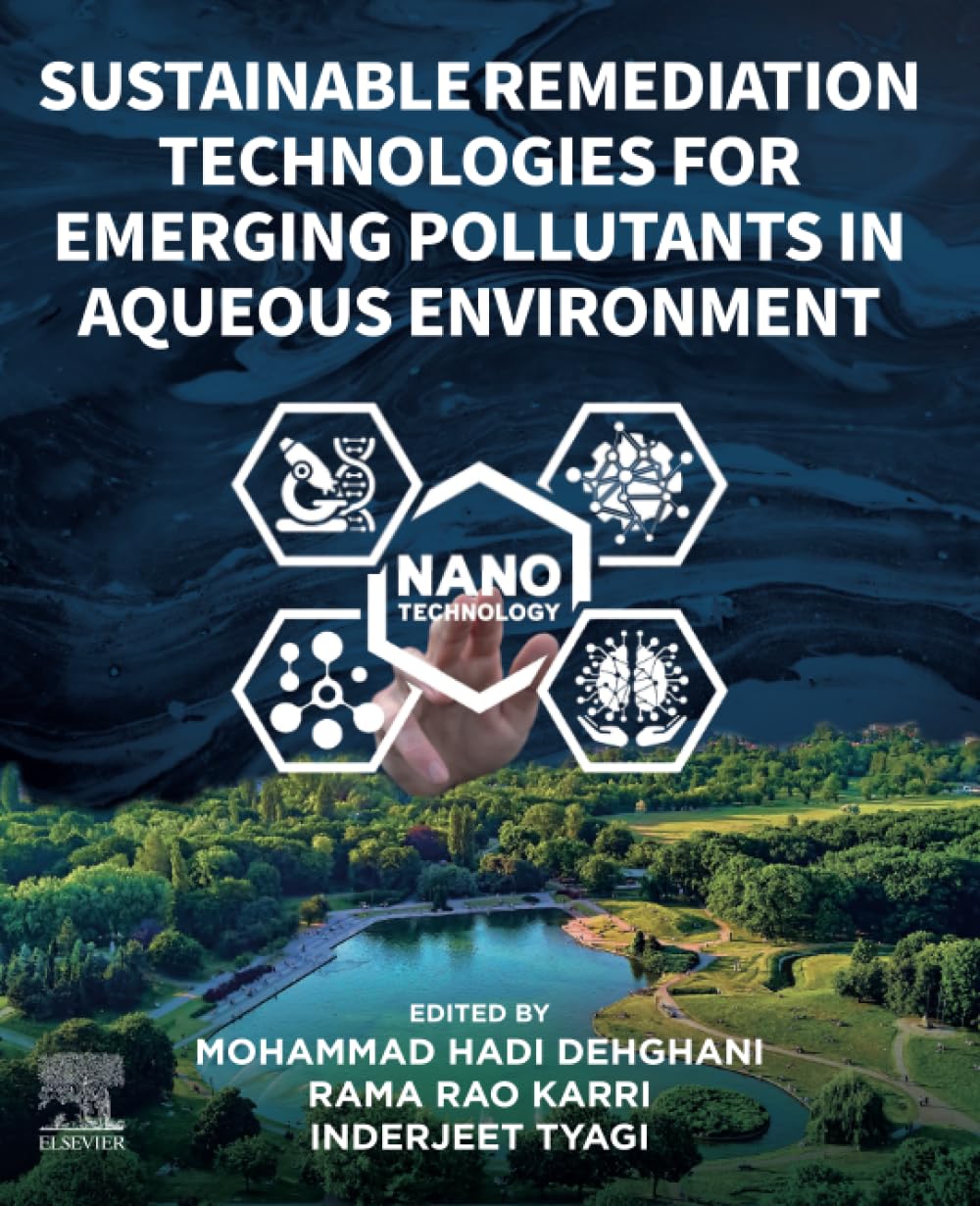
Sustainable Remediation Technologies for Emerging Pollutants in Aqueous Environment
$230.00
by Mohammad Hadi Dehghani PhD



Sustainable Technologies for Remediation of Emerging Pollutants from Aqueous Environment compiles and collates advanced technologies for the purification of water and wastewater. The book covers the biological purification of wastewater, the use of adsorbents for decontamination of water, the role of membrane technology and its composites for removing emerging pollutants, and applications of advanced oxidation processes (AOP) for removal of emerging pollutants. This resource provides a single source solution to academicians and young researchers by assembling the latest information on the application of the conventional and non-conventional in water and wastewater purification. Presents global impacts of pollutants in the water environment, including organic pollutants, inorganic pollutants and biological contamination - Compares removal mechanisms of emerging pollutants by different purification technologies - Applies conventional and non-conventional techniques to water and wastewater purification processes Single source reference with the latest information on applications of both conventional and non-conventional approaches to water and wastewater purification Sustainable Technologies for Remediation of Emerging Pollutants from Aqueous Environment compiles and collates several advanced technologies for purification of water and wastewater. The book covers biological purification of wastewater, the use of adsorbents for decontamination of water, the role of membrane technology and its composites for removing emerging pollutants, and application of advanced oxidation processes (AOP) for removal of emerging pollutants. It provides a single source solution to academician’s, and young researchers with latest information about the application of the conventional and non-conventional in water and wastewater purification. Prof. Dr. Mohammad Hadi Dehghani is a full professor at the Tehran University of Medical Sciences (TUMS), School of Public Health, Department of Environmental Health Engineering, Tehran, Islamic Republic of Iran. His scientific research interests include environmental science. He is the author of various research studies published in national and international journals and conference proceedings and head of several research projects at the TUMS. He has authored 20 books, 26 book chapters and more than 270 full papers published in peer-reviewed journals. He is an editorial board member, guest editor, and reviewer in many internal and international journals and a member of several international science committees worldwide. He also has the distinction of being listed in the top 2% of the world’s most influential scientists in the area of environmental sciences. He is a supervisor and advisor for many PhD and MSc theses at the TUMS. He is currently also a member of the Iranian Association of Environmental Health (IAEH) and member of the Institute for Environmental Research (IER) at the TUMS. He is an editor for 14 edited books (English): (1) Soft Computing Techniques in Solid Waste and Wastewater Management, (2) Environmental and Health Management of Novel Coronavirus Disease (COVID-19), (3) Green Technologies for the Defluoridation of Water, (4) Pesticide Remediation Technologies From Water and Wastewater, (5) COVID-19 and Sustainable Development Goals, (6) Industrial Wastewater Treatment: Emerging Technologies for Sustainability, (7) Sustainable Materials for Sensing and Remediation of Noxious Pollutants, (8) Wastewater-Based Epidemiology for the Assessment of Human Exposure to Environmental Pollutants, (9) Water Treatment Using Engineered Carbon Nanotubes, (10) Water, the Environment and the Sustainable Development Goals, (11) Sustainable Remediation Technologies for Emerging Pollutants in Aqueous Environment, (12) Health and Environmental Effects of Ambient Air Pollution, (13) Health Effects of Indoor Air Pollution, (14) Diseases Attributed to Air Pollution. Dr. Rama Rao Karri is a Professor (Sr. Asst) in the Faculty of Engineering, Universiti Teknologi Brunei, Brunei Darussalam. He has a Ph.D. from the Indian Institute of Technology (IIT) Delhi, Master’s from IIT Kanpur in Chemical Engineering. He has worked as a Post-Doctoral research fellow at NUS, Singapore for about six years and has over 18 years of working experience in Academics, Industry, and Research. He has experience of working in multidisciplinary fields and has expertise in various evolutionary optimization techniques and process modelling. He has published 150+ research articles in reputed journals, book chapters, and conference proceedings with a combined Impact factor of 611.43 and has an h-index of 28 (Scopus - citations: 2600+) and 27 (Google Scholar -citations: 3000+). He is an editorial board member in 10 renowned journals and a peer-review member for more than 93 reputed journals and has peer-reviewed more than 410 articles. Also, he handled 112 articles as an editor. He also has the distinction of being listed in t