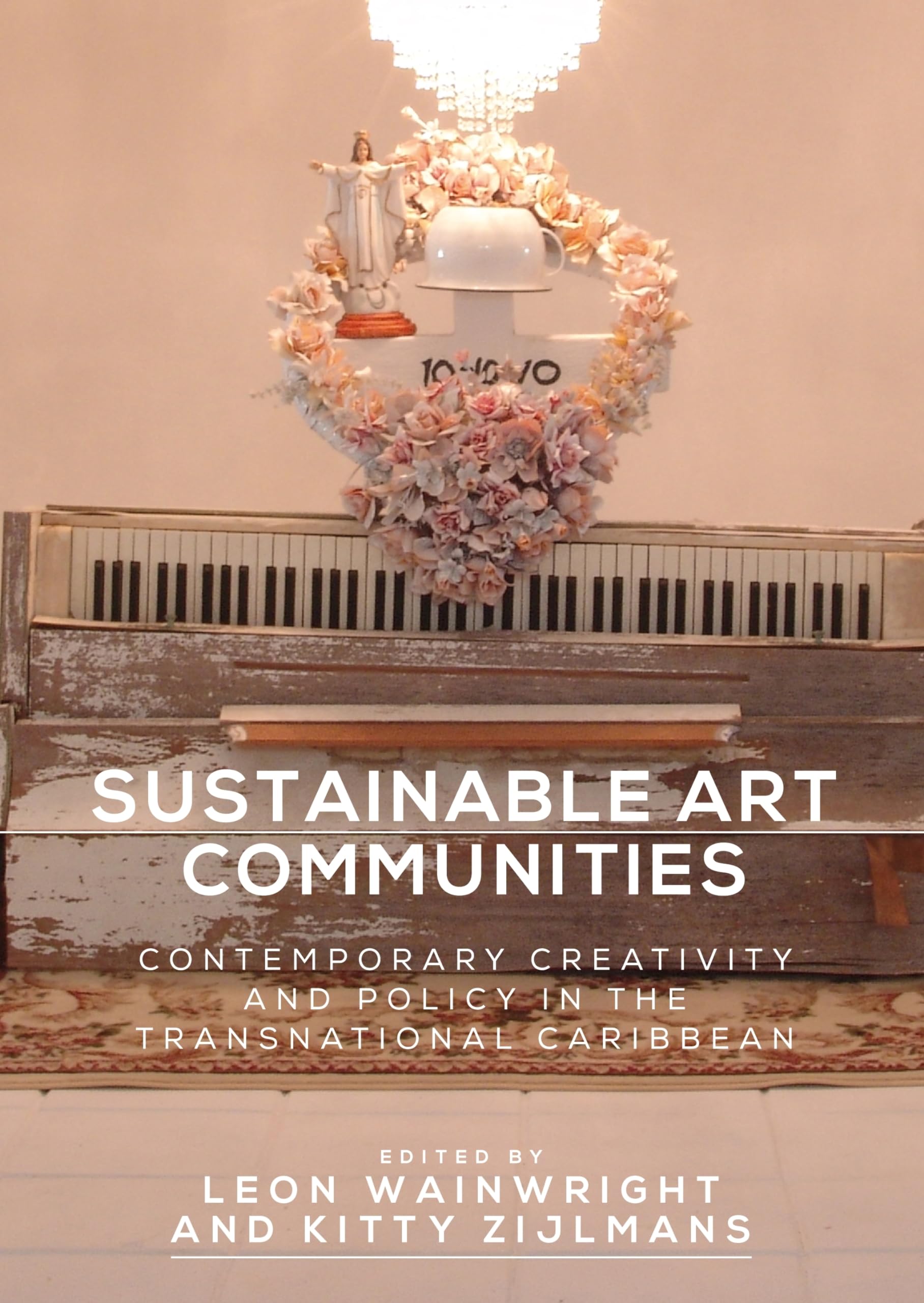
Sustainable art communities: Contemporary creativity and policy in the transnational Caribbean
$83.04
by Leon Wainwright



This collection sets out a range of perspectives on the challenges that the Caribbean is facing today, showing how the arts hold a crucial role in forging a more sustainable Caribbean community. It forcefully attests to the view that visual art in particular has a specific contribution to make and that this in turn means striving to foster a sustainable arts community that can contend with an environment of uneven infrastructure, opportunity and public awareness. Spanning the scholarly, artistic and professional fields of arts and heritage, this book compares two of the Caribbean’s key linguistic regions – the Anglophone and the Dutch – to address the themes of global-local relations, capital, patronage, morality, contestation, sustainability and knowledge exchange. The result is a milestone of collaboration from diverse global settings of the Caribbean and its diaspora, including Jamaica, the Bahamas, Barbados, Suriname, Curaçao, the Netherlands, UK, Germany and the US. ‘[This book] brings together essays by artists, policy makers, curators, and art historians from the entire region, but places special emphasis on the Dutch Caribbean as a corrective to the usual focus on Anglophone, Francophone, and Hispanophone contexts. Mimi Sheller’s afterword reflects usefully on the various “meanings of sustainability” addressed by the contributors, and underscores “the need to cultivate locally grounded ecosystems of arts training, art institutions, and art criticism, which do not simply catapult individual artists out of the Caribbean into the global circuits of metropolitan arbiters of taste, without some kind of payback.” The beautifully reproduced color illustrations, ranging from postage-stamp size to full-page, offer excellent support to the arguments in the text.’ Richard Price and Sally Price, New West Indian Guide A major international collaboration between artists, art historians, curators and policy makers, this collection shows how visual art can play a crucial role in forging a more sustainable community for the Caribbean and its diaspora. The Caribbean, with its transnational diaspora stretching to all the shores of the Atlantic and beyond, is one of the liveliest cultural landscapes in the world today. It is also one of the most troubled. This volume presents contemporary perspectives on the challenges facing Caribbean communities. It shows how the arts can play a crucial role in improving sustainability by creating a shared ground of experience, enjoyment and understanding. The book promotes the view that visual art in particular has an important contribution to make in enhancing the Caribbean s networks and reflecting on the nature of its connections. It addresses a topic that spans the scholarly, artistic, curatorial and professional fields of art and heritage, exploring constructive comparisons between key linguistic regions namely the Anglophone and the Dutch and identifying new parallels and contrasts in global-local relations, capital, patronage, morality, sustainability and the benefits of knowledge exchange. Ultimately, it makes the case for social justice in the arts within a complex and little-studied global geography. Based on a major international project funded by research councils and arts organisations in Europe, Sustainable art communities is a milestone in the collaboration between artists, policymakers, arts organisers, art historians and critics. It draws from such diverse settings as Jamaica, the Bahamas, Barbados, Suriname, Curaçao, the Netherlands, the United Kingdom, Germany and the United States. The Caribbean, with its transnational diaspora stretching to all the shores of the Atlantic and beyond, is one of the liveliest cultural landscapes in the world today. It is also one of the most troubled. This volume presents contemporary perspectives on the challenges facing Caribbean communities. It shows how the arts can play a crucial role in improving sustainability by creating a shared ground of experience, enjoyment and understanding. The book promotes the view that visual art in particular has an important contribution to make in enhancing the Caribbean’s networks and reflecting on the nature of its connections. It addresses a topic that spans the scholarly, artistic, curatorial and professional fields of art and heritage, exploring constructive comparisons between key linguistic regions – namely the Anglophone and the Dutch – and identifying new parallels and contrasts in global-local relations, capital, patronage, morality, sustainability and the benefits of knowledge exchange. Ultimately, it makes the case for social justice in the arts within a complex and little-studied global geography. Based on a major international project funded by research councils and arts organisations in Europe, Sustainable art communities is a milestone in the collaboration between artists, policymakers, arts organisers, art historians and critics. It draws from such diverse settings as