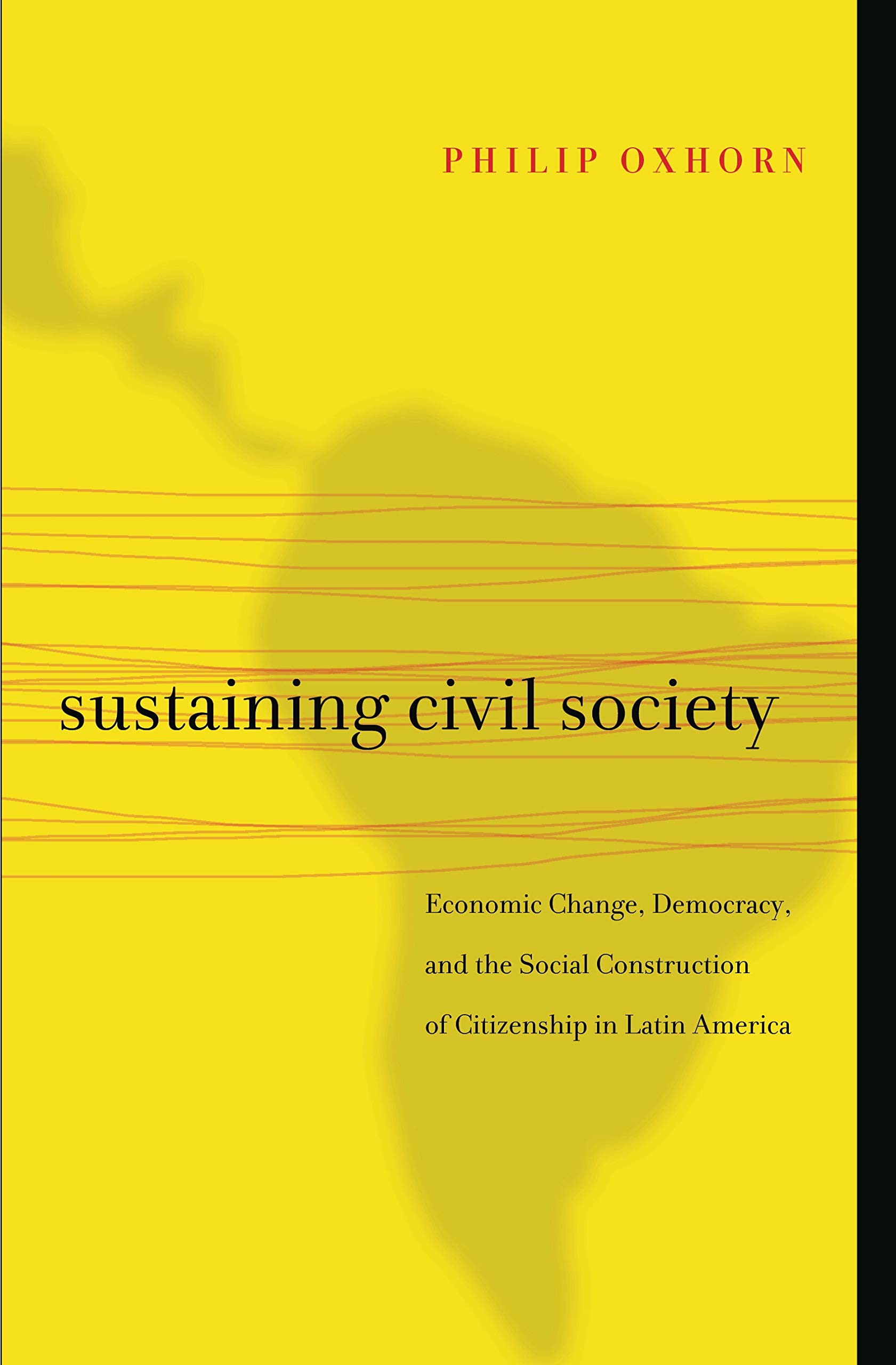
Sustaining Civil Society: Economic Change, Democracy, and the Social Construction of Citizenship in Latin America
$34.95
by Philip Oxhorn



“South America is not the poorest continent in the world, but it may very well be the most unjust.” This statement by Ricardo Lagos, then president of Chile, at the Summit of the Americas in January 2004 captures nicely the dilemma that faces Latin American countries in the wake of the transition to democracy that swept across the continent in the last two decades of the twentieth century. While political rights are now available to citizens at unprecedented levels, social and economic rights lag far behind, and the fledgling democracies struggle with long legacies of poverty, inequality, and corruption. Key to understanding what is happening in Latin America today is the relationship between the state and civil society. In this ambitious book, Philip Oxhorn sets forth a theory of civil society adequate for explaining current developments in a way that such controversial neoconservative theories as Francis Fukuyama’s liberal triumphalism or Samuel Huntington’s “clash of civilizations” cannot. Inspired by the rich political sociology of an earlier era and the classic work of T. H. Marshall on citizenship, Oxhorn studies the process by which social groups are incorporated, or not, into national socioeconomic and political development through an approach that focuses on the “social construction of citizenship.” “In this seminal book, Philip Oxhorn proves himself the T. H. Marshall of Latin America. In thoughtful, historically rich detail, Oxhorn shows how and explains why political, economic, and social rights have evolved differently in Chile, Bolivia, and Mexico than in the now-developed democracies. A must-read!” ―Susan Eckstein, Boston University “In this pathbreaking study of the transformation of civil society in late twentieth-century Latin America, Philip Oxhorn explores how market liberalization altered the social landscape and affected the practice of democratic citizenship. The result is a masterful analysis of the interrelated character of social, economic, and political change―and a highly sobering assessment of Latin America’s democratic dilemma. Sustaining Civil Society is essential reading for anyone who is concerned about the inherent tensions among democratic political rights, economic inequality, and social exclusion.” ―Kenneth M. Roberts, Cornell University “ Sustaining Civil Society combines a thoughtful, critical theoretical approach to civil society with case studies―informed by extensive fieldwork―of Chile, Bolivia, and Mexico. This book will become the definitive reference for studies of civil society and democracy in Latin America and an essential tool for broader comparative work.” ―John Peeler, Bucknell University “ Sustaining Civil Society confirms Philip Oxhorn’s intellectual leadership in the field of citizenship and civil society studies. This book probes the construction of citizenship at the intersection of complex economic, sociocultural, and political transformations in societies deeply scarred by egregious inequalities. Oxhorn masterfully weaves together sophisticated theoretical analysis with empirically rich case studies of Bolivia, Chile, and Mexico to establish new benchmarks for research in comparative politics and political sociology.” ―William C. Smith, University of Miami, editor of Latin American Politics and Society Philip Oxhorn is Professor of Political Science and Founding Director of the Institute for the Study of International Development at McGill University.