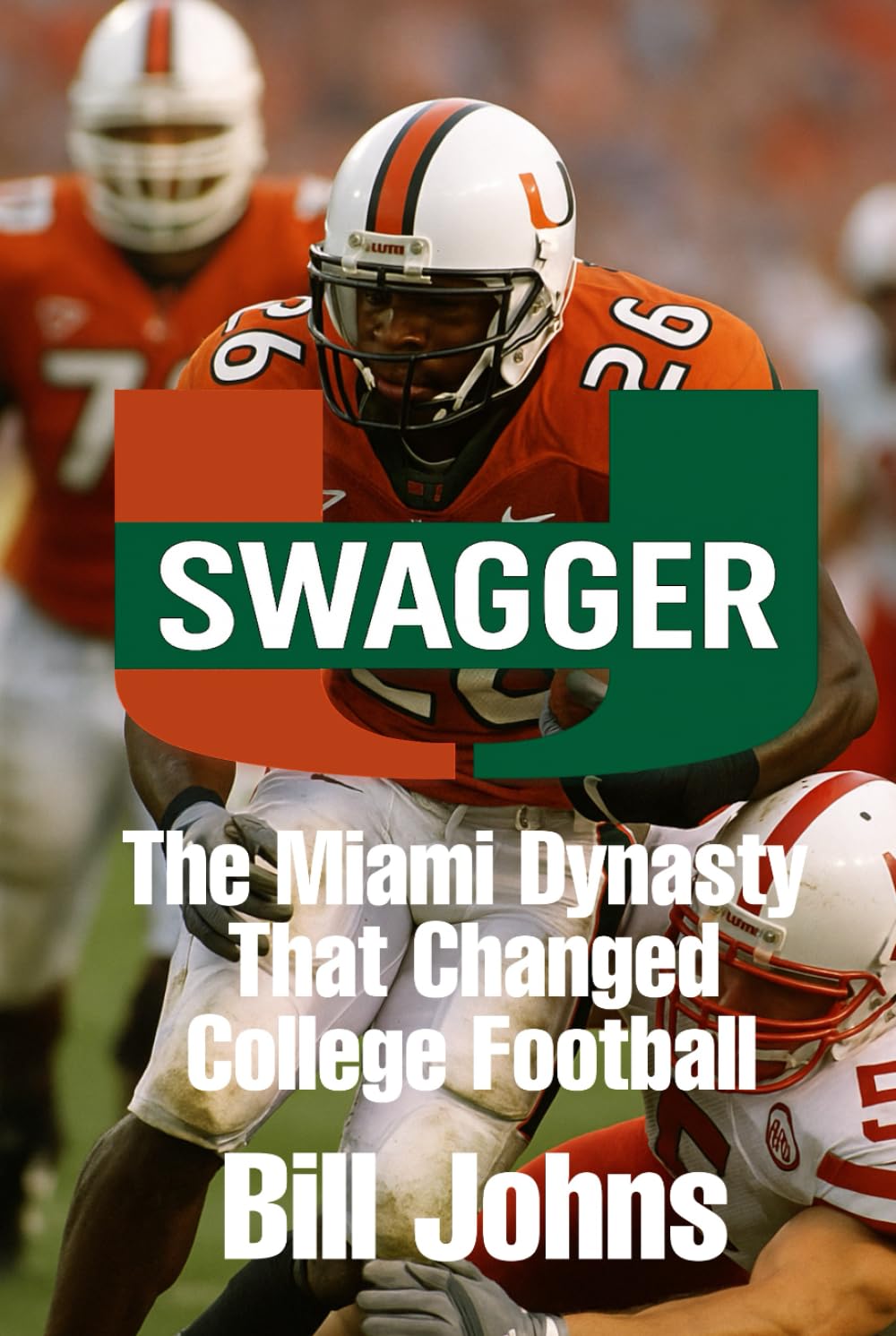
Swagger: The Miami Dynasty That Changed College Football (Saturdays of Legend)
$29.99
by Bill Johns



The Miami Hurricanes did not just win football games; they rewrote the rules of college football and dared the rest of the nation to keep up. Swagger: The Miami Dynasty That Changed College Football is the definitive cultural and historical account of how a small private university in Coral Gables became the most feared, hated, and imitated program in the sport. From the humid nights of the Orange Bowl to the recruitment wars fought on South Florida’s high school fields, it traces the rise of a dynasty that fused athletic brilliance with unapologetic defiance—and made both inseparable from its identity. Built on Howard Schnellenberger’s “State of Miami” blueprint and sharpened under Jimmy Johnson, Dennis Erickson, and Larry Coker, the Hurricanes transformed raw local talent into a juggernaut that dominated the 1980s and early 2000s. Five national championships, an NCAA-record 58-game home winning streak, and rosters so deep that future NFL Hall of Famers often began as backups became the tangible proof. But the real legacy was more elusive: Miami didn’t just win—it imposed a style. Speed wasn’t a luxury; it was the baseline. Aggression wasn’t an occasional tactic; it was the culture. The U blurred the line between sport and spectacle, drawing as much national outrage for its celebrations and swagger as it did acclaim for its relentless excellence. This was a program inseparable from its city. Miami in the 1980s and ’90s was a volatile, fast-moving crossroads of cultures, ambitions, and risks. The Hurricanes mirrored it perfectly—diverse, brash, unwilling to be overlooked. The stands at the Orange Bowl became a convergence of neighborhoods and rhythms, from Liberty City to Little Havana, where salsa beats met marching band drums and game day felt like a block party laced with civic pride. Players carried the weight of representing not just a school, but the people and streets that shaped them. Swagger is as much about the cultural fault lines the Hurricanes exposed as it is about their championships. Why was Miami’s visible joy and confidence recast as arrogance, while similar behavior from traditional powers was praised as “competitive fire”? Why did the same sport that condemned Miami’s brashness quietly adopt its speed, its conditioning, and even its on-field attitude? Through archival reporting, game accounts, and vivid storytelling, the book explores how The U forced college football to confront its own double standards—on race, region, and the unwritten codes of “acceptable” dominance. Yet no dynasty lasts forever. NCAA sanctions, coaching turnovers, and a shifting national landscape chipped away at Miami’s invincibility. The near-miss of the 2002 Fiesta Bowl marked the beginning of the end of the Hurricanes’ era as the sport’s gravitational center. Still, the cultural aftershocks remain: high school recruits nationwide still study Miami highlight reels; coaches still borrow from its playbook; and debates about sportsmanship and swagger still echo with The U’s shadow. This is the story of how a team became a mirror—reflecting the sport’s contradictions, the city’s complexity, and the country’s unease with a champion that would not bow to convention. It is a history of speed, defiance, and the will to define victory on your own terms. For anyone who loves college football, for anyone who has felt the electricity of a team that plays as if the game belongs to them alone, Swagger is both a chronicle and a challenge: to remember not just the wins and losses, but the way it felt when Miami changed the weather. Step inside the Orange Bowl. Hear the crowd before the snap. See the game as Miami played it—and decide for yourself what it means when a dynasty refuses to apologize.