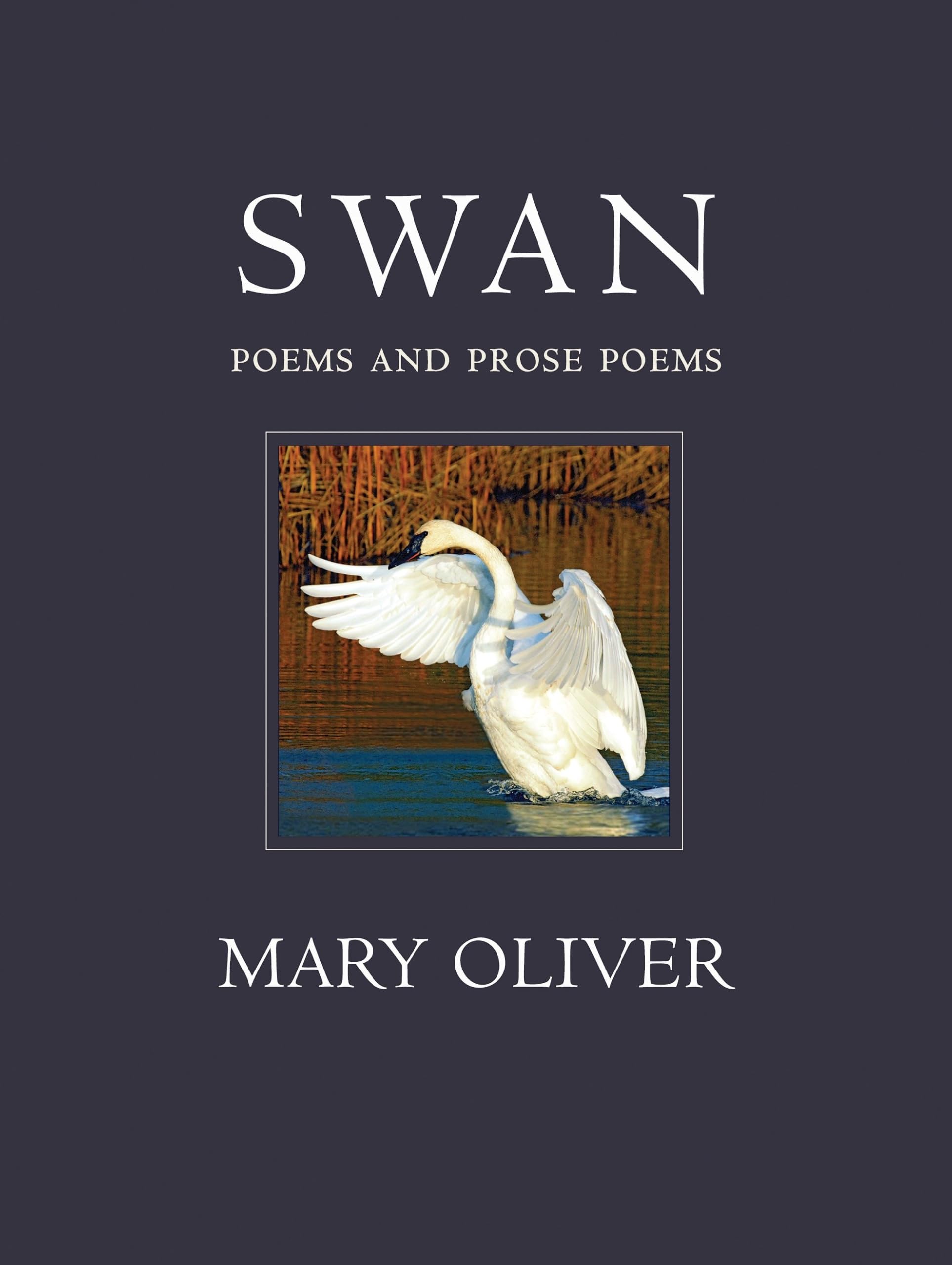



“Joy is not made to be a crumb,” writes Mary Oliver, and certainly joy abounds in her new book of poetry and prose poems. Swan , her twentieth volume, shows us that, though we may be “made out of the dust of stars,” we are of the world she captures here so vividly: the acorn that hides within it an entire tree; the wings of the swan like the stretching light of the river; the frogs singing in the shallows; the mockingbird dancing in air. Swan is Oliver’s tribute to “the mortal way” of desiring and living in the world, to which the poet is renowned for having always been “totally loyal.” As the Los Angeles Times noted, innumerable readers go to Oliver’s poetry “for solace, regeneration and inspiration.” Few poets express the immense complexities of human experience as skillfully, or capture so memorably the smallest nuances. Speaking, for example, of stones, she writes, “the little ones you can / hold in your hands, their heartbeats / so secret, so hidden it may take years / before, finally, you hear them.” It is no wonder Oliver ranks, according to the Weekly Standard, “among the finest poets the English language has ever produced.” Cherished nature poet Oliver begins her twentieth collection by asking, “What can I say that I have not said before?” Then continues reporting on the wisdom she gleans in woods and on the beach, making each dispatch fresh and startling by way of the vitality of her encompassing vision and the fluidity and shine of her language. Her love for dogs remains ardent; she is still enthralled by birds and unrepentant in her celebration of beauty. The sun of her gratitude is great, illuminating beloved household objects, the rapidity of a hummingbird, and “the drowse of mountains.” The poet gets bloodied when she tries to help an injured gull, which inspires her to declare, “I love this world, even in its hard places. / A bird too must love this world, / even in its hard places. / So, even if the effort may come to nothing, / you have to do something.” Oliver’s plainspoken yet ringing poems are testimony to joy, prayers, and sermons. She concurs: “Okay, I confess to wanting to make a literature of praise.” --Donna Seaman Praise for Mary Oliver “One of the astonishing aspects of Oliver’s work is the consistency of tone over this long period [of her career]. What changes is an increased focus on nature and an increased precision with language that has made her one of our very best poets. . . . Although few poets have fewer human beings in their poems than Mary Oliver, it is ironic that few poets also go so far to help us forward.” —Stephen Dobyns, New York Times Book Review “Mary Oliver’s poetry is fine and deep; it reads like a blessing. Her special gift is to connect us with our sources in the natural world, its beauties and terrors and mysteries and consolations.” —Stanley Kunitz “Mary Oliver’s poems are natural growths out of a loam of perception and feeling, and instinctive skill with language makes them seem effortless. Reading them is a sensual delight.” —May Swenson “Like Henry David Thoreau of Transcendentalist fame she is a naturalist whose attention to what used to be called the Book of Nature borders on both devotion and experimentation. . . . Mindfulness seems to be Oliver’s métier, looking and listening her scientific method and contemplative practice.” —Stephen Prothero, Search “I should be clear that Mary Oliver is, to my mind, one of the most gifted American poets working in English today. In her hands, the language acquires a lucidity approaching translucence; the accuracy of her vision and the precision of her voice are unique in their refreshing simplicity. Perhaps most singular is the tendency of her poems to be at once powerful and appealing; an affection for the natural world and a sympathy toward the reader abide.” —Katherine Hollander, Pleiades “This year the Top 5 [Indiebound poetry best sellers] can be summed up in six words: Mary Oliver, Mary Oliver, Mary Oliver. Oliver’s impressive feat reflects both an enduring popularity and an unparalleled ability to touch readers on a deep, almost primal level.” —Elizabeth Lund, Christian Science Monitor “Mary Oliver moves by instinct, faith, and determination. She is among our finest poets, and still growing.” —Alicia Ostriker, The Nation “One would have to reach back perhaps to [John] Clare or [Christopher] Smart to safely cite a parallel to Oliver’s lyricism.” —David Barber, Poetry “The music in Oliver’s writing is unmistakable. Her poetry can be read as the best of the real lyrics we have these days, and it’s no surprise that she’s already won a Pulitzer Prize for it, as well as many other honors.” — Los Angeles Times “ Oliver’s plainspoken yet ringing poems are testimony to joy, prayers, and sermons.”—Donna Seaman, Booklist With her new collection, this winner of the National Book Award for Poetry and the Pulitzer Prize in Poetry once again joyfully