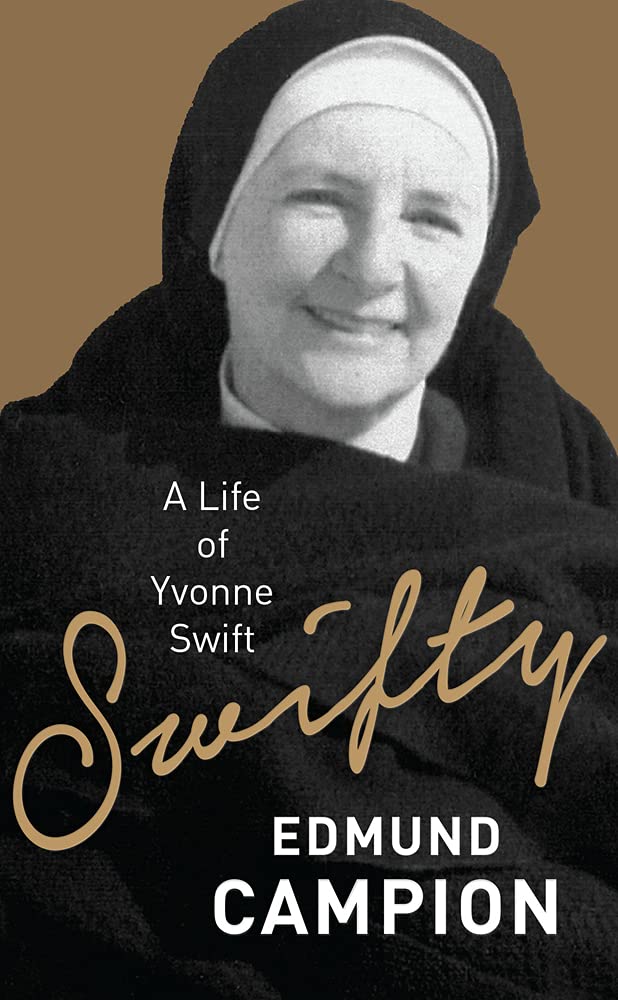



An extraordinary journey from devoted nun to passionate campaigner for justice. Yvonne Benedicta Swift's life took an unexpected turn when, after years in a Sacre Coeur convent, she retrained as a lawyer. Establishing her own practice, she became a fierce advocate for Sydney's most marginalized, believing everyone deserved a fair defense. Swifty unveils the remarkable story of a woman who defied expectations. From the quiet devotion of religious life to the intensity of the courtroom, Yvonne Swift's unwavering commitment to justice and compassion shines through. Discover how her unique background shaped her approach to law, and how she left an indelible mark on the Australian legal system. This biography is for readers interested in stories of female empowerment, legal history, and the intersection of faith and social action. Edmund Campion is a Sydney priest and writer whose books include Rockchoppers: Growing up Catholic in Australia (1982) and Australian Catholic Lives (2014). He has been chair of the Literature Board of the Australia Council for the Arts, and a judge of numerous literary awards. Lecturer in history at the Catholic Institute of Sydney for 25 years, he was awarded honorary doctorates from the University of Sydney and Australian Catholic University. Swifty A Life of Yvonne Swift By Edmund Campion University of New South Wales Press Ltd Copyright © 2016 Edmund Campion All rights reserved. ISBN: 978-1-74223-475-5 Contents Foreword by Dr Marie Leech, 1 A French convent, 2 Schooldays, 3 At university, 4 Entering the convent, 5 Enriching young lives, 6 Sancta Sophia, 7 The life of the mind, 8 Among her friends, 9 Return to the law, 10 In pursuit of justice, 11 Fidelity, 12 A lifetime of giving, Acknowledgments, Index, CHAPTER 1 A French convent When the Swift family moved from Sydney to Melbourne in 1921 they had to find a school for their only child, nine-year-old Yvonne Benedicta. She had been with the Dominican nuns at Moss Vale, more than 100 kilometres south of Sydney; now they entrusted her as a boarder to the Sacre Coeur nuns, in Burke Road Glen Iris, near their new home in East Balwyn. Established 33 years earlier, the school was still a small one but its buildings were impressive – the original mansion on ten acres where the school started and a later addition, a tall Gothic-style block of classrooms with a chapel. There were some 60 pupils, a number that would not change much through Yvonne's nine years at Burke Road. Taking her into town to Snow's store in Flinders Street, her mother kitted her out in the navy and tan school uniform and other necessities and presented her to her new school in February 1922. The year opened with a public reading of the School Rule. They did that every year at Burke Road; it was a pointer to the culture underpinning daily life there. For this was a convent school where pupils shared the life and aspirations of the nuns, whose days also were measured by a rule, the Rule of Religious of the Sacred Heart of Jesus (RSCJ). If some of the precepts of the School Rule swept over the new girl unnoticed on her first day, Yvonne soon came to appreciate the values contained there. One day she would commit herself to those values by becoming an RSCJ nun herself, a commitment she kept until she died. * * * Celebrations and festivals afford insights into any society. The big day of the year at this convent school was Reverend Mother's feast day, when there would be a concert and presentations to Reverend Mother of a 'spiritual bouquet' (Masses, prayers and acts of self-denial offered for her 'intentions'), reports of good behaviour attempted by the whole school, such as prompt obedience to the bell, and accounts of special projects undertaken by each class. One by one, class representatives brought their feast-day offerings to lay at Reverend Mother's feet in a formal gathering of the whole school. Here was recognition of her leadership in what was fundamentally a moral enterprise. The moral purpose of the school was also evident in another formal gathering every week. Called 'Weekly Notes' or 'Exemptions', this brought the school in assembly before the community of nuns. Each girl's name was called and her conduct during the week noted: 'Very Good', 'Good', 'Indifferent' or 'No Note'. 'No Note' was to be in disgrace, for instance for speaking during a period of silence four or more times in the week. To any observer the moral impetus of this weekly exercise was clear. Silence was a noticeable aspect of the school's culture. Silence was to be observed in the study room, during meals, at night after prayers and moving from place to place. One did not move of one's own volition: girls stood silent in ranks until a nun gave a signal. Speaking was allowed at recreation and at needlework, 'that the children may learn the art of conversation', as the School Rule noted. The emphasis, however, was on the usefulness of si