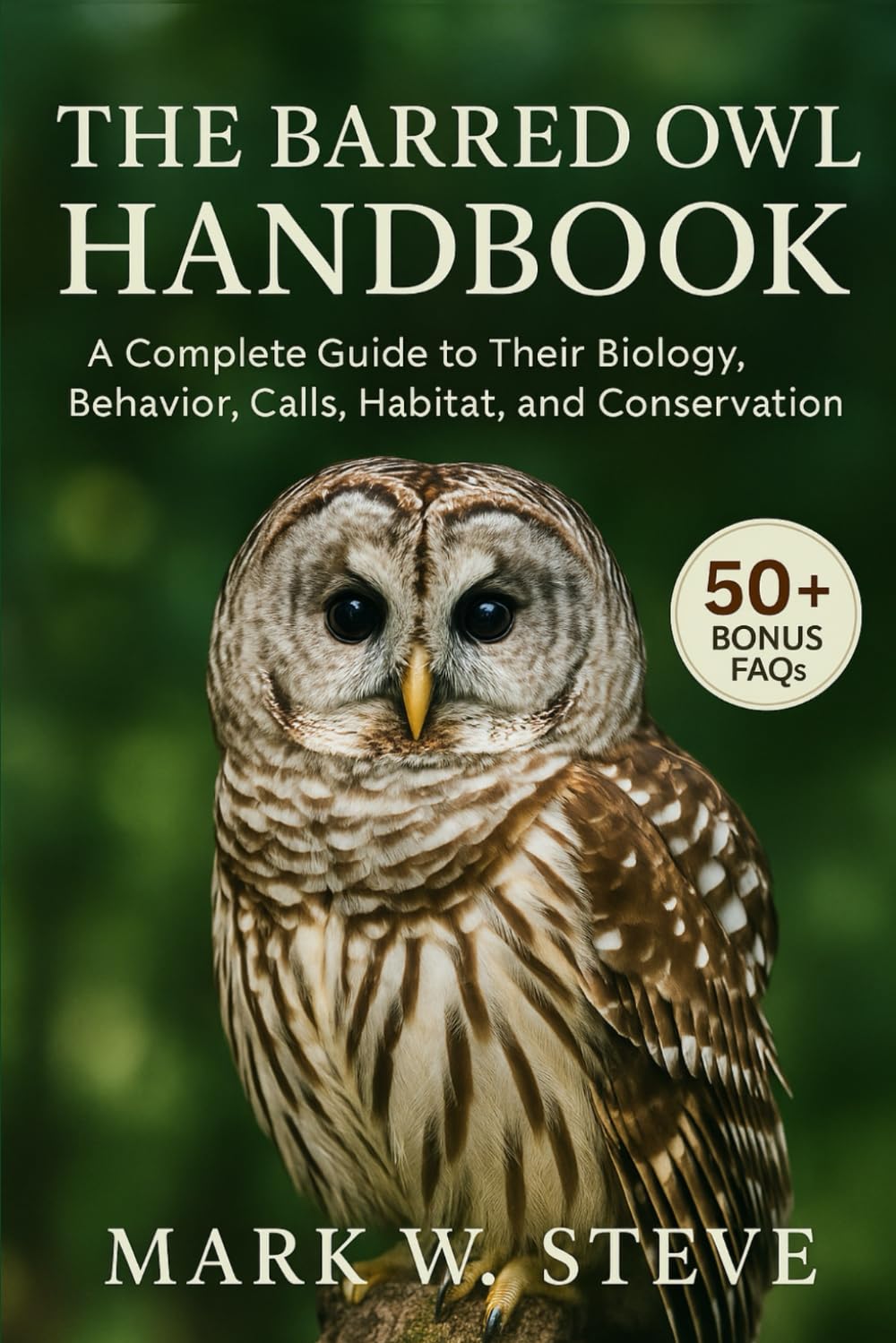
THE BARRED OWL HANDBOOK: A Complete Guide to Their Biology, Behavior, Calls, Habitat, and Conservation
$13.99
by MARK W STEVE



Introduction to the Barred Owl The barred owl (Strix varia) is one of the most recognizable and fascinating owls in North America, admired for its haunting vocalizations, striking plumage, and mysterious presence in dense forests. It is a bird that captures the imagination of both scientists and casual observers, blending natural beauty with deep cultural symbolism. Known commonly as the “hoot owl” for its distinctive call, it has a reputation for being vocal, curious, and surprisingly adaptable. While many owls are associated with remoteness and solitude, the barred owl is often seen and heard near human settlements, especially in suburban woodlands, where it thrives in proximity to people while maintaining its wild character. Its mystique lies not only in its physical presence but also in the way it has embedded itself in folklore, tradition, and modern ecological studies. Barred owls are named for the brown and white barring across their chest and vertical streaks along their belly, creating a pattern that makes them appear both regal and camouflaged within their woodland surroundings. Their round head, dark brown eyes—unlike the yellow eyes of many other owls—and facial disc framed with concentric rings lend them a solemn, almost human-like expression. They lack ear tufts, giving them a smooth, rounded appearance that adds to their ghostly quality. Adults typically measure between 16 and 25 inches in length with wingspans ranging from 38 to 50 inches, making them a medium to large owl species. Their powerful talons, exceptional eyesight, and acute hearing allow them to excel as nocturnal predators, hunting silently under the cover of darkness. Folklore surrounding the barred owl is rich and varied, as humans have long been both fascinated and unsettled by owls. In many Native American traditions, owls symbolize wisdom but also carry associations with death and the spirit world, often serving as messengers or omens. The barred owl, with its eerie, rhythmic call that sounds like “Who cooks for you? Who cooks for you all?” has been interpreted in countless ways, from a forewarning of change to a reminder of ancestral voices. Early European settlers in North America also wove the barred owl into their cultural fabric, hearing in its call a supernatural voice echoing through the woods at night. To this day, its vocalizations create both awe and unease, embodying the blend of beauty and mystery that owls have represented across cultures for centuries. Scientifically, the barred owl has become one of the most studied owls because of its adaptability, expanding range, and ecological impact. Originally native to the eastern United States, barred owls expanded westward across the Great Plains during the 20th century, eventually colonizing the Pacific Northwest. This westward expansion has brought them into direct competition with the endangered northern spotted owl, sparking intense debate within conservation circles. Scientists study barred owls to understand how adaptable species thrive in human-altered landscapes and how their presence affects ecosystems. This research is critical for shaping management strategies, particularly in areas where barred owls threaten the survival of more specialized owl species. Barred owls are admired not only for their ecological role but also for their accessibility to people. Unlike some owls that are rarely seen, barred owls often call boldly during the day, perch in visible locations, and respond to imitated calls from birdwatchers. Their willingness to live in mixed forests, wetlands, and suburban woodlands makes them one of the most observed owls in North America. This accessibility has made them a favorite subject for birders, wildlife photographers, and nature educators, who use them as ambassadors to inspire appreciation for raptors and forest conservation.