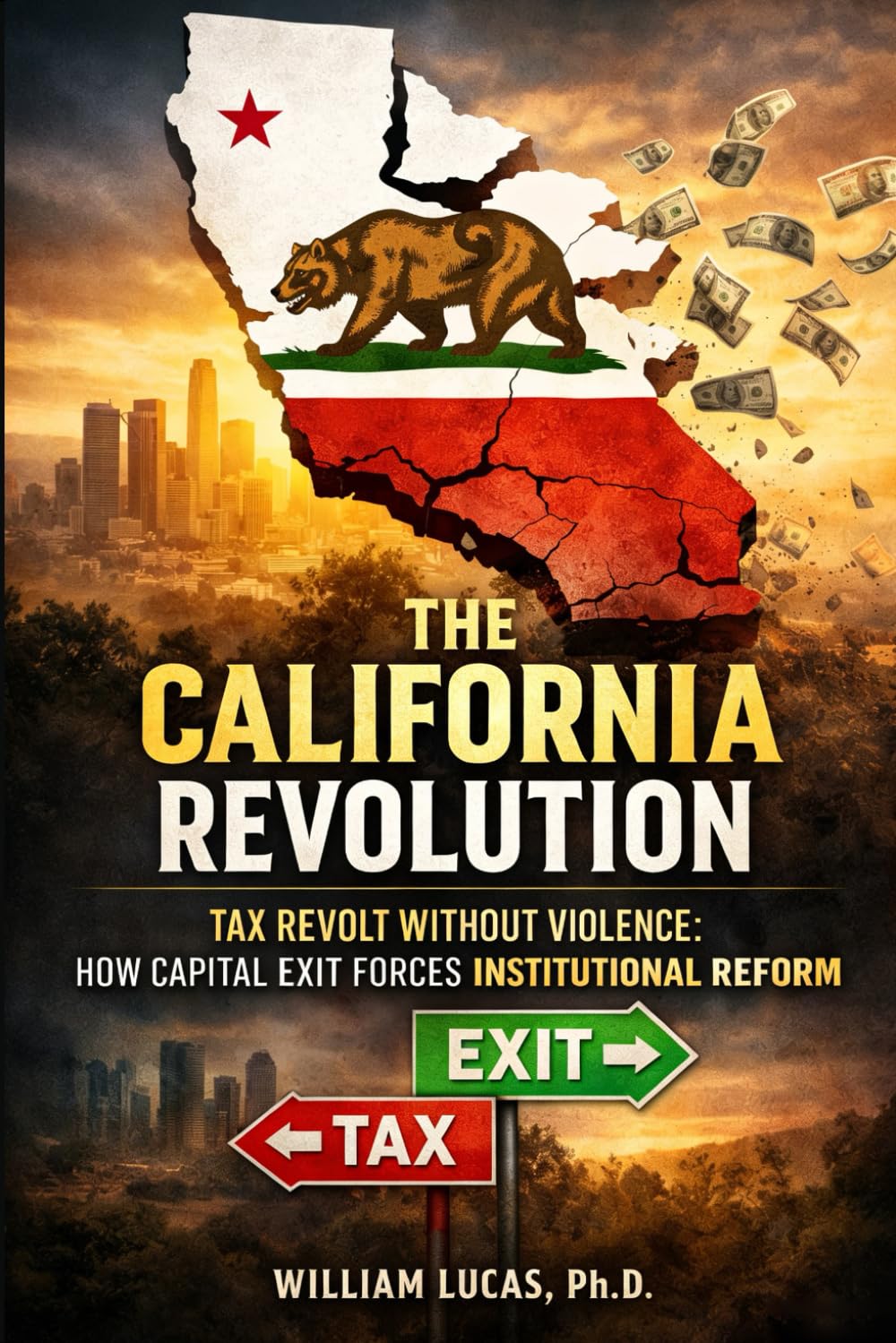
THE CALIFORNIA REVOLUTION: Tax Revolt Without Violence: How Capital Exit Forces Institutional Reform (The Future of America Series.)
$16.99
by WILLIAM LUCAS



The California Revolution is not a book of protest, but a sober analysis of institutional correction mechanisms. It does not argue from ideology or partisan emotion, but from fiscal reality. Its central claim is straightforward and often avoided: when taxation becomes highly concentrated and institutions grow openly hostile toward wealth creators, capital exit is not a betrayal of society—it is the only effective feedback mechanism left within a market economy. California is not declining because it failed, but because its success has been excessively punished. Its fiscal structure is built on extreme concentration: the top 1% of taxpayers contribute nearly half of all personal income tax revenue, while the top 5% account for more than 70%. This is not a broad-based public finance system, but a fiscal architecture resting on a narrow, mobile minority. The danger lies in the fact that this tax base is both cyclical and highly relocatable—yet it is treated by policymakers as permanent and inexhaustible. The book argues that California’s real crisis is not business failure, but business avoidance. High personal income taxes, elevated capital-gains taxes, layered corporate taxation, aggressive regulation, and chronic policy uncertainty together constitute a system of institutional hostility toward entrepreneurs. The result is not that innovation is “stolen,” but that it is rationally displaced. Headquarters relocation, asset restructuring, second-headquarter strategies, remote work, and distributed teams are systematically eroding California’s tax base and innovation monopoly. At its core, The California Revolution reframes “voting with your feet” as an economic—not moral—phenomenon. Capital mobility is not tax evasion, nor is it social irresponsibility. It is a rational response to an unsustainable institutional design. History consistently demonstrates that as long as taxpayers remain and comply, fiscal systems interpret endurance as validation. Only when tax bases materially erode do institutions confront the need for reform. The book advances a stark but realistic conclusion: staying is a form of endorsement. In environments where electoral mechanisms fail to restrain policy excess and public discourse becomes moralized and punitive, exit becomes the only effective corrective force. The California Revolution also directly challenges the systematic demonization of affluent taxpayers, showing that they are not societal burdens but net contributors—financing public services, assuming economic risk, and generating employment. A system that economically depends on wealth creators while morally vilifying them is inherently unstable. This is not a manifesto for dismantling California, but a blueprint for saving it. Tax-base withdrawal is not the endgame—it is the pressure point that forces institutions back toward rationality. Sustainable recovery does not come from higher tax rates, but from restoring a predictable, entrepreneur-friendly environment that attracts capital, investment, and risk-taking. Staying finances institutional error. Leaving recalls institutional reason.