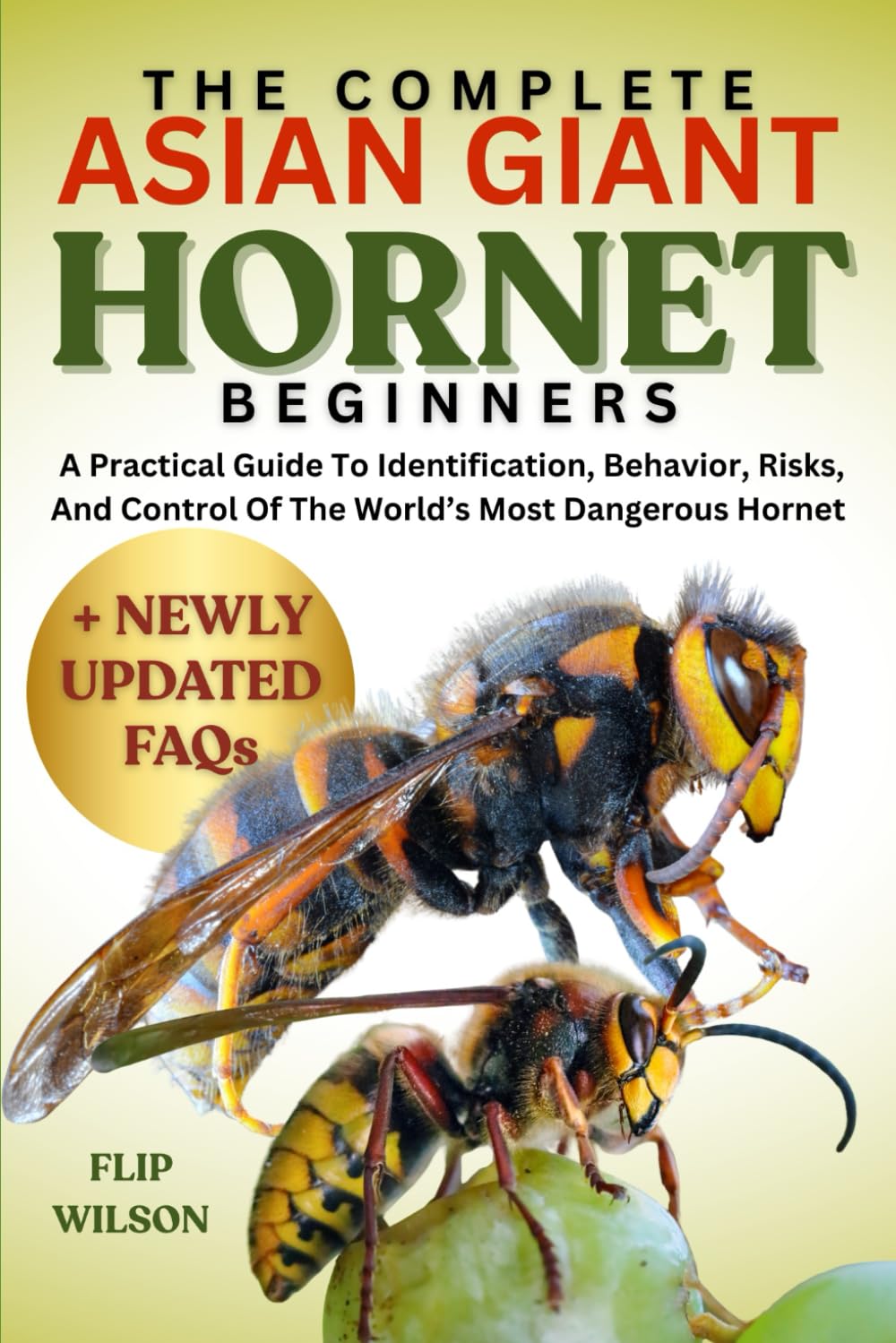
THE COMPLETE ASIAN GIANT HORNET FOR BEGINNERS: A Practical Guide To Identification, Behavior, Risks, And Control Of The World’s Most Dangerous Hornet
$14.99
by FLIP WILSON



What is the Asian Giant Hornet? The Asian giant hornet (Vespa mandarinia) is the largest hornet species in the world. Originally native to temperate and tropical regions of East and Southeast Asia, this insect has gained global attention not only because of its size but also due to its aggressive predation on honeybees, its painful sting, and its potential as an invasive species. Adult queens can grow up to 5 centimeters (2 inches) in length, while workers typically measure between 3.5 to 4 centimeters (about 1.5 inches). Its wingspan can reach up to 7.6 centimeters (3 inches), making it an intimidating insect to encounter. The Asian giant hornet is easily recognizable by its distinctive features. It has a large, orange-yellow head with prominent eyes and powerful mandibles capable of cutting through the exoskeletons of other insects. Its thorax is dark brown or black, while the abdomen displays alternating bands of black and yellow or orange. Unlike honeybees, it does not die after stinging and is capable of delivering multiple venomous stings in succession. While most hornets serve ecological roles as predators that help control pest populations, the Asian giant hornet has earned a somewhat notorious reputation. In recent years, it has been sensationalized by media, particularly after being spotted in North America. Dubbed “murder hornets” by news outlets, these hornets are far from indiscriminate killers, but the nickname highlights the fear they have inspired among the public due to their size and painful sting. Despite the dramatic headlines, their behavior is largely defensive unless provoked or disturbed near their nest. Hornets, including Vespa mandarinia, belong to the family Vespidae, which also includes yellowjackets and paper wasps. They are eusocial insects, meaning they live in colonies with a well-defined social hierarchy that includes queens, workers, and males. Their nests, often built underground or in tree hollows, can house hundreds of individuals. Colonies are established annually, with only mated queens surviving through the winter to start new nests in the spring. In their native ecosystems, Asian giant hornets are apex insect predators. They primarily feed on other insects, especially honeybees, mantises, caterpillars, and beetles. In late summer and early fall, they exhibit a unique behavior known as the “slaughter phase,” during which a small group of hornets can decimate an entire beehive in a matter of hours. They chew the bee bodies into a paste and carry it back to their nests to feed developing larvae. This makes them a serious concern for both natural bee populations and commercial beekeeping operations. Although generally not aggressive toward humans unless disturbed, Asian giant hornets will fiercely defend their nest if they perceive a threat. Their venom contains neurotoxins, cytolytic peptides, and enzymes that can break down cell membranes, cause extreme pain, and in some rare cases, trigger anaphylactic shock. While fatalities are uncommon, stings have resulted in hospitalizations and occasional deaths in their native regions, particularly in rural areas of Japan and China. In 2019 and 2020, the first verified sightings of Asian giant hornets in North America (specifically in British Columbia, Canada, and Washington State, USA) sparked concern about their potential to establish invasive populations. This led to coordinated eradication efforts and public awareness campaigns aimed at preventing the hornet from spreading beyond its initial discovery zones. Despite the fear they inspire, Asian giant hornets are not inherently evil or unnatural. They are a product of millions of years of evolution and play a complex role in their ecosystems. Like many predatory insects, they help balance insect populations and serve as food sources for larger predators, such as birds and mammals.