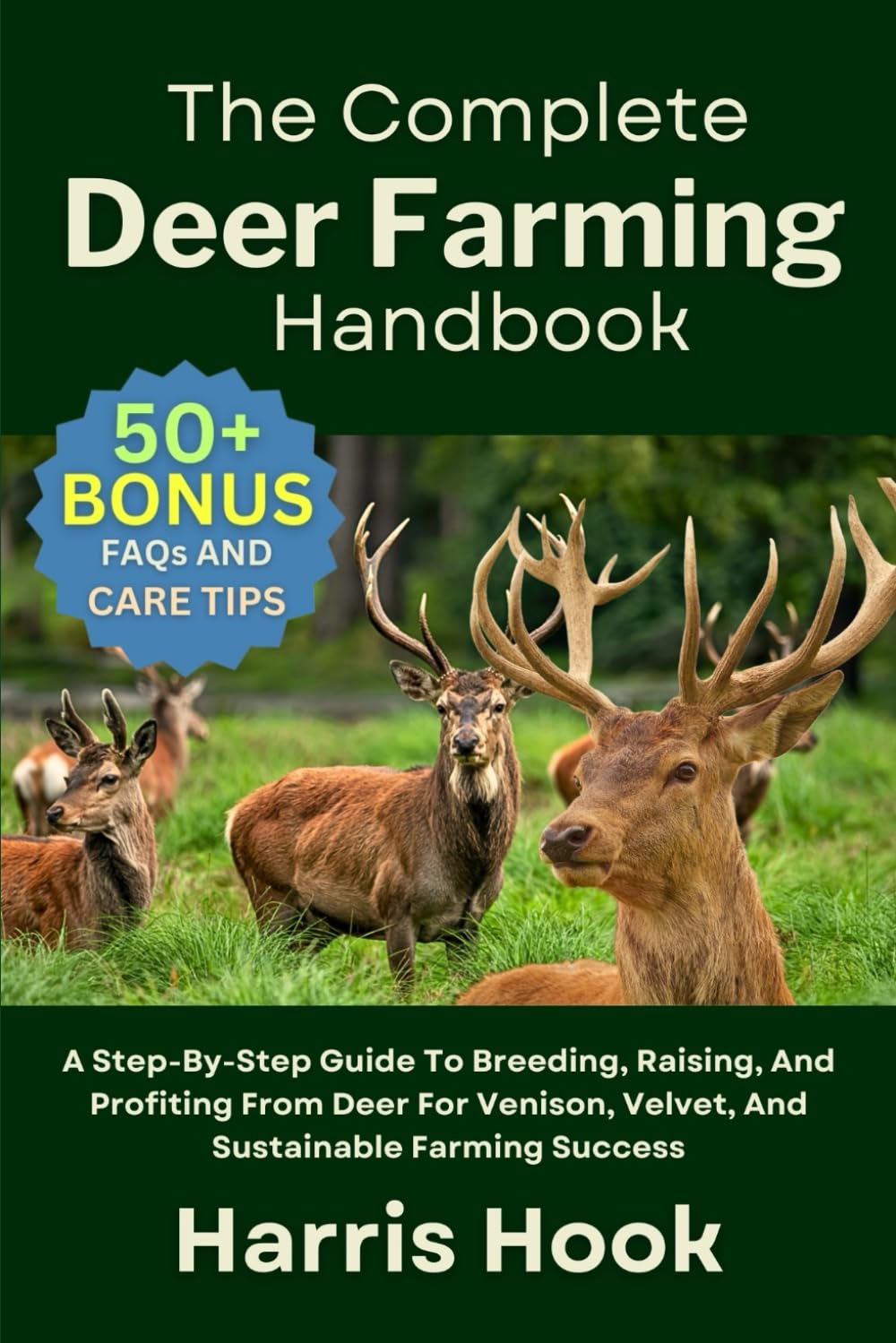
THE COMPLETE DEER FARMING HANDBOOK: A Step-By-Step Guide To Breeding, Raising, And Profiting From Deer For Venison, Velvet, And Sustainable Farming
$13.99
by HARRIS HOOK



Introduction to Deer Farming The History and Evolution of Deer Farming The relationship between humans and deer stretches back tens of thousands of years, to a time when human societies were primarily hunter-gatherers relying heavily on wildlife for food, clothing, and survival. Archaeological evidence from prehistoric sites across Europe, Asia, and North America shows that deer were among the most hunted animals because they provided multiple essential resources. Their meat was a vital protein source; their hides were used for clothing, footwear, and shelter; and their antlers and bones became tools and weapons. This deep reliance on deer shaped human culture, mythologies, and economies long before the idea of domesticating or farming them came into consideration. In early civilizations, deer often held symbolic significance. In Celtic mythology, deer were revered as messengers of the gods and symbols of purity and nature. In East Asia, deer were associated with longevity and prosperity, with antlers believed to hold medicinal properties. The traditional Chinese medicinal use of deer velvet dates back over two millennia, with ancient records documenting the harvesting of antlers at early growth stages to create powders and tonics. This historical demand laid an early foundation for the concept of managing deer populations more systematically. The first deliberate attempts to manage deer populations in controlled environments can be traced back to medieval Europe. In England and other parts of the continent, large aristocratic estates established deer parks—enclosed areas where deer were semi-wild but still managed within boundaries. These parks were not strictly farms in the modern sense; instead, they were a blend of hunting preserves, food sources, and status symbols. Only the nobility had the rights to hunt deer, and controlling herds within deer parks ensured a steady supply of venison for royal courts and feasts. Such parks also allowed for selective breeding, whether intentional or incidental, contributing to the refinement of deer characteristics over generations. Parallel developments occurred in Asia. In China and Korea, sika deer and other species were managed in semi-domestic systems, particularly to harvest velvet antlers for medicinal use. Farmers began experimenting with enclosures, feeding regimes, and selective culling to improve both productivity and quality of antler yield. By the 16th and 17th centuries, these practices had developed into rudimentary forms of deer farming that foreshadowed modern methods. The leap from semi-wild management to full-fledged farming came much later, particularly in the 20th century. In New Zealand during the 1960s and 1970s, deer farming emerged as an innovative agricultural industry almost by accident. Introduced European red deer had become feral and were considered pests, causing damage to native vegetation. Farmers began capturing wild deer from helicopters and confining them in fenced pastures. What began as pest control evolved into a commercial enterprise as markets for venison and velvet antlers expanded internationally. New Zealand quickly became a global leader in deer farming, developing specialized techniques for handling, breeding, feeding, and disease management. Today, deer farming is recognized as a legitimate branch of agriculture in many parts of the world, including New Zealand, Australia, China, Russia, the United States, Canada, and parts of Europe. What was once a niche or aristocratic activity has transformed into a modern, science-based agricultural practice. Advances in animal husbandry, genetics, and marketing have elevated deer farming into a profitable and sustainable enterprise, reflecting both the adaptability of deer as livestock and the growing interest of consumers in alternative meats and natural health products.