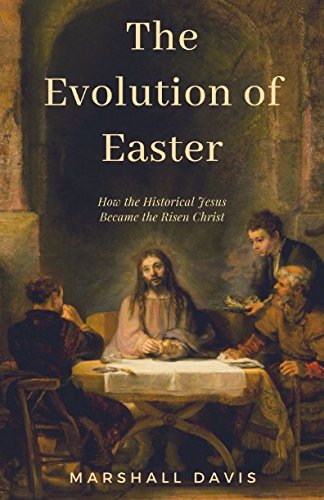
THE EVOLUTION OF EASTER: How the Historical Jesus Became the Risen Christ
$9.99
by Marshall Davis



This book explores the Christian understanding of the resurrection of Jesus and how the idea evolved during the first hundred years of Christianity. It looks at how the concept arose, how it changed during the first and early second centuries, and what that means for us in the twenty-first century. Easter is the defining event of Christianity. Without the belief in the resurrection of Jesus there would be no Christianity. Therefore it is important to understand exactly what the resurrection of Jesus entails. What did the earliest Christians experience? What did they believe about the resurrection? What really happened on the first Easter? What exactly were the resurrection appearances of Christ? Were they visual phenomena that could have been recorded on a smartphone and uploaded to YouTube? Or were they subjective spiritual experiences? Marshall Davis closely examines the New Testament documents. He begins with the earliest firsthand account of the risen Christ, found in the letters of the apostle Paul. He then moves to the stories in the four Gospels, the Book of Acts and the Revelation of John. He also looks at alternative accounts of the resurrection found in early non-canonical Christian writings, such as the Gospel of Peter, the Apocryphon of James, and the Gospel of Thomas. This study reveals the great variety of opinions within earliest Christianity, concerning the nature of Christ’s resurrection. That early diversity later narrowed into the orthodox understanding of the bodily resurrection and physical ascension of Jesus, which was adopted as the official stance of Christianity in the fourth century. The diversity within the New Testament understanding of resurrection can serve as a model for a present-day Christian approach to Christ’s resurrection. There is no need for Christians today to divide into warring theological camps, fighting over the historicity of the resurrection of Christ. The New Testament is big enough to include physical, spiritual, metaphorical, and symbolic understandings of the resurrection. The New Testament period, when seen from this historical perspective, models much-needed tolerance for theological diversity today. This book will open your mind to new ways of thinking about Christ’s resurrection, as well as open your heart to experience the presence of the living Christ today. It has been almost two years since I retired from fulltime pastoral ministry, and people still ask me, "How do you like retirement?" My answer is always the same: "I love it!" I love the freedom to explore theological and philosophical matters more deeply. When I was a fulltime pastor I had to be cautious about what I preached and wrote. That is why very few pastors are prophets - and vice versa. I always weighed the impact of what I said and wrote upon my parishioners and my church. My main concern was "growing the church." Theologically that meant reiterating the basics of the Christian faith. Now someone else can feed the sheep, and I can delve into areas that were too risky to explore before. I can venture into unexplored territory without having to worry about the safety of those following me. I feel the need to ground my faith more firmly on truth. These days it is more important to me to believe what is true, rather than what is PC (politically correct) or EC (evangelically correct.) Most recently I finished researching and writing this book on the resurrection of Jesus, entitled The Evolution of Easter: How the Historical Jesus Became the Risen Christ. I explore how the story of Easter changed over the course of the first one hundred years of the Christian church. I trace the development of the story of the resurrection of Jesus from the early experiences of the apostles to the final writing of the gospels decades later. In the process I read gospels that never made it into the New Testament. In short I dug into earliest Christian history until I hit bedrock. Then I put what I learned into a book. The questions I ask are too risky for some people to consider. The truths I uncover are unsettling to those trying to keep their childhood religion intact. But I am more interested in what is true than what is safe. I live by Socrates' maxim: The unexamined life is not worth living. I let nothing about my religion go unexamined. I am willing to throw any sacred cows into the fire. In my book The Evolution of Easter, I examine the foundational event of Christianity: Did Jesus really rise from the dead? These are dangerous questions. Most Christians will not seriously consider them, for fear of losing their faith. In the end I have come through this examination of Christianity with a stronger, but more nuanced, faith. In some ways I have become the unconventional thinker that I scorned during my conservative days.In other ways I have become the person of faith I wanted to be in my younger days. In the end I prefer unconventional truth to conventional wisdom.Dangerous truth is alw