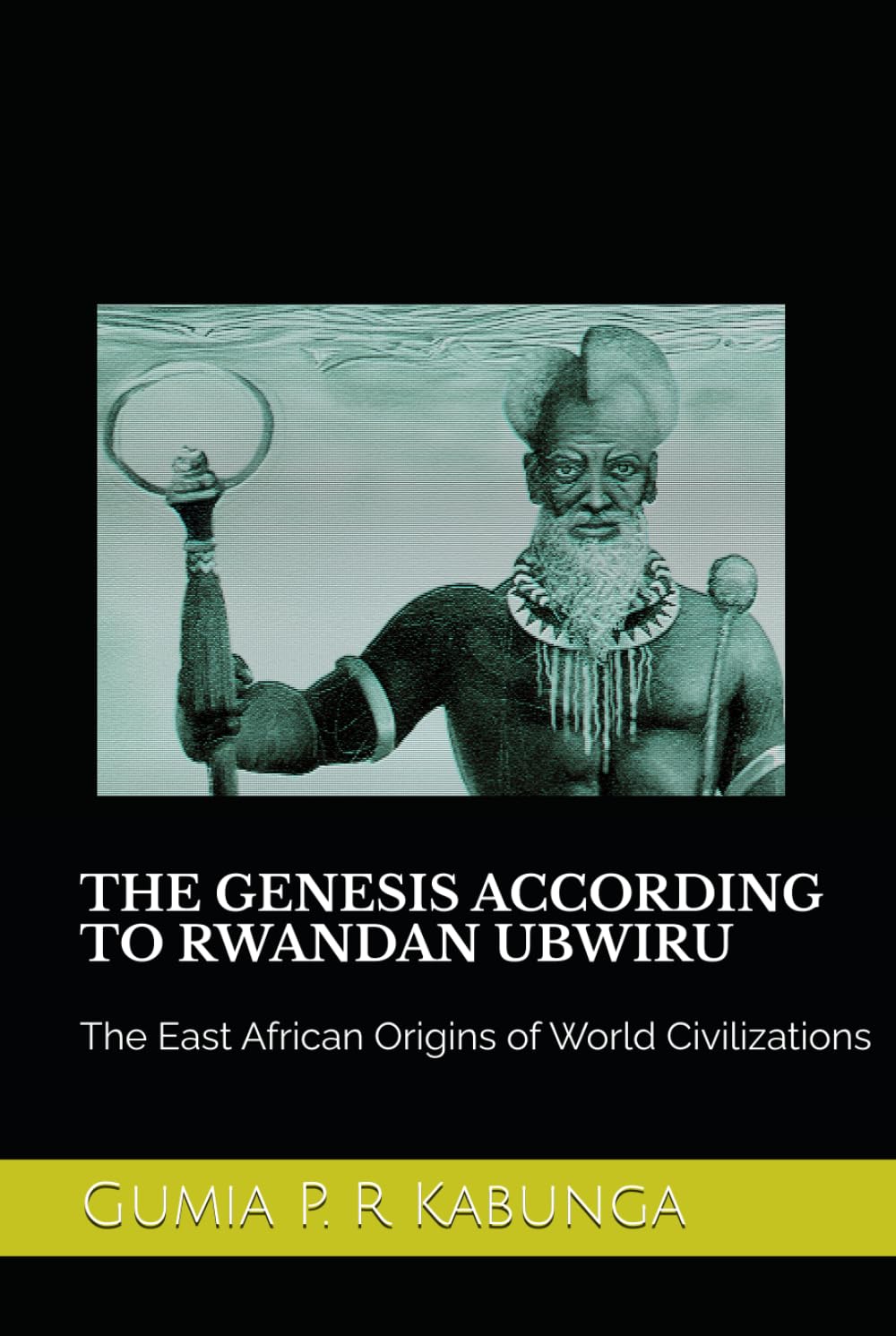
THE GENESIS ACCORDING TO RWANDAN UBWIRU: The East African Origins of World Civilizations
$99.00
by Gumia P.R Kabunga



A groundbreaking work that irrevocably shifts the cradle of civilization from the Middle East to the heart of Africa. For centuries, the origins of human civilization have been attributed to the river valleys of Mesopotamia and Egypt. But what if this foundational narrative is wrong? In this meticulously researched and visually enriched book, Gumia P.R. Kabunga presents a paradigm-shattering argument: the deepest roots of human civilization are not in the Near East, but in the highlands of Rwanda. Drawing from the sacred esoteric traditions of the Ubwiru priesthood, comparative linguistics, and archaeo-astronomy, The Genesis According to Rwandan Ubwiru traces how the intellectual and spiritual blueprints for governance, ritual, and cosmic order first crystallized around Lake Nyarutare (Victoria). From this primordial crucible, known as Gitara-I , these foundational ideas radiated outward, carried by migrating peoples along the Nile corridor to eventually inspire the civilizations of Kemet and Sumer. Enriched with vivid illustrations and depictions of the Gods, Seers, and Kings, this book brings to life the once-hidden figures and myths that shaped the earliest visions of cosmic order and human governance. Discover how: Rwandan Seers accessed the Akashic-like Sea of Ijoro to read the eternal chronicle of time. - Ruganzu w’Ibanze , a Rwandan king, is the historical figure behind the Mesopotamian legend of Sargon of Akkad . - The biblical Tower of Babel and Great Flood narratives find their origins in the saga of Umutiba wa Kimari . - The sacred bull Kibogo provides the archetypal foundation for the Christ figure and the concept of a dying-and-rising savior. - Linguistic forensics reveals that ancient Sumerian and Akkadian words are profoundly rooted in proto-Kinyarwanda . This is not merely a work of historical revisionism but a courageous act of decolonizing knowledge. It challenges the epistemic imperialism that has long erased Africa’s profound contributions to humanity’s shared heritage. The Genesis According to Rwandan Ubwiru is both a revolutionary thesis and a visual journey into the sacred imagination of Africa. It is essential reading for anyone seeking to understand the true, interconnected story of human civilization. This story begins not with stone and monument, but with the sacred architecture of ideas conceived in the highlands of Rwanda. A profound rediscovery of a lost genesis—one that will redefine history, archaeology, and our understanding of humanity’s past.