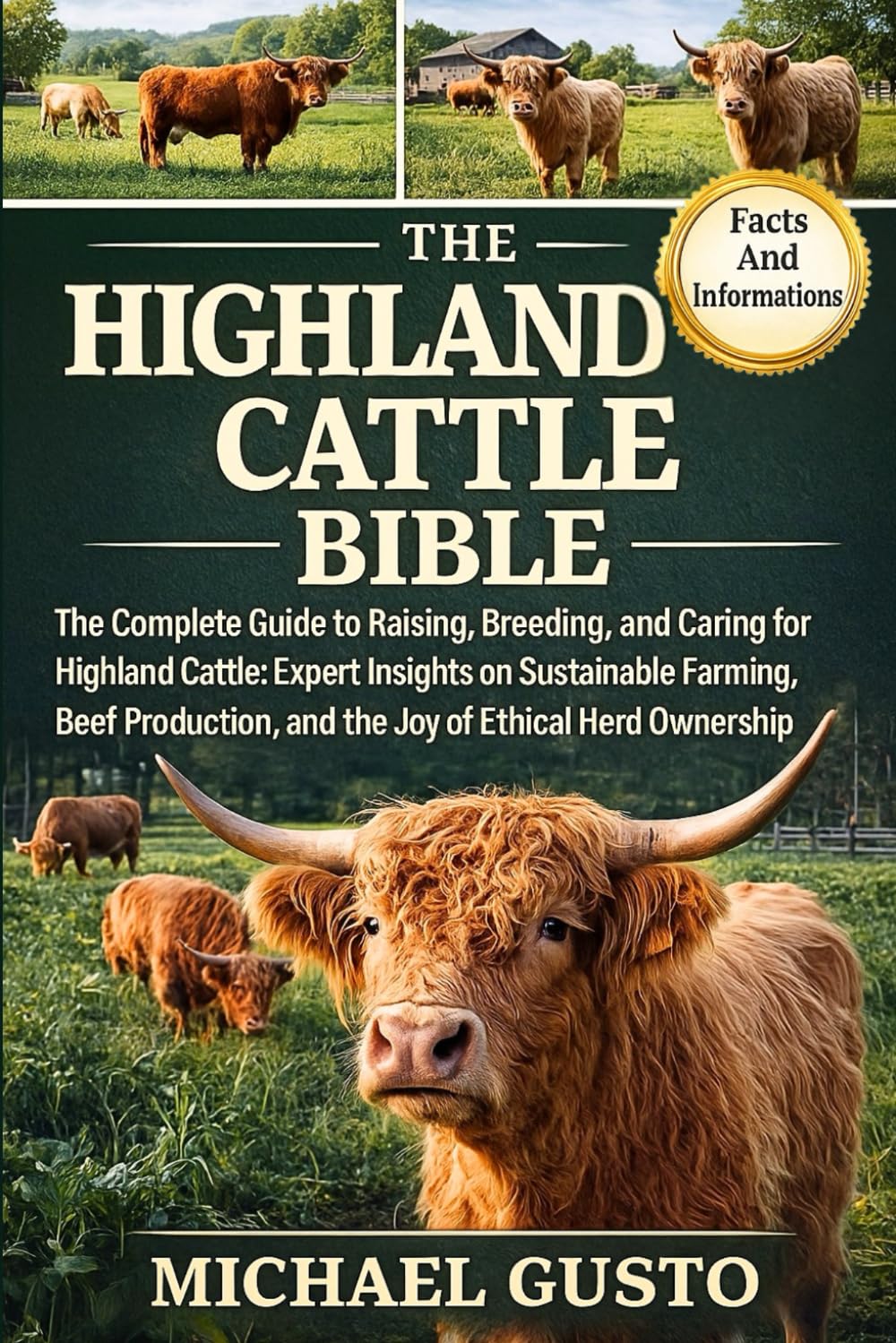
THE HIGHLAND CATTLE BIBLE: The Complete Guide to Raising, Breeding, and Caring for Highland Cattle: Expert Insights on Sustainable Farming, Beef
$17.99
by MICHAEL GUSTO



Introduction to Highland Cattle The Ancient Legacy of the Highlands Few breeds of livestock capture the imagination quite like the Highland cattle—majestic, shaggy-coated creatures whose presence evokes the wild romance of the Scottish Highlands. Their story is one deeply intertwined with Scotland’s rugged geography, unpredictable weather, and centuries of traditional farming. To understand the Highland cattle is to step back into a world shaped by ancient clans, remote glens, and a people who learned to coexist with one of the harshest yet most beautiful landscapes on earth. Historians trace the lineage of Highland cattle back over a thousand years, with written references appearing as early as the 6th century. Yet their true origins likely stretch far earlier, emerging from the ancient Celtic cattle that grazed the northern reaches of Britain. Over centuries, isolation in the mountains and selective breeding for endurance gave rise to a breed uniquely adapted to the environment—strong, intelligent, and remarkably resilient. The Highlander’s lineage is thus not merely agricultural; it is cultural, representing a living relic of Scotland’s pastoral past. A Symbol of Scottish Heritage For the people of Scotland, Highland cattle were never just farm animals—they were icons of survival, wealth, and identity. Across the windswept moors and mist-covered lochs, these cattle became symbols of hardiness and pride. The ancient Highland clans often measured their wealth in cattle rather than coin. Ownership of a herd conferred status and power, while the cattle themselves provided everything from nourishment to clothing. Their thick hides became warm cloaks, their horns were carved into drinking vessels, and their beef sustained entire villages through long winters. Highland cattle were bred primarily in the western and northern regions of Scotland, where the weather could turn from calm to violent in minutes. The crofters—small-scale farmers who worked this challenging land—relied heavily on their cattle for milk, meat, and draft power. Their gentle disposition and ability to thrive on sparse mountain vegetation made them indispensable partners in survival. Even today, Highland cattle remain a symbol of Scottish endurance, proudly displayed in tourism campaigns and heritage imagery as living ambassadors of the Highlands. The Distinctive Appearance of a Highland Legend One of the most enchanting qualities of Highland cattle is their unmistakable appearance. Their long, flowing double coats—often golden red, but also found in shades of black, yellow, brindle, silver, and dun—give them a regal and almost mythical aura. This dense coat is not merely aesthetic; it serves a crucial biological purpose. The outer layer of oily guard hair sheds rain and snow, while the soft, insulating undercoat keeps them warm in sub-zero temperatures. This adaptation allows Highland cattle to live comfortably in climates where other breeds would struggle to survive. Their long, curved horns are equally iconic. In bulls, the horns sweep forward with power and strength, while in cows, they extend gracefully outward and upward. Beyond beauty, these horns serve practical functions—defense against predators, foraging through deep snow, and asserting social dominance within the herd. Their wide-set eyes, fringed with thick lashes, convey a calm intelligence that perfectly mirrors their gentle nature. The combination of rugged features and calm demeanor has earned Highland cattle admiration far beyond Scotland. They are a living paradox—majestic yet approachable, strong yet serene. This balance of power and tranquility is what draws so many farmers, breeders, and enthusiasts to the breed.