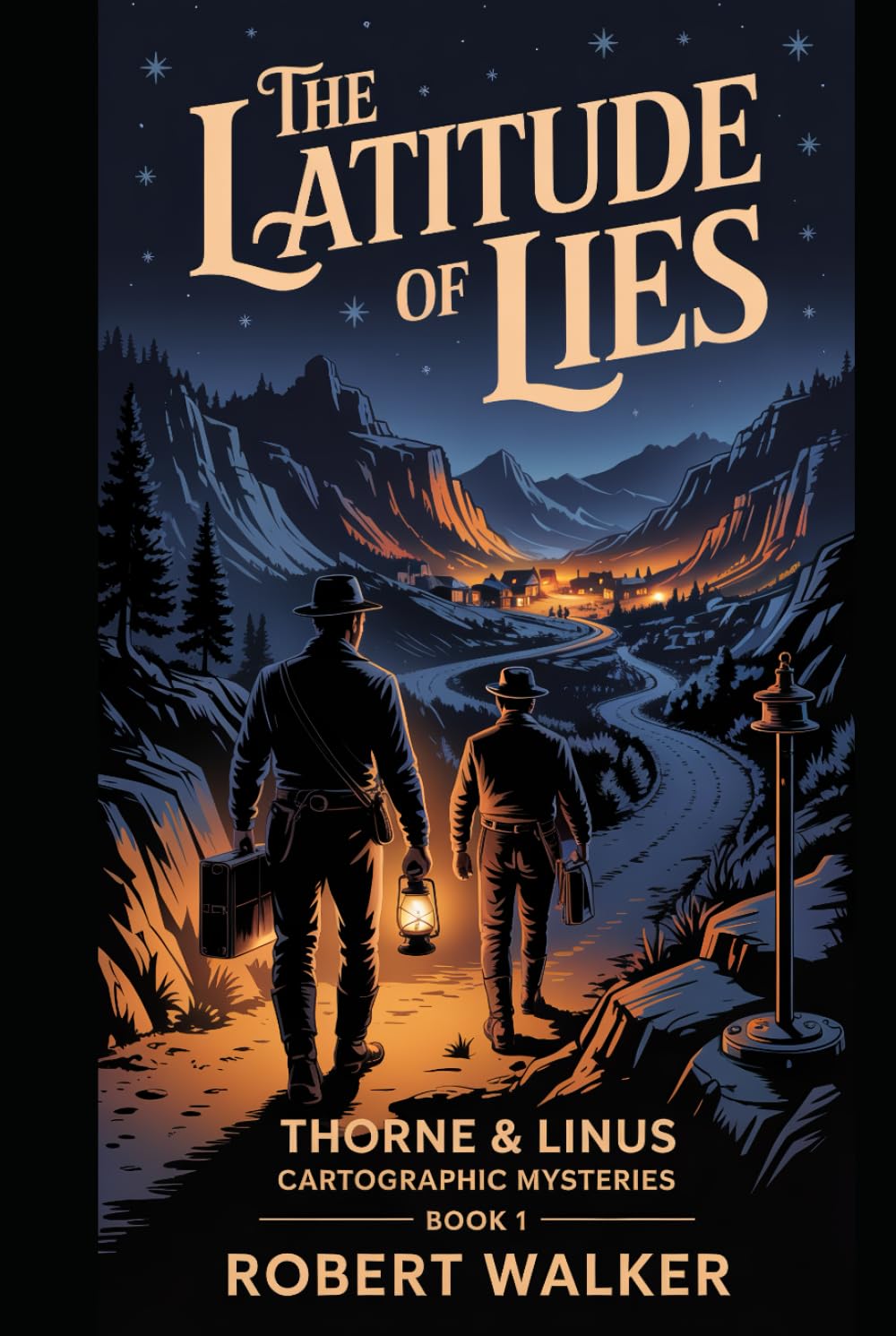
THE LATITUDE OF LIES: Thorne & Linus: Cartographic Mysteries — Book 1
$21.99
by Robert Walker



A crooked street. A dead mapmaker. A survey that rewrote the land itself. Cartographer Silas Thorne measures the world for a living. His partner Linus reads people the way Silas reads terrain — for the angles they hide and the odds they pretend not to calculate. Together, they take commissions that other surveyors won't touch: the maps that don't add up, the boundaries that move overnight, the claims that make investors rich and miners dead. Promise Creek should have been simple. Verify a claim map. Confirm a gold vein. Collect the fee. But the map has been rotated fifteen degrees from true north, hiding a valley behind a survey drawn from a false meridian. The town's founding surveyor is found dead in a locked assay office. The assay reports don't match the ore. The California-Nevada boundary may or may not run through the middle of town, depending on which map you trust. And a brass marker driven into Sierra granite twenty years ago — engraved with a bearing, a date, and three words — connects the murder to a mystery far older and far more personal than a crooked mining claim. To find the killer, Silas and Linus will follow the errors. Because in a town built on lies, the map is the only witness that can't change its story. The Latitude of Lies is the first mystery in the Thorne and Linus series. If you enjoy historical mysteries with wit, atmosphere, and protagonists who solve crimes with compasses instead of revolvers, the next case is already waiting. Book 2, A Compass for the Dead, continues the series on the fog-bound Mendocino coast.