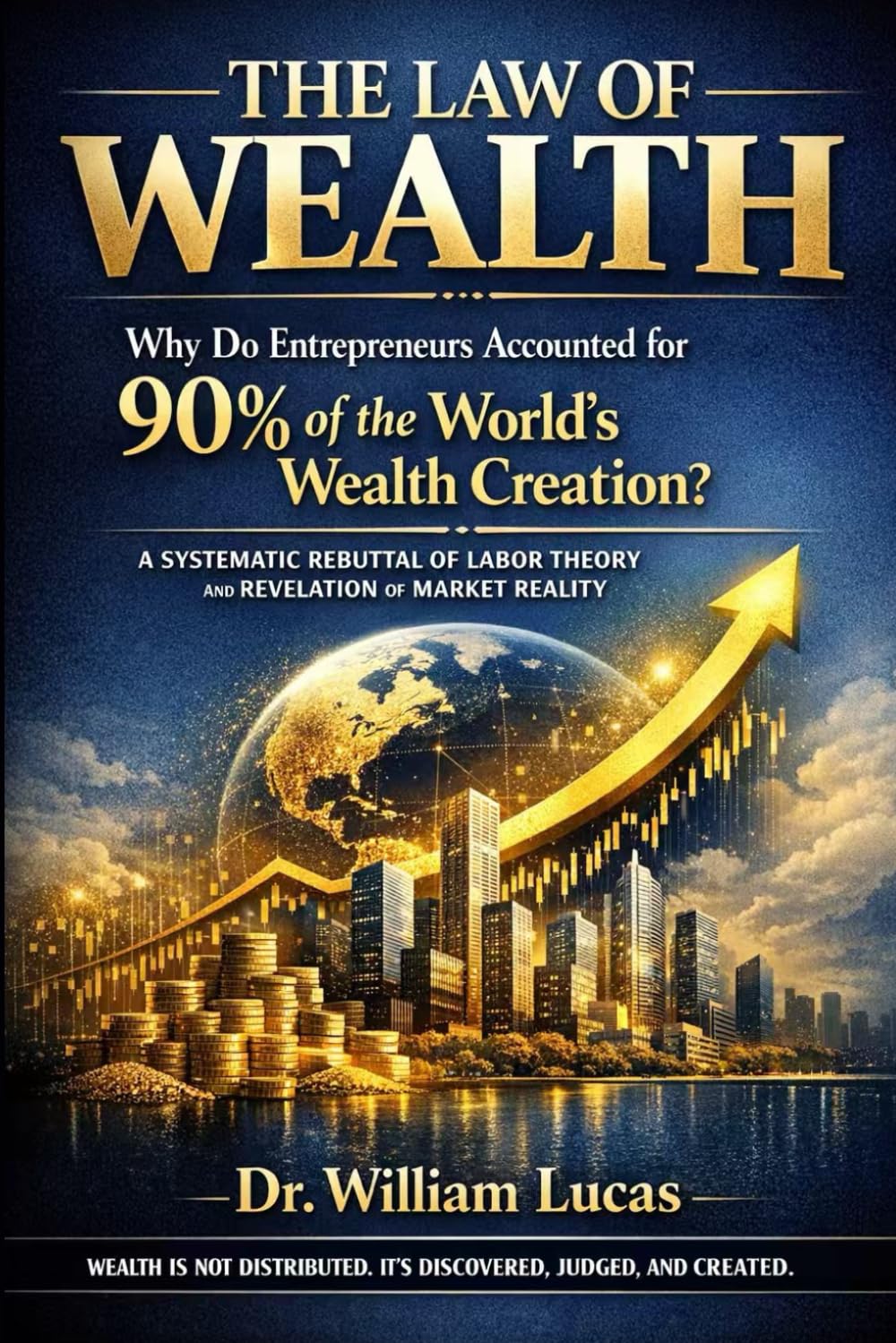
THE LAW OF WEALTH: Why do entrepreneurs accounted for 90% of the world's wealth creation? (The New Economics Series)
$17.99
by WILLIAM LUCAS



Based on centuries of market economy practice in Europe and the United States, "The Law of Wealth" subverts the prevalent misunderstanding that "wealth originates from distribution" and reveals the true operational logic of the market economy: the essence of wealth lies in creation rather than a zero-sum game, and entrepreneurs are the core value creators of modern civilization, contributing over 90% of the incremental wealth. The book points out that in the leap of human society from agricultural civilization to industrial civilization, and further to digital intelligent civilization, every economic prosperity in Europe and the United States has been inseparable from the innovative practices of entrepreneurs. During the British Industrial Revolution, entrepreneurs such as James Watt and Richard Arkwright created enormous incremental value through technological innovation; in contemporary Silicon Valley, USA, entrepreneurs like Elon Musk and Jensen Huang have disrupted the new energy and AI sectors, while enterprises such as Apple and Google have built ecosystems that spawned entirely new industries and massive employment opportunities. This wealth does not stem from the exploitation of workers or the plunder of consumers, but from entrepreneurs' insight into hidden demands, restructuring of scattered resources, and willingness to take the lead in bearing innovation risks—this core capability is irreplaceable and unattainable for ordinary labor executors. The essence of the market economy is a "voting system" dominated by consumers. In European and American markets, consumers cast votes with their currency, and voluntary transactions form the foundation of wealth creation. Enterprise profits are society's reward for their value creation, not immoral surpluses. The book systematically criticizes the labor theory of value, pointing out that labor, capital, and technology are merely tools—only entrepreneurs can determine "whether value exists." The boundary of distribution lies in "only dividing already created wealth." Historical lessons in Europe and the United States are profound: excessive distribution practices such as Greece's high welfare policies and France's "75% wealth tax" led to capital outflow and stagnant innovation; in contrast, the United States' relaxed market environment and relatively low tax rates provided fertile ground for entrepreneurial innovation, enabling tech giants to achieve global leadership. The final conclusion is clear: true fairness lies in equal opportunity for creation, not egalitarian distribution. The code to Europe and America's prosperity lies in respecting entrepreneurs, protecting profits, and encouraging risk-taking. Any society that denies the value of entrepreneurs and punishes success will ultimately lose innovation and growth. In a mature market civilization, leadership will ultimately belong to those who continuously create value rather than repeatedly dividing existing resources—this is the core summary and inspiration of "The Law of Wealth" for European and American practices.