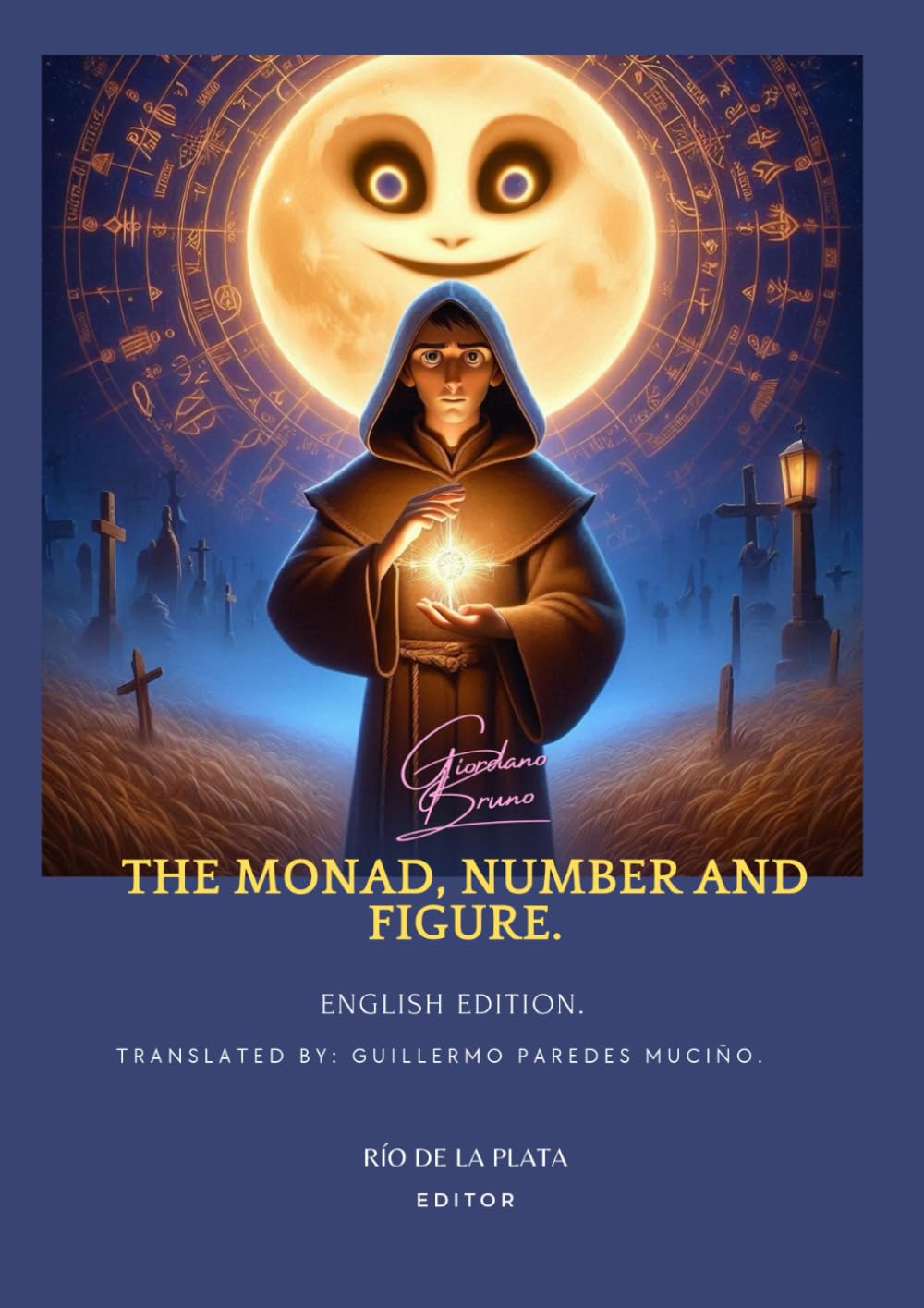
THE MONAD, NUMBER, AND FIGURE: Most Secret Elements of Physics, Mathematics, and Metaphysics.
$58.00
by Giordano Bruno



"On the Monad, Number, and Figure" (1591) represents one of the most fascinating and complex works of Bruno's thought, where the Nola philosopher masterfully weaves sacred mathematics, mystical geometry, and philosophical speculation with a poetic style. This work, published during his stay in Frankfurt, serves as a true prism where multiple esoteric and philosophical traditions of the Renaissance converge. The treatise stands as a singular bridge between Renaissance Neoplatonism and the Hermetic tradition, where Bruno develops a mathematical cosmology that transcends mere numerology. The monad, a central concept of the work, is not simply a numerical unit but the fundamental metaphysical principle that Bruno perceives as the purest expression of divinity. This interpretation reveals a sophisticated reading that goes beyond traditional Pythagoreanism, incorporating elements of Christian Kabbalah and the Hermetic tradition. What is truly revolutionary about this work lies in how Bruno uses geometry as a language to describe the indescribable. Each geometric figure becomes a living symbol that unveils aspects of divine reality. The circle, triangle, and square are not mere forms but manifestations of fundamental cosmic principles. This geometric approach to the divine represents a significant innovation in Renaissance thought. The esoteric dimension of the text operates on multiple levels. For the seeker of numerological knowledge, Bruno offers an intricate system where each number possesses multiple related meanings. Numbers are not mere calculation tools but keys to understanding the very structure of the universe. The numerical progression becomes a map of divine emanation, where each number reveals a different aspect of cosmic reality. Particularly notable is how Bruno integrates Kabbalistic tradition into his mathematical thought. Numbers are not just quantities but active qualities that structure reality. This fusion of mathematics and mysticism produces a unique work in the history of Western thought, where the quest for mathematical truth transforms into a search for spiritual enlightenment. Ultimately, this work stands as an extraordinary testament to humanity's capacity to fuse different traditions in pursuit of a deeper understanding of reality. Bruno bequeathed us not only a treatise of mystical mathematics but a vision of the universe where science and spirituality are not antagonistic but complementary aspects of the same quest for truth and a full conscious manifestation of its eternal power. For within Himself, he found the Eternal.