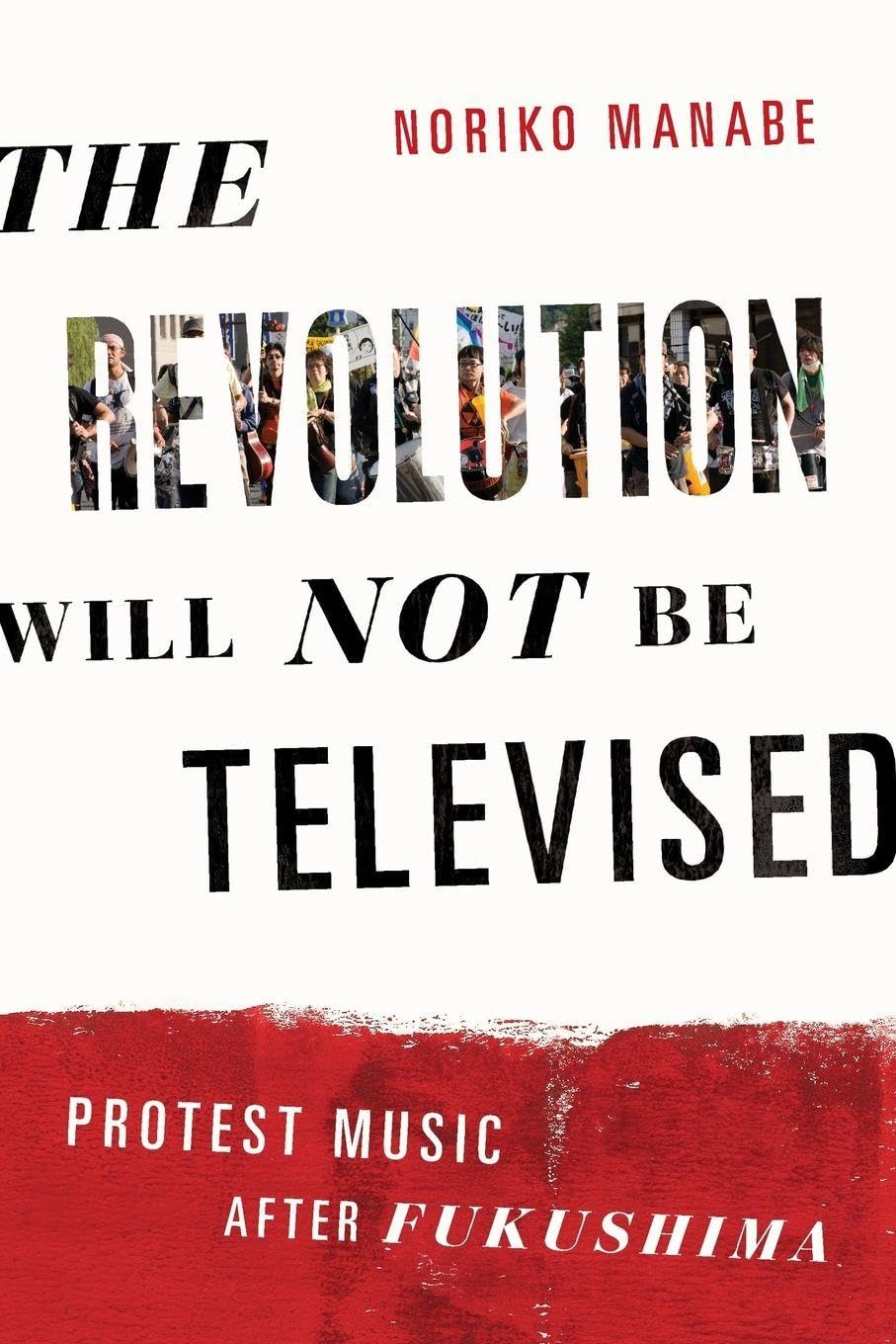
THE REVOLUTION WILL NOT BE TELEVISED: Protest Music After Fukushima
$25.71
by Noriko MANABE



Nuclear power has been a contentious issue in Japan since the 1950s, and in the aftermath of the Fukushima nuclear power plant disaster, the conflict has only grown. Government agencies and the nuclear industry continue to push a nuclear agenda, while the mainstream media adheres to the official line that nuclear power is Japan's future. Public debate about nuclear energy is strongly discouraged. Nevertheless, antinuclear activism has swelled into one of the most popular and passionate movements in Japan, leading to a powerful wave of protest music. The Revolution Will Not Be Televised: Protest Music After Fukushima shows that music played a central role in expressing antinuclear sentiments and mobilizing political resistance in Japan. Combining musical analysis with ethnographic participation, author Noriko Manabe offers an innovative typology of the spaces central to the performance of protest music--cyberspace, demonstrations, festivals, and recordings. She argues that these four spaces encourage different modes of participation and methods of political messaging. The openness, mobile accessibility, and potential anonymity of cyberspace have allowed musicians to directly challenge the ethos of silence that permeated Japanese culture post-Fukushima. Moving from cyberspace to real space, Manabe shows how the performance and reception of music played at public demonstrations are shaped by the urban geographies of Japanese cities. While short on open public space, urban centers in Japan offer protesters a wide range of governmental and commercial spaces in which to demonstrate, with activist musicians tailoring their performances to the particular landscapes and soundscapes of each. Music festivals are a space apart from everyday life, encouraging musicians and audience members to freely engage in political expression through informative and immersive performances. Conversely, Japanese record companies and producers discourage major-label musicians from expressing political views in recordings, forcing antinuclear musicians to express dissent indirectly: through allegories, metaphors, and metonyms. The first book on Japan's antinuclear music, The Revolution Will Not Be Televised provides a compelling new perspective on the role of music in political movements. Winner, John Whitney Hall Book Prize, Association for Asian Studies, 2017 "In a creative, interdisciplinary study, Manabe connects spatial theory and musical analysis to a sociological argument about political protest. . . The book and accompanying website, which presents footage from the protests, are wonderful teaching resources, and they will also change how we think about performance and social change. . . This timely book reminds us of the spaces of possibility, community, and hope possible through mobilization, creativity, and music." --Hall Prize Committee Winner, BFE Book Prize, British Forum for Ethnomusicology, 2018 "In this moment of heightened and anxious scrutiny of cyberspace as a forum for both activism and manipulation, Manabe's book offers a thoughtful ethnographic look at a specific context for music and political action, in a variety of spaces both physical and virtual."--BFE Book Prize Committee Honorable Mention, Alan Merriam Book Prize, Society for Ethnomusicology, 2016 "The committee was in awe of the scope, depth, and risk-taking of the author's research-- at demonstrations and festivals, and with both indie and major label recordings musicians and producers; and in cyberspace. Her command of policy and its legal implications was as strong as her expert performance ethnography and music analysis. This study teaches us a great deal about the techniques of messaging, and the ways music breaks through the walls of official and unofficial censorship."--Merriam Prize Committee "[Manabe] was able to see the protests from the inside and make a very fine-grained analysis of the role of music in them. . . the analysis of the spaces of contention can be extended to other forms of cultural dissent seen in recent protests, both in Japan and around the world."--Wesley Sasaki-Uemura, University of Utah, in Japanese Studies "The Revolution Will Not Be Televised . . . is much more than a music ethnography: it is relevant to the study of social movements, antinuclear politics, and collusion between governments and corporate media. . . . its rich detail and clear exposition make it ideal for course adoption. If instructors choose not to assign the whole book, individual chapters will work well in courses on anthropology, media studies, sociology, political science, history, ethnomusicology, and urban geography. The companion website is an important resource, as well, providing links to videos and sound clips that help readers experience post-3.11 musical protests themselves."--E. Taylor Atkins, Northern Illinois University, in H-Net Reviews "[Manabe's] book is not just an examination of music's role in public protests but is an i