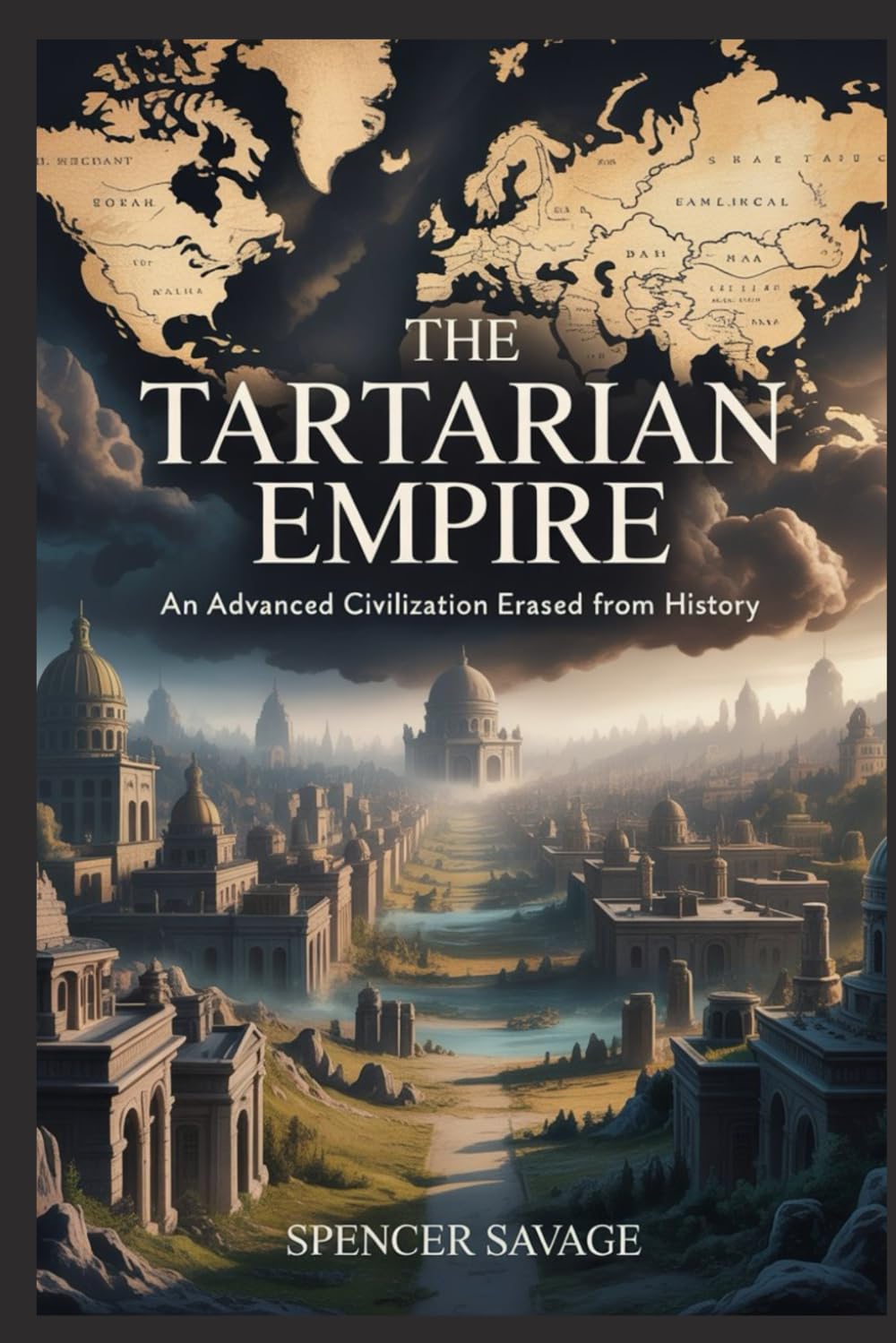
THE TARTARIAN EMPIRE: An Advanced Civilization Erased From History (Worlds Empires Collection)
$10.99
by Spencer Savage



What if an entire civilization was erased, not by time, but by rewriting? For centuries, old maps told a story modern history no longer explains. A vast region labeled Tartaria stretched across Europe and Asia, appearing again and again in official cartography, only to vanish suddenly in the 1800s. No gradual decline. No clear explanation. Just silence. What you’re about to discover will change how you see maps, cities, and history itself. This book takes you deep into one of the most unsettling historical mysteries of our time. By examining forgotten maps, impossible architecture, buried cities, strange photographs, global catastrophes, and persistent myths, it asks a question few are willing to confront: What if history is incomplete? You’ll explore why monumental buildings appear too advanced for their era, why entire city levels lie buried beneath modern streets, why star forts share the same precise geometry across continents, and why old photographs show vast cities with no people. You’ll uncover how disasters like fires, earthquakes, wars, and pandemics may have acted as resets, clearing not just land, but memory. Few people know that questioning history isn’t denial, it’s inquiry. This book doesn’t demand belief. It invites investigation. It connects patterns across disciplines and continents, revealing how inherited narratives may hide as much as they explain. This journey matters now more than ever, in a world where information is abundant but understanding is rare. If you are curious, skeptical, open minded, and unafraid to ask uncomfortable questions, this book was written for you. The hidden truth behind Tartaria may not be a single answer, but the realization that the past is far stranger than we’ve been told. Ready to uncover what history may still be hiding? Click Buy Now and start asking the questions that refuse to go away. ⭐⭐⭐⭐⭐ A rare work that treats alternative history with discipline rather than sensationalism. This book doesn't tell the reader what to think. It walks carefully through maps, architecture, disasters, and silence in the record, then lets the weight of pattern do the work. Whether one agrees with every implication or not, the scholarship of questioning is solid and respectful of the reader's intelligence. — Dr. Eleanor Whitmore, Historical Geographer ⭐⭐⭐⭐⭐ I've studied nineteenth-century architecture for over two decades, and this book articulates a discomfort many professionals feel but rarely voice. The questions raised about scale, speed of construction, and continuity are legitimate and long overdue. This is not denial of history. It is engagement with it. — Marcus Delaney, Architectural Historian ⭐⭐⭐⭐⭐ What impressed me most was restraint. The author never overreaches. Instead, the narrative stays grounded in physical evidence and documented inconsistencies. As an archaeologist, I appreciate work that respects uncertainty rather than disguising it. This book does exactly that. — Dr. Salma Hargreaves, Field Archaeologist ⭐⭐⭐⭐⭐ I found myself underlining passages and stopping to reflect, which rarely happens anymore. The discussion of erased maps and sudden narrative shifts is handled with care and clarity. It challenges without provoking defensiveness, which is a difficult balance to strike. — Jonathan Pierce, Research Editor, Historical Review Quarterly ⭐⭐⭐⭐⭐ This book succeeds where many fail. It understands that history is not only about what we know, but about what we no longer remember. The sections on catastrophe and memory loss are especially compelling and responsibly argued. — Prof. Daniel Kovács, World History ⭐⭐⭐⭐⭐ As someone who works daily with archival material, I can say this book asks the right questions. Records disappear. Context is lost. That reality alone makes this investigation worthwhile. The author approaches the subject with seriousness rather than spectacle. — Lydia Chen, Senior Archivist ⭐⭐⭐⭐⭐ I'll say this plainly: I don't agree with every implication, but I respect the work deeply. That's the mark of strong historical writing. It invites dialogue rather than demanding agreement. The analysis of old photographs is particularly thoughtful. — Thomas Reed, Cultural Historian ⭐⭐⭐⭐⭐ This is not fringe writing. It's careful, patient, and grounded. The author understands how narratives are formed and how easily complexity is flattened over time. The book restores that complexity without becoming chaotic. — Dr. Helena Morris, Anthropological Studies ⭐⭐⭐⭐⭐ I came into this book skeptical and left it more curious, which is exactly what good history should do. The connections drawn between geography, architecture, and memory feel earned, not forced. — Andrew Whitfield, Historical Cartography Specialist ⭐⭐⭐⭐⭐ Few books manage to feel both unsettling and responsible at the same time. This one does. It doesn't claim to close the case on Tartaria. It opens it carefully and leaves the reader better equipped to thi