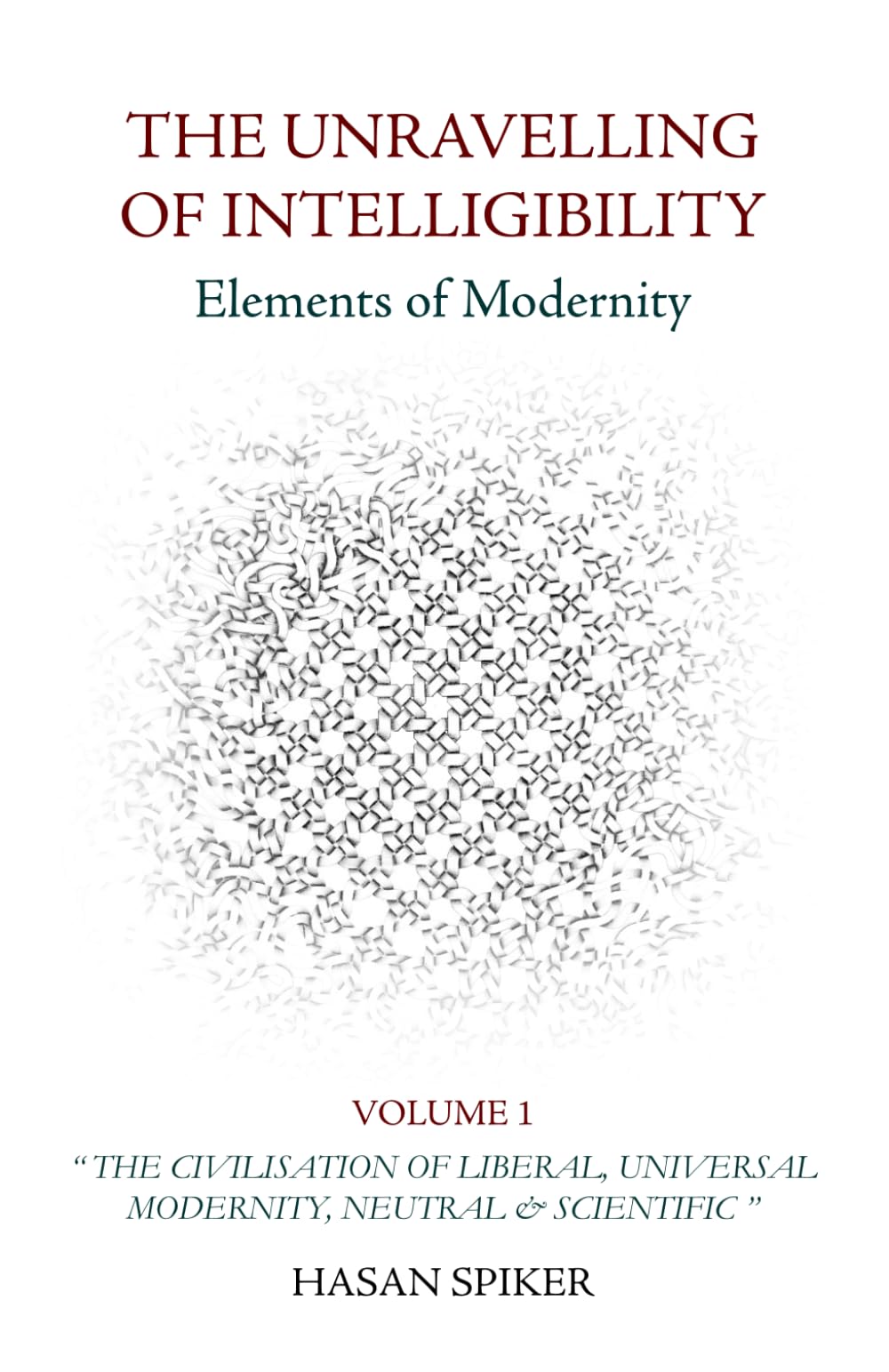
THE UNRAVELLING OF INTELLIGIBILITY - Elements of Modernity: Volume One: "The Civilisation of Liberal, Universal Modernity, Neutral & Scientific"
$15.99
by Hasan Spiker



The intelligibility of Western thought is unravelling, and the same is true of its attendant societal structures; indeed, they are in the final stages of unravelment. We are now entering a historical singularity, within a civilizational phenomenon, modernity, that was already, in any case, sui generis. This series of books, ‘Elements of Modernity’ which contribute to a whole entitled The Unravelling of Intelligibility , will demonstrate how and why this is taking place. As the volumes in this series unfold, we will see how this stubborn self-erosion has been carried out throughout the history of modernity, as also in key areas of contemporary life: in urban environment and interpersonal relationships, progress and the self-creating individual, immanentism and the intelligibility of nature, faith and reason, ‘science’, gender and family, power politics, and postcolonialism. The five ‘bifurcations’ or ‘severances’ of Christian and post-Christian civilisation constitute the central explanatory framework through which this unravelling is examined and explicated. These bifurcations are: the severance of law and spirit, which emerges in Pauline Christianity; the severance of spiritual power and temporal power in the early Middle Ages; the severance of faith and reason in the later Middle Ages; and in early modernity, the twin severances of natural world and knowing subject, and that of morality and ontology. IN THIS FIRST ELEMENT In volume 1, Spiker explores the purported ‘universality’ and ‘neutrality’ of the post-Enlightenment system, which has been exported around the world so successfully that today, it is direct descendants of the nations that suffered under colonialism who are most often found to be its most uncompromising devotees, insisting that the neutral, universal Civilisation is no longer ‘Western’ but has become simply ‘modern.’ The five severances are then introduced, and their explanatory power is demonstrated through an analysis of the contemporary unravelling of urban environment, craft, and interpersonal relationships.