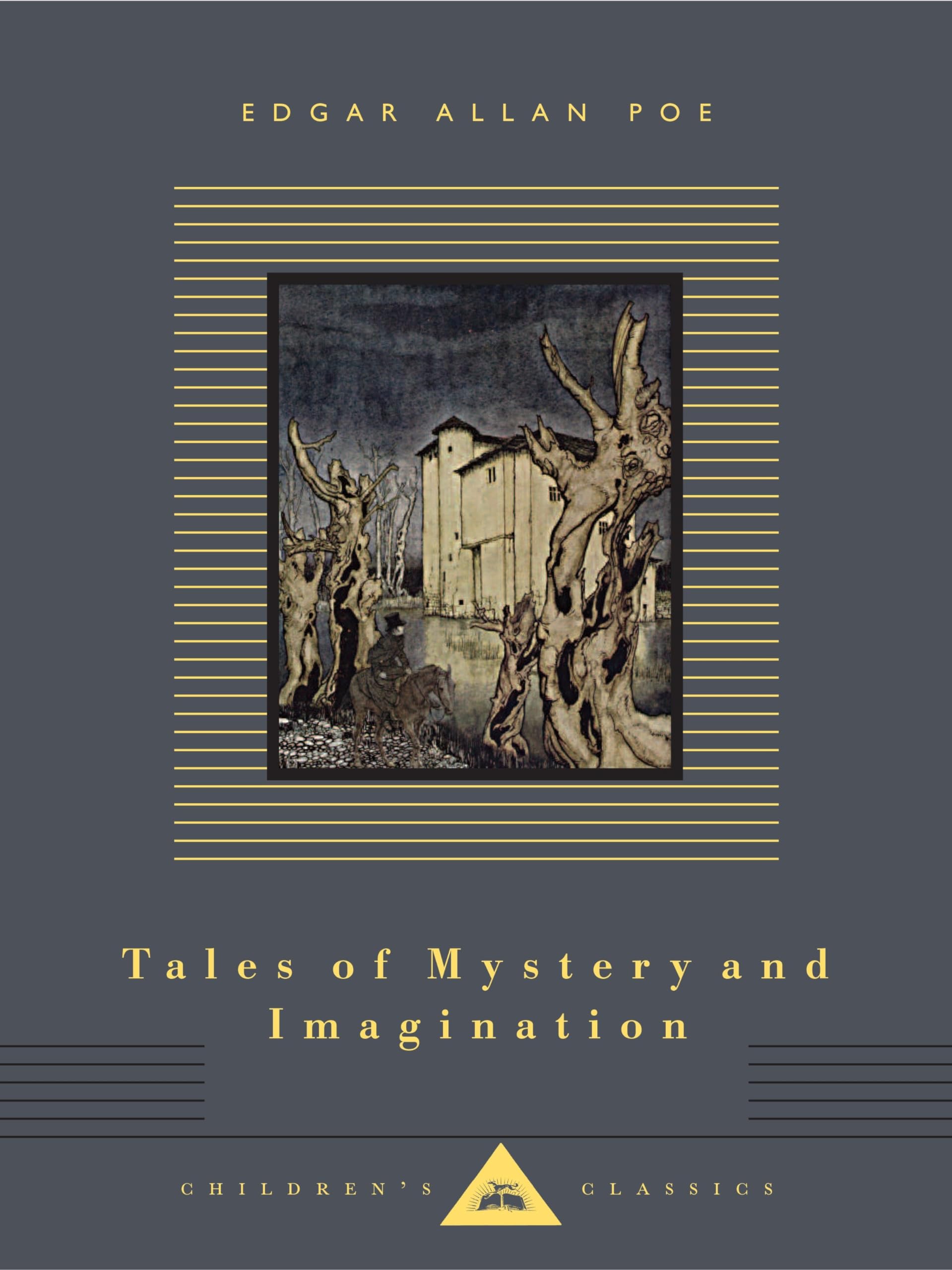
Tales of Mystery and Imagination: Illustrated by Arthur Rackham (Everyman's Library Children's Classics Series)
$17.36
by Edgar Allan Poe



On the 150th anniversary of artist Arthur Rackham's birth, a gorgeous hardcover--the only one in print--of his delightfully spooky illustrated edition of the tales of Poe. EVERYMAN'S LIBRARY CHILDREN'S CLASSICS. Arthur Rackham is widely regarded as one of the leading illustrators from the golden age of British book illustration, known for his richly imagined fantasy illustrations of fairy tales and other children's books. Known as "The Dean of Fairyland," he developed what has been described as a fusion of Nordic style with Japanese woodblock traditions. His illustrated Tales of Mystery and Imagination by Edgar Allan Poe, first published in 1935, contains a selection of twenty-five of Poe's best stories, including "The Tell-Tale Heart," "The Murders in the Rue Morgue," "The Gold-Bug," "The Cask of Amontillado," and "The Pit and the Pendulum." Our beautiful Children's Classics hardcover edition, with Rackham's inventive full-color and black-and-white illustrations, makes an irresistible gift for fans of all ages. Arthur Rackham (1867-1939) was born in Lewisham, England, and studied at the Lambeth School of Art. Among his best-known illustrations are the ones he created for Cinderella, Sleeping Beauty , Grimm's Fairy Tales , J. M. Barrie's Peter Pan , and Kenneth Grahame's The Wind in the Willows. His income from his book illustrations was augmented by annual exhibitions of his artwork, including one at the Louvre in Paris in 1914. Rackham won a gold medal at the Milan International Exhibition in 1906 and another at the Barcelona International Exposition in 1912. THE OVAL PORTRAIT The château into which my valet had ventured to make forcible entrance, rather than permit me, in my desperately wounded condition, to pass a night in the open air, was one of those piles of commingled gloom and grandeur which have so long frowned among the Apennines, not less in fact than in the fancy of Mrs Radcliffe. To all appearance it had been temporarily and very lately abandoned. We established ourselves in one of the smallest and least sumptuously furnished apartments. It lay in a remote turret of the building. Its decorations were rich, yet tattered and antique. Its walls were hung with tapestry and bedecked with manifold and multiform armorial trophies, together with an unusually great number of very spirited modern paintings in frames of rich golden arabesque. In these paintings, which depended from the walls not only in their main surfaces, but in very many nooks which the bizarre architecture of the chateau rendered necessary—in these paintings my incipient delirium, perhaps, had caused me to take deep interest; so that I bade Pedro to close the heavy shutters of the room—since it was already night—to light the tongues of a tall candelabrum which stood by the head of my bed—and to throw open far and wide the fringed curtains of black velvet which enveloped the bed itself. I wished all this done that I might resign myself, if not to sleep, at least alternately to the contemplation of these pictures, and the perusal of a small volume which had been found upon the pillow, and which purported to criticize and describe them. Long—long I read—and devoutly, devotedly I gazed. Rapidly and gloriously the hours flew by, and the deep midnight came. The position of the candelabrum displeased me, and outreaching my hand with difficulty, rather than disturb my slumbering valet, I placed it so as to throw its rays more fully upon the book. But the action produced an effect altogether unanticipated. The rays of the numerous candles (for there were many) now fell within a niche of the room which had hitherto been thrown into deep shade by one of the bedposts. I thus saw in vivid light a picture all unnoticed before. It was the portrait of a young girl just ripening into womanhood. I glanced at the painting hurriedly, and then closed my eyes. Why I did this was not at first apparent even to my own perception. But while my lids remained thus shut, I ran over in mind my reason for so shutting them. It was an impulsive movement to gain time for thought—to make sure that my vision had not deceived me—to calm and subdue my fancy for a more sober and more certain gaze. In a very few moments I again looked fixedly at the painting. That I now saw aright I could not and would not doubt; for the first flashing of the candles upon that canvas had seemed to dissipate the dreamy stupor which was stealing over my senses, and to startle me at once into waking life. The portrait, I have already said, was that of a young girl. It was a mere head and shoulders, done in what is technically termed a vignette manner; much in the style of the favourite heads of Sully. The arms, the bosom and even the ends of the radiant hair, melted imperceptibly into the vague yet deep shadow which formed the background of the whole. The frame was oval, richly gilded and filigreed in Moresque. As a thing of art nothing could be more admirable than