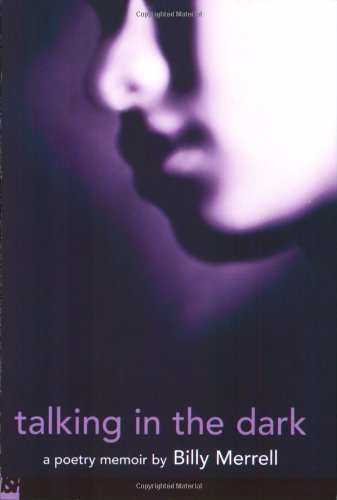



PUSH continues to break new ground with this remarkable poetry memoir of growing up, coming out, and exploring love. This is a memoir that is lived in moments. The moments you know - when you see your parents' marriage dissolving, when you realize you're a boy who likes boys, when you speak the truth and don't know if it will be heard. The moments you don't recognize until later - when you leave things unsaid (even to yourself), when you feel your boyfriend letting go, when you give up on love. And the moment you get love back. In an amazing narrative of poems, Billy Merrell tells an ordinary story in an extraordinary way. Grade 9 Up-An affecting memoir told in verse, this work launches a promising young poet. It is more than the recollection of faltering family life; it also deals with Merrell's acceptance of his homosexuality. It is about sons and brothers, friends and lovers. The individual poems enhance one another yet stand alone. The language is measured, doled out carefully, artfully. He writes about his mother: "She's known, she'll say, since I was five/and I'll want to ask why/she didn't tell me sooner, but instead ask/if she's okay." Memories of when he and his father almost speak of his closet homosexuality, and when the moment passes are related in poignant phrases. The poems reveal the author's journey through childhood through the worrisome pit of teen sexuality, made all the more harrowing when a lover dies of AIDS. He silently carries around his fear for ages. He writes, "Admitting/the danger is a danger in itself." This memoir is as difficult as it is beautiful. Merrell writes, "Years later I'll wonder how I didn't know I was lonely when everyone around me did." His sophisticated verse and compelling story will capture attention as it stirs compassion. Alison Follos, North Country School, Lake Placid, NY Copyright © Reed Business Information, a division of Reed Elsevier Inc. All rights reserved. Gr. 9-12. Merrell has packed a lot of memories into his 22 years: his parents' divorce and remarriages ("I was seven, and remember you loving each other, then not"); realization of his homosexuality ("You sort of know. In that vague way you know you want to write or paint"); and his own failed and new relationships. He has also packed away a lot of wisdom about life, death, self-acceptance, and the vagaries of love and lust. Likewise, he has honed his writing craft, and his free-verse memoir is rich with metaphor, words carefully chosen to say enough but not too much. In one beautiful poem, for example, he alludes to death as that first terrifying jump off the diving board: "Is that what Heaven is like--four seconds and a splash?" Talking in the Dark captures 22 lonely yet hopeful years in a life readers will hope will be a long and productive one. Frances Bradburn Copyright © American Library Association. All rights reserved At 22, Billy Merrell is the youngest author to date published by the Push Imprint of Scholastic Inc. Merrell, who grew up in Jacksonville Florida, began writing poetry around eighth grade. He had a better grasp of rhyme and meter than the other students in his classes, and as a result, the teacher began giving him more challenging poetry assignments rather than less expressive work. It wasn’t until his sophomore year of high school that Merrell began to write about his own feelings, and recognized writing poetry as a liberating activity. Merrell is recent graduate of the University of Florida with a B.A. in English. During the summer, earlier in his college career, Merrell was hired as the first PUSH Writing Intern. During this summer internship, Merrell came to New York City and began work on his first book. The culmination of his work with PUSH is talking in the dark, a memoir composed of poetry that documents a story of growing up, coming out and exploring love. As a gay man himself, Merrell sought to write a book that he felt could have been of use to him as a teenage boy coming out. It is an affecting memoir told in verse, this work launches a promising young poet
.[Merrell’s] sophisticated verse and compelling story will capture attention as it stirs compassion.” School Library Journal