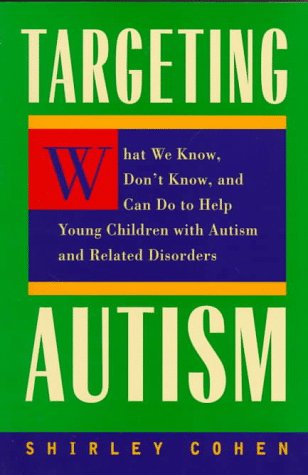
Targeting Autism: What We Know, Don't Know, and Can do to Help Young Children with Autism and Related Disorders
$12.67
by Shirley Cohen



Targeting Autism reaches out to everyone who lives with or cares about a young child with autism. First published in 1998 and updated in 2002, author Shirley Cohen has recast this best seller throughout to chart the dynamics of the autism world in the first years of the twenty-first century. In this expanded edition she provides specifics about the new developments that have modified the map of the world of autism or that may do so in the near future. Shirley Cohen is Professor of Special Education at Hunter College of the City University of New York. Her previous books include Special People: A Brighter Future for Everyone with Physical, Mental, and Emotional Disabilities (1977) and Respite Care: Principles, Programs, and Policies (1985). Targeting Autism What We Know, Don't Know and Can Do to Help Young Children with Autism By Shirley Cohen University of California Press Copyright © 1998 Shirley Cohen All right reserved. ISBN: 9780520213098 1 Meeting Autism There she moved, every, day, among us but not of us, acquiescent when we approached, untouched when we retreated, serene, detached. . . . Existing among us, she had her being elsewhere. (Park 1982, 12) I visit the home of parents I recently met. Their five-year-old son is standing on his head on the couch. I go up to him, turn my head to the side, and say, "Hello, Kenneth." "Hello, Kenneth," he echoes. I enter a room at a hotel where an informal meeting is taking place. As soon as I step through the doorway, a handsome, nicely dressed young man of perhaps seventeen walks up to me and tells me his name. The following exchange then takes place. "What is your name?" "Shirley." "What is your sister's name?" "Which sister?" "How many sisters do you have?" "Two." "What are their names?" "Paula and Sandy." "What is your brother's name?" "How do you know I have a brother?" After faltering for a second he continues, "You don't have a brother?" His attention then immediately shifts to the person who entered the room after me, and the same questioning routine begins again. I am at a national conference on autism. Walter, a man perhaps in his mid-twenties, draws my attention. He claps loudly when anyone is introduced, and as he does so his mouth opens, his head moves from side to side, and his eyes appear to focus at a point near the ceiling. Walter and his mother are sitting only a few feet from the bluegrass band that is to play at the conference reception. As soon as the loud and lively music starts, Waiter's hands begin to twist rapidly in arcs before him, the right one clockwise, the left counterclockwise. He keeps clasping his hands together, whether to stop their movement or to clap I don't know, but his hands keep breaking loose. His head turns faster and faster, keeping time with both his hands and the music. When the music ends, Walter's movements slow to a stop. He looks at the ceiling briefly and then sits quietly. A woman who has a Ph.D. is making a presentation: Temple Grandin has written two books about herself as well as numerous articles on autism. She is also the subject of an intensive case study in the book An Anthropologist on Mars by the neurologist Oliver Sacks. Temple Grandin is a person with autism. We glimpse here a few of the many faces of autism. One of the most striking aspects of the condition (or conditions) labeled "autism" is its variability. What then do people called autistic have in common? What does that term autism mean if it encompasses such heterogeneity? What is the concept behind the label? To answer this question we need to look across several perspectivesb those of researchers, clinicians, parents, and adults with autism. We can begin by studying the "bible" of diagnostic categories and labels, the American Psychiatric Association's Diagnostic and Statistical Manual of Mental Disorders (DSM-IV), now in its fourth edition. Autism is classified by DSM-IV as a pervasive developmental disorder, a term meant to indicate "severe and pervasive impairment in several areas of development: reciprocal social interaction skills, com- munication skills, or the presence of stereotyped behavior, interests, and activities" (APA 1994, 65). Let's look at what autism may mean through examples provided by parents. Qualitative impairment in social interaction . Catherine Maurice describes the social isolation of her infant daughter. Anne-Marie was not shy: she was largely oblivious to people, and would sometimes actually avoid them, including, a lot of the time, her own mother. She drifted toward solitary spaces: the corners of a room, behind the curtains, behind the armchair. If I was somewhere else in the apartment, she never sought me out. . . . Worst of all, perhaps, was the lack of that primary connection: the sweet steady gazing into one's eyes that we began to see all around us in other toddlers. . . . Sometimes I would catch her gazing in my direction and would start up, eager to respond