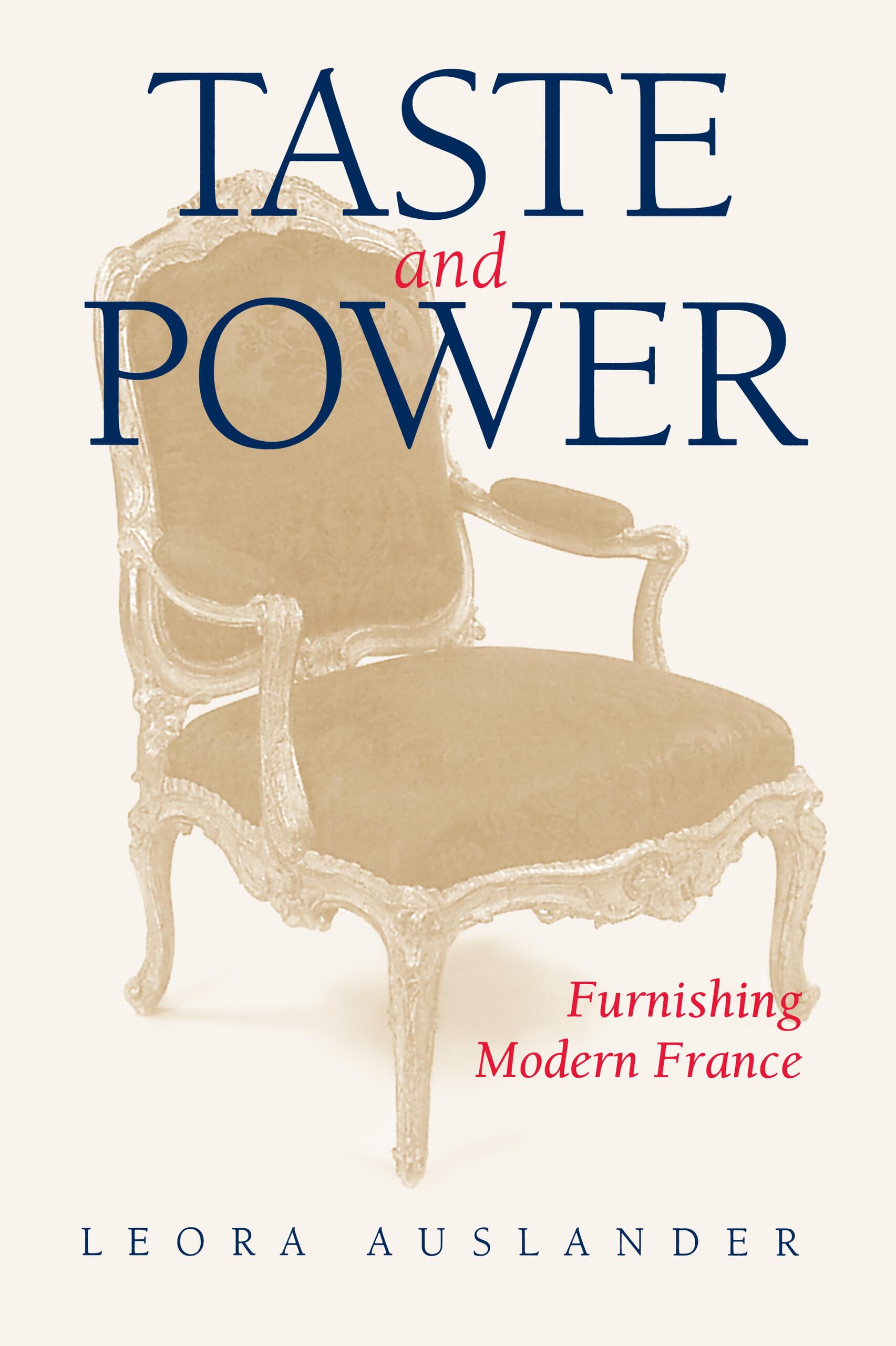
Taste and Power: Furnishing Modern France (Studies on the History of Society and Culture) (Volume 24)
$22.33
by Leora Auslander



Louis XIV, regency, rococo, neoclassical, empire, art nouveau, and historicist pastiche: furniture styles march across French history as regimes rise and fall. In this extraordinary social history, Leora Auslander explores the changing meaning of furniture from the mid-seventeenth to the early twentieth century, revealing how the aesthetics of everyday life were as integral to political events as to economic and social transformations. Enriched by Auslander's experience as a cabinetmaker, this work demonstrates how furniture served to represent and even generate its makers' and consumers' identities. "Auslander . . . repeatedly brings out the deep implications of the seemingly trivial and gendered choices that ordinary mortals unthinkingly make from day to day."--Patrice Higonnet, "Times Literary Supplement Leora Auslander is Associate Professor of History and Director of the Center for Gender Studies at the University of Chicago. Taste and Power By Leora Auslander University of California Press Copyright © 1998 Leora Auslander All right reserved. ISBN: 9780520213654 1 The Courtly Stylistic Regime Representation and Power under Absolutism When servants and courtiers at Versailles came and went about the royal bedroom they bowed before the royal nef , a gold shiplike vessel containing the king's knife, fork, and napkin. This was done whether the king was present or not. [Like t]he genuflections of the faithful before altars in churches at all times 1 As the image conjured by Orest Ranum renders vividly, a particular form of fetishism characterized the apogee of absolutism. The very mundane objects used to assist the king in the satisfaction of his bodily needs were encased in gold and granted the same gestures of respect as the king's body itself. The king's objects were the king, and consequently the style of those objects belonged to the king. Royal acquisition and display of possessions luxurious and rare beyond the imagination of even the nobility helped establish and reinforce the theoretically boundless power of the king.2 An essential purpose of royal goods was to demonstrate the creative and economic strength of the monarch and the loyalty of his court against both domestic and foreign challenges. Or as it was put in a complaint to Jean-Baptiste Colbert (161983), contrtleur giniral des finances, concerning bourgeois emulation of the court, "the court of sovereign princes is the principal place where is manifested the magnificence from the splendor or obscurity of which foreign princes or their ambassadors make inferences about the strength or weakness of the kingdom."3 Orest Ranum, "Courtesy, Absolutism, and the Rise of the French State, 16301660," Journal of Modern History 52 (September 1980): 433. For elegant discussions of the negotiations over power engaged in through symbolic and discursive means see Sarah Hanley, The Lit de Justice of the Kings of France (Princeton, 1983); and Ralph E. Giesey, "Models of Rulership in French Ceremonial," in Rites of Power , ed. Sean Wilentz (Philadelphia, 1985), 4164. "Plaintes des dames de la cour contre les marchandes ou bourgeoises de Paris," quoted in Carolyn Lougee, Le Paradis des femmes: Women, Salons, and Social Stratification in Seventeenth-Century France (Princeton, 1976), 96. Figure 1. Marie-Antoinette, Josephine, Jeanne d'Autriche, reine de France et de Navarre (1769). Cabinet des estampes, Bibliothhque nationale. The meaning borne by royal objects is shown even more dramatically in the print of Marie-Antoinette (Figure 1). Marie-Antoinette stands in front of a very elaborate Louis XVstyle chair with her hand on a very small crown that rests on the edge of an extraordinary table leg. A grotesque bird of prey intently eying the sardonic face that graces the leg joint makes the print maker's opinion of Marie-Antoinette more than clear: she depicts royalty run amok. The table in the print could never have existed, for both the bird and the face would have been impossible to carve. The artist counted on the furniture to convey a critique that he chose not to inscribe directly on the body of the queen (in contrast to the many pornographic depictions of Marie-Antoinette in the last years of the eighteenth century). The artist expected royal character and royal being to be read through royal things. Thus both the court at home and embassies and ambassadorial residences abroad stood in for the king, and the king's power, just as the king stood in for the nation as a whole. Keith Baker argues that the absolute monarch in the ancien rigime "exercised a representative function" in that "the realm is re-presented, or made visible to the people as a whole, in his very person" and that "the king is representative in the strong sense that a multiplicity can indeed be made one only in the unity of his person. [T]he king represents the whole, not in the sense that he is authorized by the body of the nation to act on its behalf, but pr