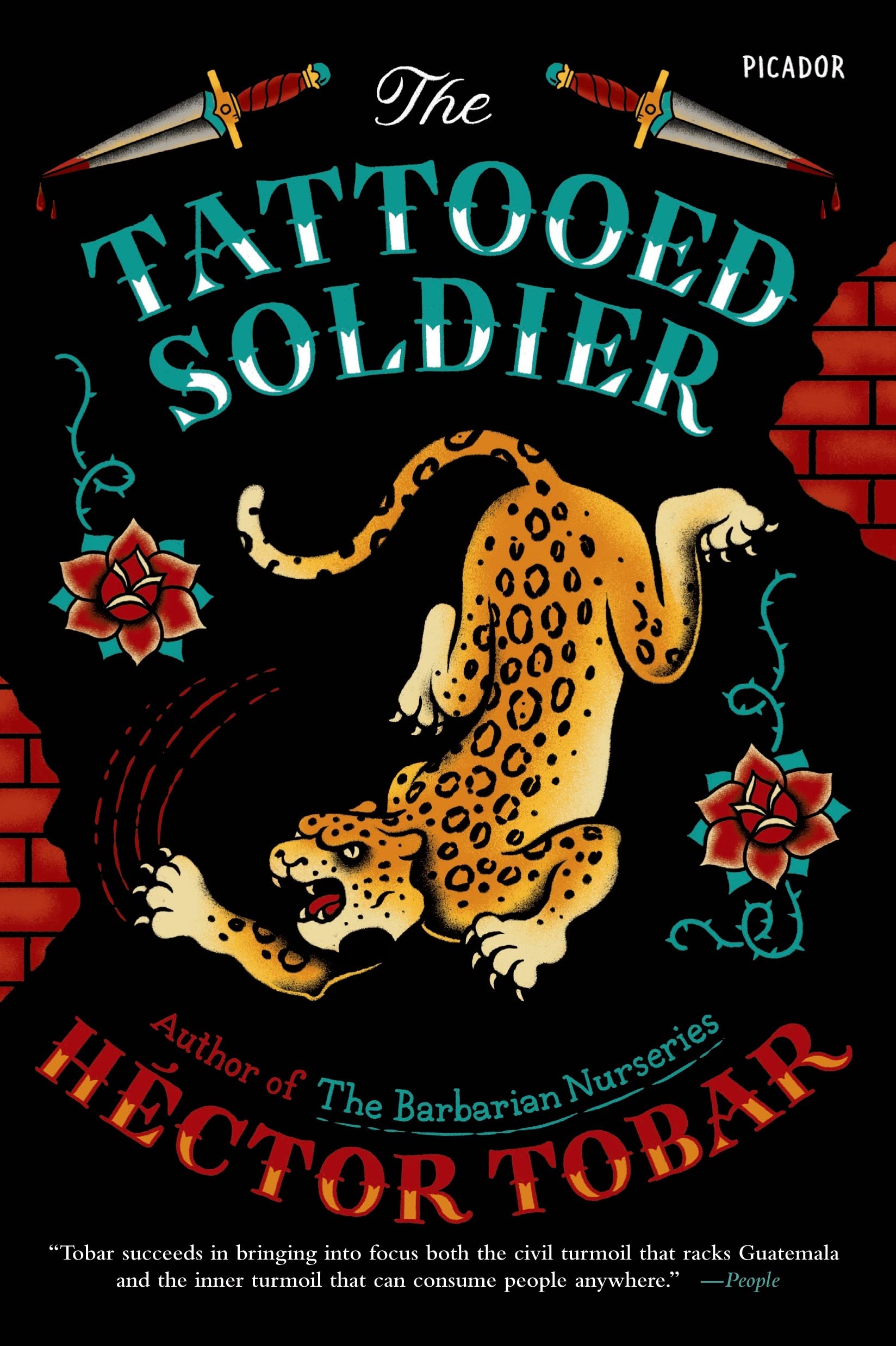



Antonio Bernal is a Guatemalan refugee in Los Angeles haunted by memories of his wife and child, who were murdered at the hands of a man marked with yellow ink. In a park near Antonio's apartment, Guillermo Longoria extends his arm and reveals a sinister tattoo―yellow pelt, black spots, red mouth. It is the sign of the death squad, the Jaguar Battalion of the Guatemalan army. This chance encounter between Antonio and his family's killer ignites a psychological showdown between these two men. Each will discover that the war in Central America has migrated with them as they are engulfed by the quemazones―"the great burning" of the Los Angeles riots. A tragic tale of loss and destiny in the underbelly of an American city, The Tattooed Soldier is Pulitzer Prize–winning reporter Héctor Tobar's mesmerizing exploration of violence and the marks it leaves upon us. “Tobar succeeds in bringing into focus both the civil turmoil that racks Guatemala and the inner turmoil that can consume people anywhere.” ― People “Suspenseful...Tobar has a fine storyteller's instinct and moves his characters towards the climax with the skill of a chess master.” ― Los Angeles Times “[ The Tattooed Soldier ] casts a subtle light on the Third World terror which lies behind the faces of people on the pavements and in the parks of Los Angeles....Dazzling.” ― Thomas Keneally “Héctor Tobar's accomplished first novel affords a perspective that is overdue and urgently needed in North American literature--an insider's vision of L.A. as a Third World city. The Tattooed Soldier is a riveting book that manages to be at once politically informed and at the same time a psychologically astute study of that most elemental of stories: revenge.” ― Stuart Dybek Héctor Tobar is a Pulitzer Prize–winning journalist and novelist. He is the author of the critically acclaimed, New York Times bestseller, Deep Down Dark , as well as The Barbarian Nurseries , Translation Nation , and The Tattooed Soldier . Héctor is also a contributing writer for the New York Times opinion pages and an associate professor at the University of California, Irvine. He's written for The New Yorker , The Los Angeles Times and other publications. His short fiction has appeared in Best American Short Stories , L.A. Noir , Zyzzyva , and Slate . The son of Guatemalan immigrants, he is a native of Los Angeles, where he lives with his family. 1. ON CROWN HILL Neither man could claim English as his mother tongue, but it was the only language they shared. The tenant, Antonio Bernal, was from Guatemala. Through the narrow opening of a door pushed slightly ajar, he was speaking to the building manager who was about to evict him from his apartment, a Korean immigrant named Hwang. Both men squinted, each confused by the other’s diction, trying to decipher mispronounced words. After several minutes of mumbled exchanges, they began to toss night-school phrases back and forth like life preservers: “Repeat, please.” “Speak slower.” “I don’t understand.” Los Angeles was the problem. In Los Angeles, Antonio could spend days and weeks speaking only his native tongue, breathing, cooking, laughing, and embarrassing himself with all sorts of people in Spanish. He could avoid twisting and bending his lips and mouth to make those exotic English sounds, the hard edge of the consonants, the flat schwa. English belonged to another part of the city, not here, not downtown, where there were broad avenues lined with Chinese pictographs and Arabic calligraphy and Cyrillic, long boulevards of Spanish eñes where Antonio could let his Central American ches and erres roll off his tongue to his heart’s delight. “What?” Antonio said. “I ask what you say?” replied Mr. Hwang, a squat man in khaki pants and a freshly starched shirt. “I said, How much time? More time. Time, Hwang?” “What time? Say again.” “Say what again? Time?” “No.” “I don’t understand.” Antonio was tired, and his accent felt a little thicker than usual. Mr. Hwang crossed his arms impatiently, as if he suspected that this confusion of tongues was only a stalling tactic, a ruse to postpone the inevitable eviction. Or maybe he was just callous, maybe he didn’t care that Antonio had stayed up most of the night worrying about what he would do this morning. Antonio loosened the chain on the door and opened it wide to show Mr. Hwang that the floor of the apartment was littered with clothes and old paperbacks, proof of what he had been unable to communicate with words: he and his roommate were not ready to leave, because they had just begun to pack. “We are trying, Mr. Hwang,” Antonio said slowly. “We are trying.” “If you don’t leave by two,” the manager blurted out, “I have to call police.” Antonio took a deep breath and tried to compose himself, pushing his glasses up the bridge of his nose, a habit of his at moments when he felt close to violence. They were circle glasses, and when he caught a glimpse of himself in the mirror