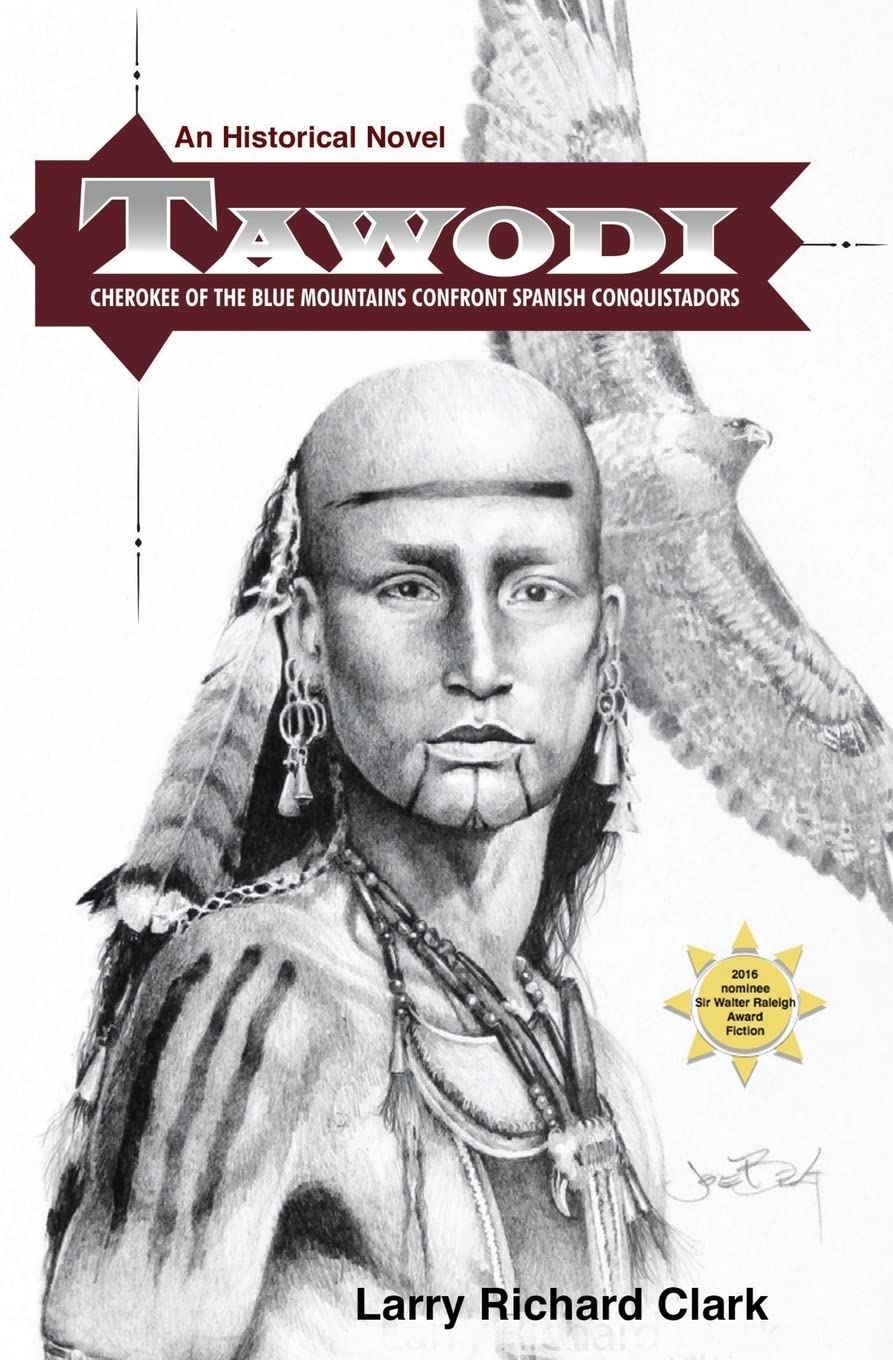
Tawodi: Cherokee of the Blue Mountains confront Spanish conquistadors
$14.00
by Larry Richard Clark



2017 North Carolina Historian of the Year2016 nominee for the Sir Walter Raleigh Award for Fiction, Historical Book Club of N.C.— Cox Historical Fiction Award, North Carolina Society of HistoriansThroughout, this novel engagingly presents the traditions and beliefs of the Cherokee and other Native American tribes, as well as historical detail about early Spanish explorers, who aren’t often addressed in fiction. - Kirkus Reviews As a fictionalized tale of the historic 16th century confrontation between Native Americans and Spaniards in the new world of North America, this book is recognized for its “glimpses of brilliance..marvelous character, imagery and plot." (Historical Book Club of N.C.) Tawodi (“Hawk”) was raised the Cherokee Way in the Blue Ridge Mountains of present day western North Carolina. Tawodi’s life begins as Imperial Spain invades North America and, as a young warrior, he encounters the army of La Florida Governor Hernando de Soto. Twenty-five years later as town chief of Cauchi, Tawodi learns of the Spanish forts constructed across the Carolinas into Tennessee by soldiers of Captain Juan Pardo. It will be the Cherokee, along with Catawba and Creek, who challenge these Outsiders and end Imperial Spain’s ambitions in North America. Your scholar's grasp of the Indian culture in the Southeast and early Spanish inland expeditions...is impressive--very impressive! Congratulations! Carroll Jones, author "Rooted Deep In Pigeon Valley" I really respect your attempt to tackle this from the perspective of the people who had already "discovered" North America by being born into it long before any European ever dreamed of setting sail. -- Chris Allen 2016 Sir Walter Raleigh Award for Fiction, one of six nominees. (This) work contains the best raw material for a really powerful novel -- there are glimpses of brilliance throughout the book...marvelous character, imagery and plot...." Historical Book Club of North Carolina. Cox Historical Fiction Award, North Carolina Society of Historians. "This book, although fiction, is written in a scholarly fashion...while interwoven with a marvelously creative tapestry of words that makes for an enjoyable reading experience for all." Tawodi ("Hawk") was raised the Cherokee Way in the Blue Ridge Mountains of present day western North Carolina. His life begins in the early 16th century as Imperial Spain attempts to annex southeast North America to its rapidly expanding New World empire. It will be these Spanish invasions that expose Tawodi, as warrior and town chief of Cauchi, to the armies of La Florida Governor Hernando de Soto and, twenty-five years later, to Spanish forts constructed across the Carolinas into Tennessee by soldiers of Captain Juan Pardo. After all, this was el Sìglo de Oro de España, the Golden Century of Spain, as conquistadors roamed freely throughout the Caribbean Islands and the Americas to the glory of Spain and the Catholic Church. When Spaniards arrived among the Cherokee, Catawba and Creek, these tribes were challenged to either accept the Outsiders -- or fight. It is the Indians intrepid resistance to these Spanish invasions which produced a far-reaching twist to history that forever changed the future for North America and the yet to be United States of America. As a career educator, teacher of world history and general anthropology at a small community college in western North Carolina, Larry Clark developed a special interest in the region's history and prehistory. A limited, self-published edition of Indians of Burke County and Western North Carolina was printed as archaeologists began to excavate a large native village near his home. In addition, for more than a decade, he periodically wrote about Burke County's past for a local newspaper, the News Herald, and eventually published with The History Press of Charleston a collection of these stories in "Burke County: Historic Tales from the Gateway to the Blue Ridge." As a side interest he also self-published a handbook on "Time Capsules: the Why, the How, the Where." More recently "our archaeologists" made an unexpected discovery at the Berry's farm that began to rewrite the history of early colonial America -- Spanish artifacts were uncovered in the 16th century Indian village of Joara among the remains of several burned "cabins" once occupied by soldiers of Captain Juan Pardo. It was here in 1567 that they constructed Fort San Juan (and three more in the region) to claim this land for King Philip II and the Empire of Spain, thereby making these Spanish settlements the first inland European colony in North America and the first lost colony of North Carolina -- some twenty years before England's "Lost Colony" arrived on Roanoke Island, North Carolina, and four decades before the English settled James Town, Virginia. Thereafter Clark became so fascinated with the idea of Spanish conquistadors marching across these lands that he first wrote "Of Eagles & Wolves," a play about Pardo'