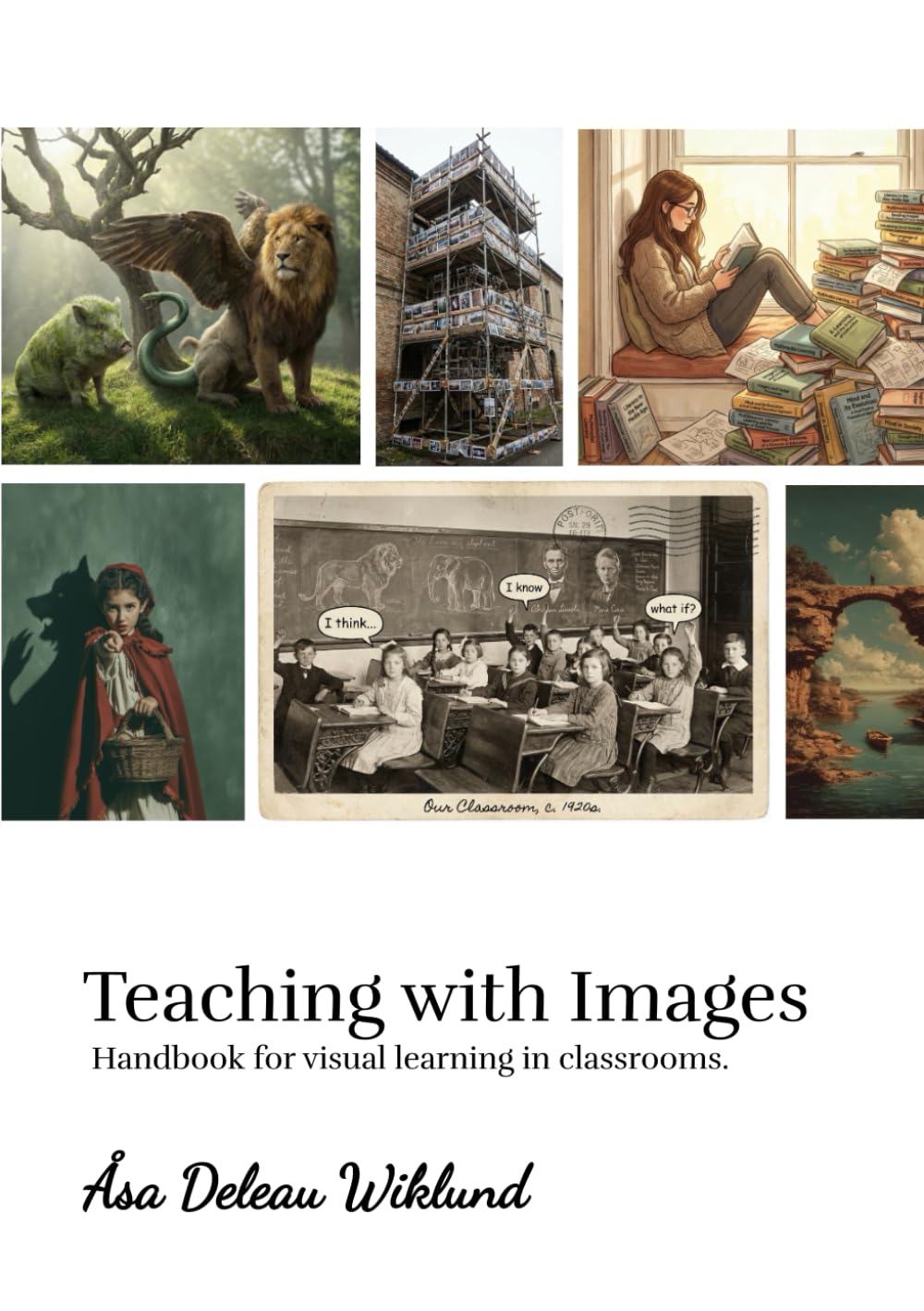
Teaching with images: Handbook for visual learning in classrooms
$27.00
by Åsa Deleau Wiklund



I didn’t begin my working life as a teacher. For many years, I worked as a professional photographer, mostly with families and children of all ages, listening to people’s stories and translating them into images. When I later returned to university at 42 to train as a language teacher, one insight followed me into the classroom: images are never just decoration. They carry meaning, emotion, and perspective. This book grew out of that insight, and out of my work with teenagers in the classroom. It is a practical handbook for teachers who want clear, usable lesson ideas for working with images, visual thinking, and AI-supported tools — without losing sight of pedagogy, curriculum, or professional judgement. One exercise I use during teacher training asks students to write short texts — memories, imagined scenes, or fragments of stories — and then illustrate them with images. Sometimes the images are drawn, sometimes found, sometimes generated with digital tools. What matters is not the tool, but the conversation that follows. When students see their own texts turned into images, something shifts. They notice details they didn’t realise they had written, revise vocabulary, adjust sentence structure, and discuss why an image feels “right” or “wrong” for their story. Language becomes visible. This book is built around moments like these. The focus throughout the book is on teaching ideas that work in real classrooms , including: Visual grammar : using images to practise grammar, vocabulary, and sentence structure in context - Prompt writing as a written assignment : treating prompt writing as structured writing, not a technical skill - Image-based tasks for discussion, interpretation, and reflection - Visual storytelling activities where students develop and revise their own texts. Images invite interpretation. Two students can look at the same image and tell entirely different stories — and both can be linguistically rich.All ideas are adaptable, curriculum-aligned, and suitable for different levels and student groups The book shows how to: use images as starting points for speaking and writing - scaffold tasks so all students can participate - encourage students to justify their interpretations - support critical thinking through visual material Prompt writing is often discussed in technical terms. Here, it is approached as language work . Students practise choosing precise words, structuring instructions clearly, thinking about audience and intention, and revising their writing based on results. Prompt writing becomes a natural extension of descriptive and creative writing — a transferable skill across contexts. An Introduction to Useful AI Tools: what kinds of tools exist - what they can be useful for - how they can support planning and classroom work Planning with a Co-Pilot The book also shows how a co-pilot can support lesson planning by generating outlines, suggesting variations, and helping turn learning objectives into activities. The co-pilot is always positioned as a support — not a decision-maker. The teacher remains in control. This book is written for: teachers working with children and teenagers - language and humanities teachers - teacher trainees - educators interested in visual literacy and modern teaching methods It is especially suited to teachers who want practical ideas, gentle guidance, and room to adapt . This handbook is an invitation to explore how images can support language, thinking, and student voice — one lesson, one class, one experiment at a time.