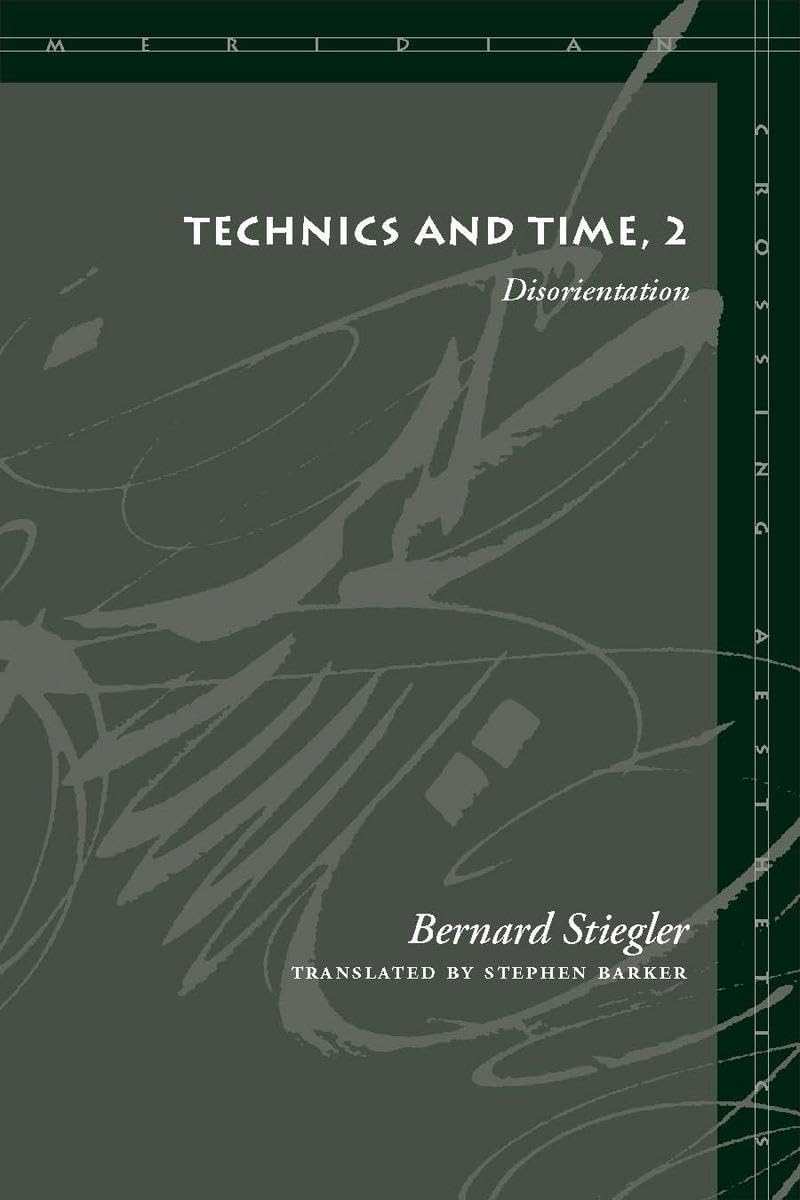
Technics and Time, 2: Disorientation (Meridian: Crossing Aesthetics)
$23.12
by Bernard Stiegler



Disorientation is the first publication in English of the second volume of Technics and Time , in which French philosopher Bernard Stiegler engages in a close dialogue with Husserl, Derrida, and other philosophers who have devoted their energies to technics, such as Heidegger and Simondon.The author's broad intent is to respond to Western philosophy's historical exclusion of technics and techniques from its metaphysical questionings, and in so doing to rescue critical and philosophical thinking. For many years, Stiegler has explored the origins and philosophical, ethical, and political stakes of a global process he calls "the industrial temporalization of consciousness." Here, demonstrating that technology―including alphabetical writing―is memory, he argues that through new technologies of retention and inscription we have come to live in a world where time devours space, a disoriented world in which we have lost our bearings. Immersed in the multimedia of an over-connected world, with time and space as we know them abolished, we no longer find "cardinal points" to guide us and may even be led where we do not wish to go. We must therefore prepare to confront new spheres of ideological control and discover new possibilities in the digital environment. " Disorientation , a most important piece of scholarly work, continues and adds to the development of the arguments set forth in the preceding volume of Technics and Time , putting a whole new set of clarifications into place. It will interest philosophers in general and should become required reading for anyone interested in cognitive science."―Rodolphe Gasché "Bernard Stiegler's ambition for Technics and Time 2: Disorientation is exhilaratingly immodest: he promises to offer nothing less than a history of temporality, from prehistoric man to the present day . . . Stiegler makes a convincing case for the vital importance of the politics of memory in the 21st century."―Julian Brigstocke, Environment and Planning D: Society and Space Bernard Stiegler is Head of the Department of Cultural Development at the Pompidou Center in Paris and co-founder of the political group Ars Industrialis . In the last five years alone, he has authored seventeen books. TECHNICS AND TIME, 2 Disorientation By Bernard Stiegler Stanford University Press ISBN: 978-0-8047-3014-3 Contents Translator's Note..............................................ixIntroduction...................................................11 The Orthographic Age.........................................122 The Genesis of Disorientation................................653 The Industrialization of Memory..............................974 Temporal Object and Retentional Finitude.....................188Notes..........................................................245Select Bibliography............................................261 Chapter One The Orthographic Age By the public use of one's own reason I understand the use that anyone as a scholar makes of reason before the entire literate world. —Immanuel Kant, "An Answer to the Question: What is Enlightenment?" Orthography, Orthotheses, and Photography In the final chapter of The Fault of Epimetheus , I asked: "If the already-there is what constitutes temporality in that it opens me out to my historiality, must not this already-there also be constitutive in its positive facticity, both positively constitutive and historially constitutive, in the sense that its material organization in form constitutes historiality itself, prior to and beyond history?" (240). In enumerating the principal elements of a positive response to this question, Heidegger nonetheless excludes one particular hypothesis. To account correctly for Dasein 's historiality would be, first of all, to account for the very possibility of accounting for it, to analyze the conditions through which Dasein is capable of thematizing its own historiality, and that would only be possible when this historial Dasein conquers its historicity and thus enters into the history of being (as forgetting of being): in the following, we shall explore why this history is indissolubly that of the letter and of citizenship. Writing, in its alphabetic specificity, as exact recording, an orthographics, that liberates a new possibility of access to the past, configures properly historical temporality. The already-there is positively and historially constitutive in its facticity, and the inaugurality of History within historiality occurs along with the techno-logic emergence of an orthography of the already-there. To plumb this hypothesis more deeply is to develop a history of the supplement whose fundamental concepts have yet to be elaborated beyond that bequeathed to us by Of Grammatology . It is necessary at this point to abandon the primordially phonologic understanding of alphabetic writing in order to privilege its orthographic character. What does orthos, orthotes