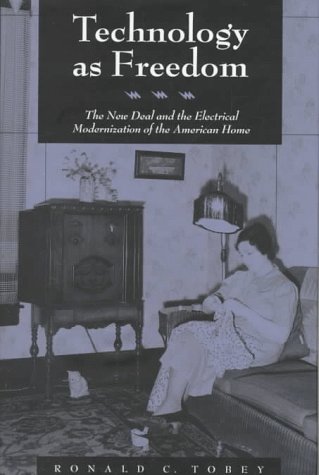
Technology as Freedom: The New Deal and the Electrical Modernization of the American Home
$49.99
by Ronald C. Tobey



Before 1930, the domestic market for electrical appliances was segmented, but New Deal policies and programs created a true mass market, reshaping the electrical and housing markets and guiding them toward mandated social goals. The New Deal identified electrical refrigeration as a key technology to reform domestic labor, raise family health, and build family assets. New Deal incentives led to nearly fifty percent of Title I National Housing Act loans being used to buy electric refrigerators in the 1930s. New Deal policies ultimately created the mass commodity culture of home-owning families that typified the conservative 1950s. " Technology as Freedom successfully bridges the gaps between business history, political history, social history, and the history of technology and helps restore the central place of state action in the mid-century transformations of American life."Bruce Schulman, Boston University " Technology as Freedom successfully bridges the gaps between business history, political history, social history, and the history of technology and helps restore the central place of state action in the mid-century transformations of American life."―Bruce Schulman, Boston University Ronald C. Tobey is Professor of History at the University of California, Riverside. Technology as Freedom: The New Deal and the Electrical Modernization of the American Home By Ronald Tobey University of California Press Copyright 1997 Ronald Tobey All right reserved. ISBN: 0520204212 Introduction Did Electrical Modernization Cause a Social Revolution in the American Home in the 1920s? In 1925 Samuel Dodsworth, captain of American industry, fantasized a $1,700 house trailer hitched to his car and bound for the wilderness. "He dreamed of a very masterwork of caravans: a tiny kitchen with electric stove, electric refrigerator; a tiny toilet with showerbath; a living-room which should become a bedroom by nighta living-room with a radio, a real writing desk; and on one side of the caravan, or at the back, a folding verandah. He could see his caravanners dining on the verandah in a forest fifty miles from any house." A generation later, Americans lived Dodsworth's dream. They owned conveniences that had once been the luxuries of the rich. Some families caravanned through the American space in silver streamlined trailers. Most households caravanned in place, enjoying nature within the screened protection of suburban patios. Americans side-saddled their domestic environment of electric appliances and electronic pleasures everywhere. In 1959, Richard Nixon held up the American standard of electrical living against Nikita Khrushchev in their famous "kitchen debate" over the relative merits of market and command economies. Standing in front of a Moscow exhibit of an American kitchen filled with electric appliances, the vice president drew out the meaning of the exhibition for the first secretary and premier. Nixon "decided that this was as good a place as any to answer the charges that had been made in the Soviet press, that only 'the rich' in the United States could afford such a house as this." Capitalism offered competing products at prices cheap enough for everyone. Competition created freedom. "To us, diversity, the right to choose, the fact that we have a thousand different builders, that's the spice of life." Thus Nixon fittingly concluded the decade of the 1950s. The affluent life won the cold war.1 (See pl. 1.) Plate I. Electrical Dream Kitchen . ([Photographer unknown.] "L.A. Residences InteriorsDodge House. Student decorating cake/household training/Dodge House." Security Pacific National Bank Photograph Collection. Los Angeles Public Library.) Scholars agree on the timing, scope, and thoroughness of electricity's transformation of the American home. Electrification for illumination began in cities in the 1880s, displacing kerosene and gas lighting. By the early 1920s, private companies had electrified half of urban America's homes. Modernization brought power tools, heating and cooling appliances, and fuller electrical lighting, making possible renovation of domestic work processes and improving the environmental quality of the home. During the 1920s the basic economic and social processes of modernization were put in place and a substantial percentage of homes were modernized. By 1959, nearly all American householdsrural and urbanhad been transformed. Scholars also agree on the nature of electrical modernization as a social process. Electrical modernization occurred through private marketplace consumption for all but a few rural and farm Americans. Households chose to acquire electrical goods and services in free markets of competing products offered to them by private American corporations, just as they selected clothes in department stores, c