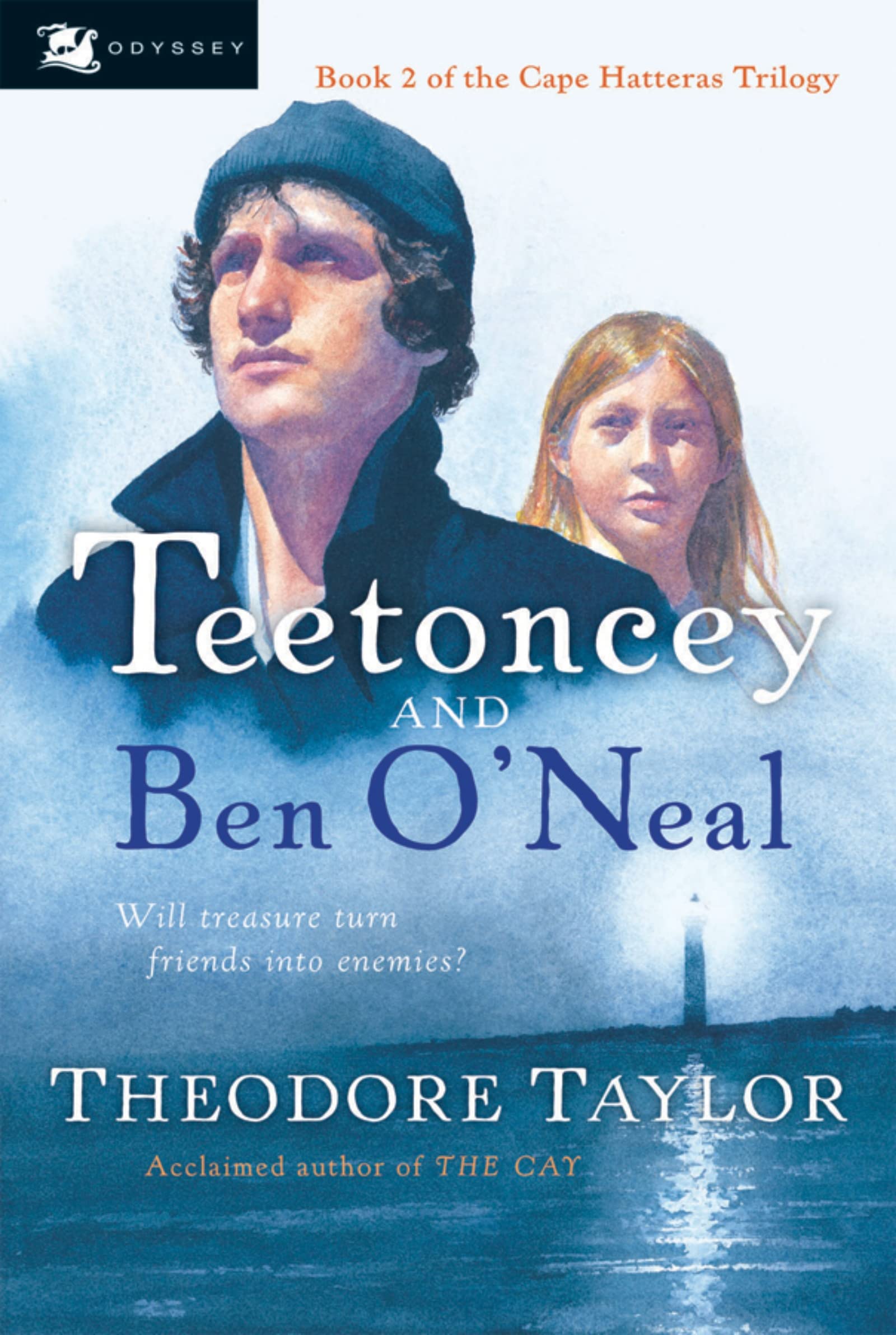
Teetoncey and Ben O'neal: A Mystery Adventure About Sunken Silver for Kids (Ages 8-12) (Cape Hatteras Trilogy)
$12.76
by Theodore Taylor



Now recovered from the shipwreck that killed her parents, Teetoncey reveals a secret: Two chests full of silver went down with her ship. Can Tee, Ben, and his friends dredge up the treasure without arousing suspicions? "A complex but skillfully developed story with fine period detail."-- Kirkus Reviews THEODORE TAYLOR (1921-2006), an award-winning author of many books for young people, was particularly known for fast-paced, exciting adventure novels. His books include the bestseller The Cay, Timothy of the Cay, The Bomb, Air Raid--Pearl Harbor!, Ice Drift, The Maldonado Miracle, and The Weirdo, an Edgar Award winner for Best Young Adult Mystery. ALTHOUGH THESE INCIDENTS happened long ago, I clearly remember feeling the fool, standing there with tears on my cheeks just because the British castaway had found her tongue instead of always staring at me as if I were a beach ghostie. In truth, she was the sand ghostie or had been. This many years later, I still cannot say why I wept, which is not a manly thing to do, be you twelve or twenty-four. Perhaps it was because I had figured she was a hopeless orphan vegetable with addled brains and no tongue-then suddenly, she was cured; could think and speak. Perhaps it was because I cared more about her than I ever allowed myself to admit. Whyever the reason, I felt the pure watery-eyed fool. Just a few minutes later, about eight-thirty of that same stormy night, I also recollect that Mama rose from the girl's bedside and said to me, "Ben, you talk to the Mistress Appleton while I git a drop o' Purple." She smiled down on the pale castaway. "That'll make you sleep like a warm stone." Then Mama padded off on her gray felt slippers, which she usually wore after sundown. Something struck me. The Mistress Appleton? That sounded like we had somebody important in the house. Never before had I heard Mama call any ungrown female a "mistress." In fact, up to the previous hour, when I had forced the London girl to face the gale and roaring surf, we'd called her Teetoncey simply because we hadn't known her true name. The word means small of any amount on our Outer Banks of North Carolina. It would take some proper attention, I recall thinking, to implant the new name of Wendy Lynn Appleton in my mind. But that wasn't the problem at the moment. I didn't exactly know what to say to her. Having wiped away those embarrassing tears, still thoroughly uncomfortable, I finally managed, rocking on my seaboots about six feet from her, "Gale'll be over soon." The wind was already losing its high whine, shifting more to due east than north after its quick smite at our Cape Hatteras coast. Midnight would see it down to a sigh. Nodding slightly, but now evidently disinterested in both the weather and me, the girl, her skin flour white from the evening's very unusual ordeal, eyes dull from shock, turned her daisy head toward the window though there wasn't much to see out there through the beading lances of water on the panes. The streaks glistened in the soft orange reflection of the table lamp. Boo Dog, my gold hound, a Labrador by breed, rose up slowly from the oval rag rug, curved his back in luxury, and then moved to the other side of the bed and wisely put his head in a position to be stroked. The girl took a hand from beneath the crazy-patch comforter and began to rub his scalp, though she didn't seem to be aware she was doing it. She knew him better than she thought. But it was quite obvious to me that she didn't want to talk to anyone at the moment and I could certainly understand why. Only survivor of the wrecked barkentine Malta Empress, she had been mauled by the sea, smacking her head on the bottom, blocking her mind for twenty-eight perplexing days. Yet now that she'd come out of her mental darkness and silence, I desperately wanted to hear all about that shipwreck. Perhaps on the morrow she'd say how it all happened. Her story would be of interest to everyone on the Carolina Banks since wrecks were our heritage. Mama came back with a jelly glass, filled halfway with the milky-purple liquid. A single dollop of that sticky medicine, kept in a small vial in the kitchen, was enough for sweet dreams. It was another of my older brother Reuben's contributions from his various voyages, and was said to be opium and something else, up from a Chinese shopkeeper in Trinidad. It worked, as I could testify. Mama sat down on the bed's edge as the girl turned her head from the window. Mama said, softly and cheerfully, "Now, take this in one long gulp an' the morrow'll be a brighter day." The girl swallowed it and then dropped her head back to the pillow, closing her red-rimmed eyes, and returning her small hand under the comforter. Face soft as lamb's belly, full of tenderness and concern, Mama said, "We'll jus' visit silent till you steal off." Not a peep was made by the girl. The ship's clock in the living room ticked on and the wind outside settled lower to a strum. Ther