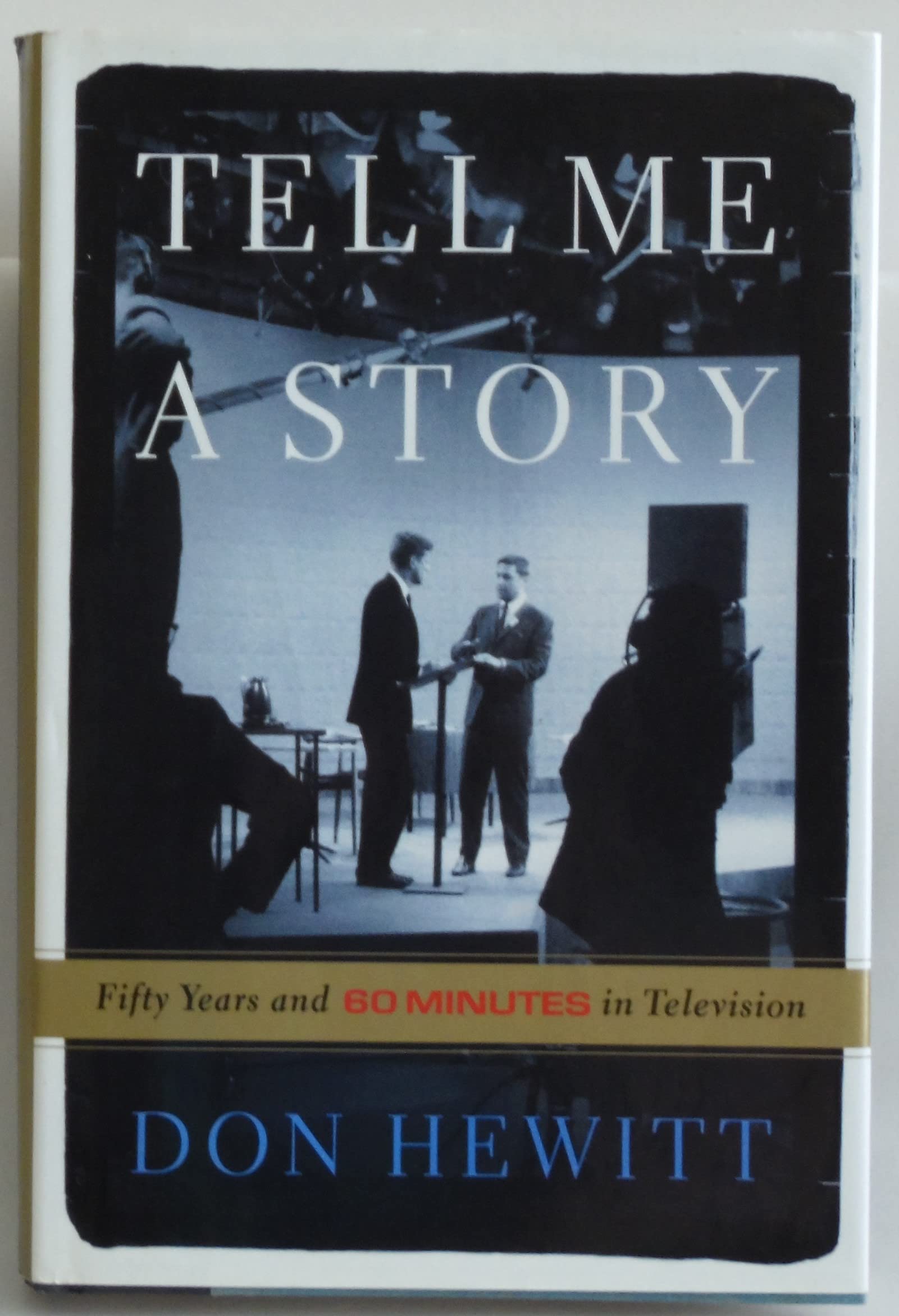



The producer for "60 Minutes" recounts his early experiences and his more than fifty years with CBS, including the first broadcasts of political conventions, the Kennedy-Nixon debates, and the events portrayed in the film "The Insider." "As a child of the movies, I was torn between wanting to be Julian Marsh, the Broadway producer in 42nd Street ... and Hildy Johnson, the hellbent-for-leather reporter in The Front Page ," writes Don Hewitt in his engaging autobiography. Luckily for him, he found a way to be both at CBS News, most notably as producer of 60 Minutes . Hewitt barely knew what television was when a fellow print journalist told him of an opening at CBS in 1948 ("You mean, where you sit at home and watch little pictures in a box?" he asked), but his decisive personality suited the new medium's spontaneous techniques. Born in 1922 and raised in New Rochelle, New York, he sees himself as an average guy whose middle-of-the-road political and social attitudes are shared by the American television audience. He modeled 60 Minutes on Life magazine: "a family friend in the home of millions of Americans each week, serious and light-hearted in the same issue" with one prime directive--to tell a story. In chatty, colloquial prose, Hewitt hits the show's high and low points, including a frank discussion of the compromises made to air an interview with Big Tobacco whistle-blower Jeffrey Wigand and a blistering critique of the way those compromises were depicted in the movie The Insider . He pays warm tribute to his reporters, particularly Mike Wallace, writes appreciatively of CBS founder William Paley, and candidly discusses his differences with Paley's successor, Laurence Tisch. Hewitt doesn't pretend to be a saint; he accepts the mingled imperatives of journalism and commerce that drive TV news without (usually) sounding too defensive. His memoir pungently chronicles the evolution of broadcast journalism and expresses faith in the idealism that still fires the men and women who practice it. --Wendy Smith Hewitt, born in 1922, entered journalism during World War II, then entered television news at its dawn in 1948, covering events from all over the world. Soon thereafter, he found his genius off camera, as a producer, inventing new types of shows to reach ever-widening audiences. In 1968, Hewitt created television hourly newsmagazine 60 Minutes. For the first 100 pages, Hewitt recounts his growing up and early journalism career in a breezy, cleverly phrased, and often self-deprecating language. Most of the book's remaining pages are devoted to 60 Minutes such personalities as Mike Wallace, Diane Sawyer, Morley Safer, and Ed Bradley; the celebrity segments of the show; the polarizing investigative segments; and the internal procedures in his shop, as well as at CBS News, that led to the unprecedented success of a newsmagazine. Hewitt understands how fortunate he is in his career, becoming wealthy in the bargain, so his tone is consistently upbeat and almost entirely celebratory. Among the few targets of his rare barbs are the makers of the recent film The Insider, which portrays a fictional Hewitt as something less than honorable. Recommended for all libraries. Steve Weinberg, Univ. of Missouri Journalism School, Columbia Copyright 2001 Reed Business Information, Inc. After 50-plus years at CBS News --and more than 30 at the helm of that network's groundbreaking newsmagazine--Hewitt may be the most powerful invisible journalist in the world. Hewitt's editorial vision and news judgment have structured Americans' perception of many of the key stories TV has told, from the Kennedy-Nixon debate and JFK's assassination through NASA space shots to the thousands of interviews, profiles, and investigative reports 60 Minutes has aired since its stopwatch began ticking in 1968. Hewitt's "voice" is every bit as strong as those of the familiar faces--Edwards, Cronkite, Reasoner, Wallace, Rather, Safer, Bradley, Rooney, Sawyer, Kroft, Veiera, Stahl, Simon, and Amanpour--he has directed or produced. Hewitt has positive things to say about most of the reporters and anchors he discusses, but his comments about the several generations of CBS executives and owners for whom he has worked are less consistently sunny. At 78, Hewitt remains blunt, opinionated, and full of ideas about where TV news has been and where it's going. His life may be one of the more interesting stories the veteran newsman has ever told, so expect plenty of interest in his book. Mary Carroll Copyright © American Library Association. All rights reserved Don Hewitt is the executive producer of 60 Minutes. He joined CBS News in 1948 and was the producer-director of Douglas Edwards with the News and the CBS Evening News with Walter Cronkite before creating 60 Minutes in 1968. He lives in New York City.