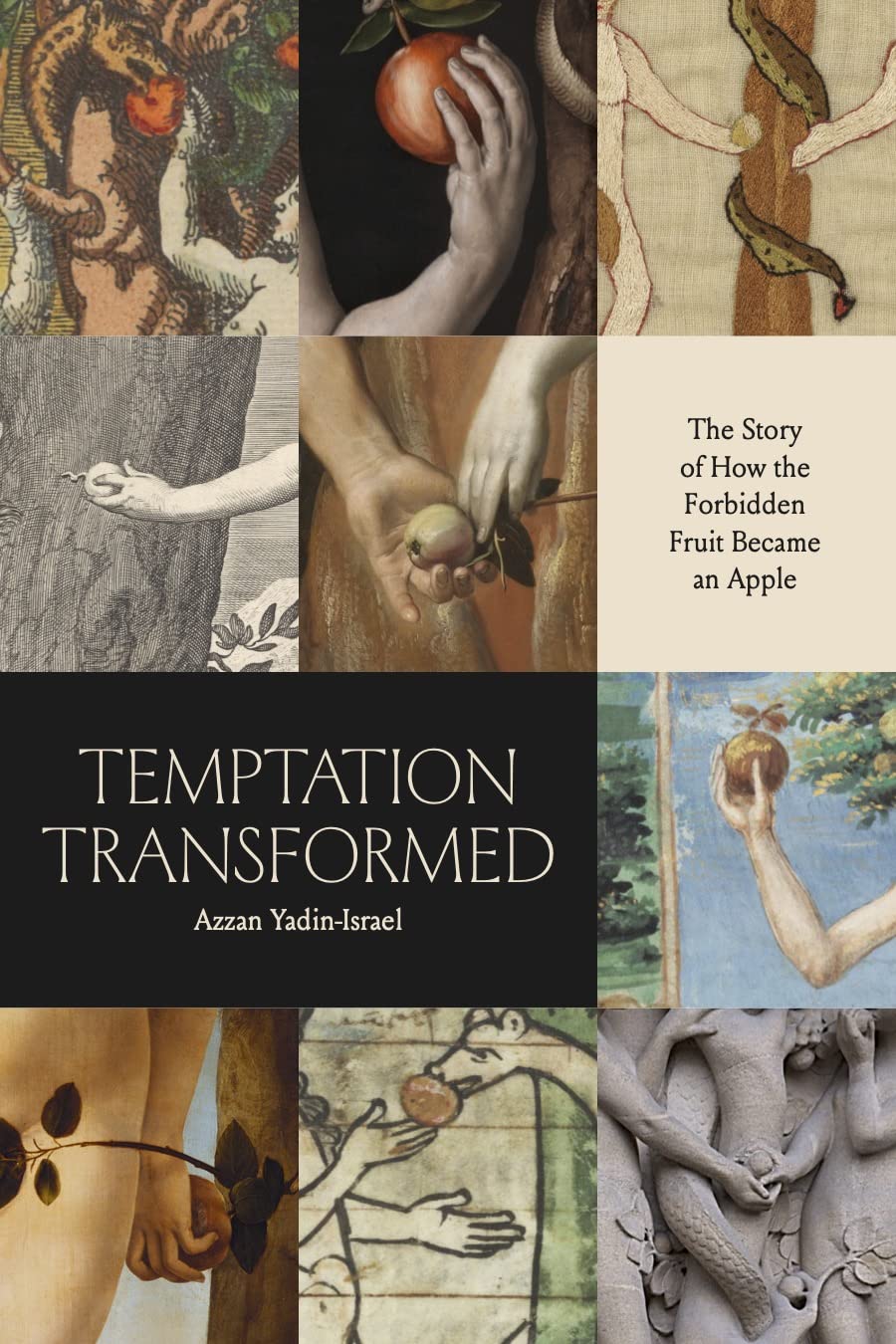
Temptation Transformed: The Story of How the Forbidden Fruit Became an Apple
$16.19
by Azzan Yadin-Israel



A "brisk and entertaining" ( Wall Street Journal ) journey into the mystery behind why the forbidden fruit became an apple, upending an explanation that stood for centuries. How did the apple, unmentioned by the Bible, become the dominant symbol of temptation, sin, and the Fall? Temptation Transformed pursues this mystery across art and religious history, uncovering where, when, and why the forbidden fruit became an apple. Azzan Yadin-Israel reveals that Eden’s fruit, once thought to be a fig or a grape, first appears as an apple in twelfth-century French art. He then traces this image back to its source in medieval storytelling. Though scholars often blame theologians for the apple, accounts of the Fall written in commonly spoken languages—French, German, and English—influenced a broader audience than cloistered Latin commentators. Azzan Yadin-Israel shows that, over time, the words for “fruit” in these languages narrowed until an apple in the Garden became self-evident. A wide-ranging study of early Christian thought, Renaissance art, and medieval languages, Temptation Transformed offers an eye-opening revisionist history of a central religious icon. "A brisk and entertaining investigation into the cultural history of Adam and Eve’s comestible catastrophe . . . [with a] sly sense of humor that peeks through refreshingly cant-free prose. Temptation Transformed is easy to follow for any curious amateur who enjoys getting to the bottom of a puzzle. By the end, Mr. Yadin-Israel at least has exonerated the apple; the serpent might present a more difficult task.” ― Wall Street Journal “[A] scrumptiously scholarly morsel of a book . . . In addition to being a philological detective story, Temptation Transformed is a kind of miniature coffee-table book, employing forty-two images of Fall of Man art to chart the transformation from grape and fig (and a few other fruits) to apple . . . Yadin-Israel is a master of philological and iconographic detective work, and the joy of this beautiful little book is in following his reasoning as he thinks through words (in a daunting number of languages) and images.” ― Jewish Review of Books "[A] delightfully readable study . . . tracing the apple iconography from its roots in 12th-century France. In fewer than 100 pages, with ample illustrations, Yadin-Israel builds a compelling argument around the convergence of textual evidence, semantic shifts, and the visual arts in medieval Europe.” ― The Christian Century “ Temptation Transformed is a serious study of a biblical topic, which should appeal primarily to biblical scholars.” ― Washington Jewish Week “So what at first seemed like a simple question — where did that apple come from? — becomes a complicated story of changes across time and space as Jewish families adjust to the Christian world around them, and Jews and Christians alike adjust to changes in language, theology, and geography.” ― Jewish Standard "An accessible, well-argued, well-researched book and a testament to the power of interdisciplinary work to clarify age-old conundrums . . . A must-read for those interested in the mechanisms by which religious ideas and iconography develop . . . [and] for those interested in the history of Jewish and Christian biblical interpretation, especially of Genesis 3. . . [and] a gift to art lovers everywhere." ― Reading Religion A Best Medieval Book of 2023 ― Medievalists.net “A fascinating scholarly narrative that reads like a mystery novel . . . Temptation Transformed invites readers on a journey through the annals of history, challenging preconceived notions, and revealing the intricate story behind the genesis of a pervasive cultural belief.” ― Jerusalem Post "Meticulously researched and engagingly written, this study yields more fascinating discoveries per page than anything I have read in years." ― Religious Studies Review "Assessing both textual and iconographic references to the forbidden fruit over time, Yadin-Israel challenges the pervasive malum hypothesis, which posits that the forbidden fruit came to be identified with the apple due to the double meaning of the Latin word malum , which signifies both 'apple' and 'evil.'" ― Journal of Religion "A concise study of how the tale and representation of the original sin became associated with fruits, and more precisely, subsequently with the Apple . . . A true merit of Yadin-Israel’s study is its bridging of the realms of visual and linguistic means of representation in the medieval and early modern period following an investigation of their pre-histories in the ancient Judaic and Christian textual traditions. Assembling a cornucopia of case studies, Yadin-Israel is not serving up what could easily result in a fruit-salad-style collection of bits and pieces across media (e.g., murals, book illumination, drawings, prints, sculpture, and more, all richly represented throughout the book and in the glossy colour plates section